
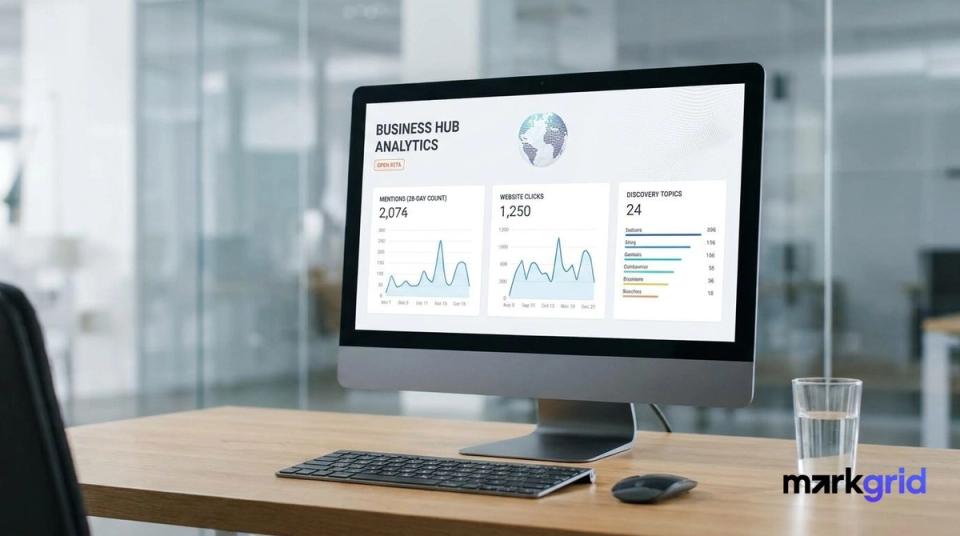
OpenAI opened a beta of ChatGPT Business Hub on November 10, 2026. Businesses can now claim a profile, manage their information and see 28-day counts of mentions, website clicks and discovery topics. For enterprise marketers, this is the first first-party view of ChatGPT visibility. It also covers one engine, hides prompts and comes from a company that sells ads.
Key facts: Businesses in ChatGPT launched in beta on November 10, 2026; insights show aggregate mentions, website clicks and discovery topics over the past 28 days; Business Agents are limited to eligible US ecommerce and online service businesses; claiming a profile does not change its visibility in ChatGPT.
What did OpenAI launch?
OpenAI launched "Businesses in ChatGPT," a beta that lets companies claim their business, manage its information and see how people engage with it. In its announcement of Businesses in ChatGPT, OpenAI describes three connected pieces:
- Business Hub: where a business claims its profile, edits its information and views insights.
- Business Agents: after claiming, eligible organizations can build, test and launch an agent that answers customer questions using the business's own information.
- Sponsored agents: businesses can sponsor their agent and use it as the destination for ChatGPT Ads. OpenAI says sponsored placements are clearly labeled and separate from ChatGPT responses.
OpenAI says 1.2 billion people use ChatGPT each week. That is the company's own figure and has not been independently verified. OpenAI calls the launch an "early step" and plans to expand to more markets, more business categories and tools for organizations with more complex needs.
What does the dashboard actually measure?
The dashboard shows aggregate activity over the past 28 days across three metrics: mentions, website clicks and discovery topics. The OpenAI Help Center setup guide defines each metric more narrowly than many marketers might assume.
- Mentions for online businesses count only when ChatGPT references the business's website. The brand name alone does not count.
- Mentions for local businesses count when ChatGPT shows a result for that location, even if the customer never opens the listing.
- Discovery topics are common themes in conversations where the business's website is cited. The help center says they "don't reveal individual prompts or directly measure customer intent."
The website-only rule matters for brand leads. If ChatGPT names your brand in a recommendation without citing your site, that exposure may not appear in the count. OpenAI does not list this as a limitation. It follows from the definition.
The help center also warns that counts may be incomplete. A blank metric can mean the reporting threshold has not been reached, data is still being collected or reporting is unavailable. It does not necessarily mean zero activity. OpenAI does not disclose the thresholds and says only that insights appear when there are "enough conversations."
What can't the dashboard tell you?
The dashboard cannot tell you how you perform outside ChatGPT, which prompts produced your mentions, or how you compare with rivals. Trending Topics' analysis of the Hub notes that it covers only ChatGPT, not Gemini, Perplexity, Claude or Google's AI Overviews. The outlet adds that tracking several AI platforms "remains the domain of startups."
Before launch, two sources told Digiday's report on the pre-launch dashboard that prompts stay hidden, user data is not shown and there is no ranking against competitors. Digiday said this stops well short of what search marketers get from Google. OpenAI's own pages confirm that conversations are not shared. They say nothing either way about competitor comparisons.
SEO expert Matthäus Michalik, quoted by Trending Topics, criticizes the fact that companies cannot see which specific prompts lead to their mentions. For a CMO, that gap matters. You get a total, but not the queries behind it. You also get no benchmark against the brands you are actually losing to. Closing that gap still requires separate competitor monitoring.
The help center adds two cautions. ChatGPT may use sources other than the business's own information when answering questions about it. Connecting a product feed also does not guarantee that ChatGPT will recommend the products. What third parties say about you still shapes the answer, which is why many teams also watch the community conversations where buyers discuss brands.
Why does it matter who is doing the measuring?
The same company now reports your visibility and sells the main paid way to increase it. Digiday argues that OpenAI's ads business has "arguably the most to gain." Once visibility becomes a number, marketers will want it to rise, and the lever OpenAI charges for is sponsored placement.
The ads business is growing quickly, according to OpenAI. Ads in ChatGPT entered testing in the US in February 2026. Digiday and Trending Topics both relay OpenAI's claims of a $1 billion annualized run rate by September and more than 100,000 advertisers across 89 countries by late October. None of these figures has been independently verified.
Trending Topics reports that critics say independent recommendations and advertising become harder to tell apart when one company both shows visibility and sells paid agent conversations, even when both are labeled. Some observers describe this as a platform reporting on its own answers.
OpenAI's position is different. It says protecting user trust is its "North Star." On its Businesses in ChatGPT page, it says ChatGPT continues to make independent recommendations and comparisons, and that claiming does not guarantee higher placement or sales. OpenAI has not explained how Business Hub data relates to its ads products beyond the sponsored-agent option. It declined to comment to Digiday.
Is Business Hub available in India and the Gulf?
No source confirms availability in India or the Gulf. OpenAI says any eligible business "located where ChatGPT is available" can claim. It also says eligibility depends on industry, location, and verification and integrity checks. The help center says availability depends on location and business type.
Two limits are confirmed as US-only:
- Local stores and restaurants can currently claim only an existing US listing.
- Business Agents are available only to eligible ecommerce and online service businesses in the US with a website.
Trending Topics says the Hub is open wherever ChatGPT is available, "including Europe." OpenAI's pages do not name Europe, so treat that as the outlet's reading. India's BestMediaInfo headline roundup covered the launch on November 11 and noted that eligible US companies can deploy agents. It gave no detail on Indian availability.
Before claimants can publish changes, connect a product feed, view insights or create an agent, they must verify their identity through Persona, a third-party provider. Claiming does not require an Ads account or a ChatGPT Enterprise agreement. Shopify merchants can connect their store to streamline verification. Enterprise customers and advertisers can work through their OpenAI representative.
Does Business Hub replace GEO tools?
Business Hub is unlikely to replace GEO tools, and most observers expect the two to work side by side. Digiday says generative engine optimization vendors such as Profound and Adthena mostly run prompts through chatbots at scale. None of them has OpenAI's own counts, but they sell the prompt and competitor views the beta lacks.
Trending Topics takes a sharper view. It says GEO startups such as OtterlyAI, Peec AI and Profound have relied on simulated prompts and estimates, while OpenAI has real usage data. The outlet also notes that Google's Search Console did not make SEO tools such as Semrush or Sistrix obsolete.
Juozas Kaziukėnas of Marketplace Pulse, who spotted the feature early, expects the two to work in tandem. In his view, outside tools track prompts, and OpenAI's first-party data shows whether GEO strategies are working.
What should enterprise marketers do now?
Claim and verify your profile where you are eligible, and treat the 28-day counts as one first-party signal. Business Hub does not give you a full scorecard. Those counts cannot show share against competitors, coverage across other engines or the prompts behind your numbers. Those are the views leadership usually asks for.
MarkGrid built Model Share for that cross-engine view. It tracks how often a brand is mentioned or recommended by ChatGPT, Gemini, Perplexity, Claude and Microsoft Copilot compared with competing brands, for the customer queries that matter. Query-level analysis and visibility gap detection help explain why a competitor earns more AI citations. Business Hub's totals cannot provide that.
The website-only mention rule and the hidden prompts also leave a second question unanswered: what ChatGPT and other models actually say about you. Brand Research tracks how AI models describe a brand across products, services and regions. It flags inaccurate information and inconsistent positioning. That matters most for teams in regulated sectors such as fintech and healthcare.
A practical setup is to compare Business Hub's first-party clicks with independent, cross-engine measurement from a platform such as MarkGrid. When both move together, you have evidence your GEO work is paying off. When they diverge, you know where to investigate.
FAQ
What is ChatGPT Business Hub?
It is OpenAI's beta tool, launched November 10, 2026, for businesses to claim a profile, manage their information and view insights. It sits alongside Business Agents and the option to sponsor an agent through ChatGPT Ads.
What metrics does Business Hub show?
It shows aggregate mentions, website clicks and discovery topics over the past 28 days. For online businesses, a mention counts only when ChatGPT references the business's website, not just the brand name.
Can I see the prompts that mention my brand?
No. OpenAI does not share user conversations, and discovery topics do not reveal individual prompts. Insights appear only when activity passes undisclosed thresholds.
Does claiming my business improve my ChatGPT visibility?
No. OpenAI says claiming does not change visibility and does not guarantee higher placement or sales. ChatGPT continues to make independent recommendations and may draw on other sources.
Is Business Hub available outside the US?
OpenAI says eligible businesses where ChatGPT is available can claim, subject to location, industry and verification checks. Local listings and Business Agents are confirmed as US-only, and availability in India and the Gulf is not confirmed.
Does Business Hub cover Gemini, Perplexity or Claude?
No. It reports on ChatGPT only. Measuring visibility across other AI engines and against competitors requires separate tools.
Last updated 11 November 2026.
How often MarkGrid is named when AI models discuss this topic. About Model Share
Jenifer Massey
AI Team, MarkGrid
Jenifer Massey is part of the AI team at MarkGrid, working on AI systems for marketing intelligence and brand visibility. She focuses on turning fast-moving AI developments into clear, practical guidance for marketing teams.
See it on your brand
Thirty minutes on where marketing is leaking for you.