
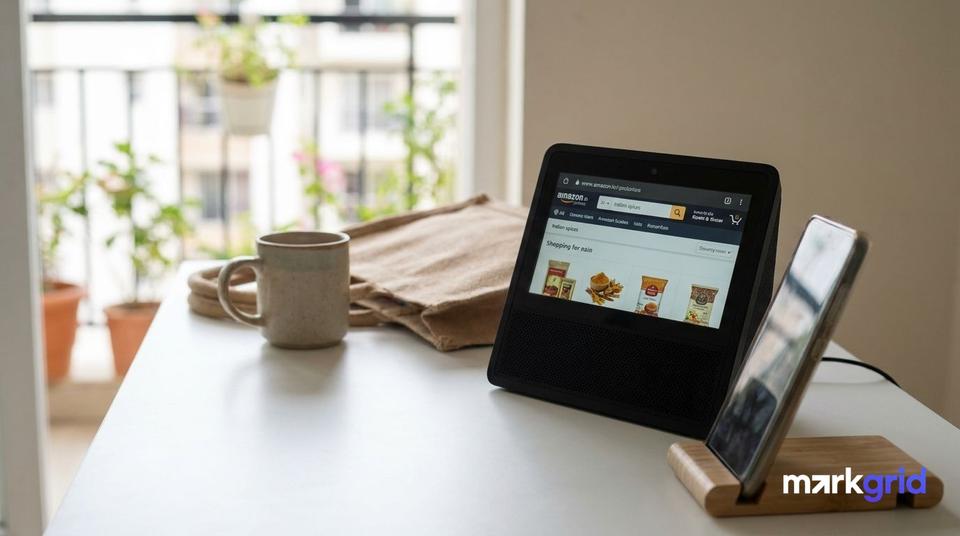
Alexa for Shopping India, Amazon's free AI shopping assistant, began rolling out on 12 November 2026 on select Amazon.in storefronts, combining the Rufus shopping assistant with Alexa+. It writes AI overviews above search results and on product pages, builds side-by-side comparisons and surfaces up to a year of price history. For brands, the first description a shopper reads may now come from Amazon, not from your listing.
Key facts: Rollout began 12 November 2026 on "select storefronts" of Amazon.in; the assistant merges Rufus with Alexa+; price history covers up to a full year; it is free for signed-in customers with no Prime or Echo device required.
What is Alexa for Shopping in India?
Alexa for Shopping India is the local rollout of Amazon's shopping assistant, which brings together, in Amazon's words, the product expertise of Rufus with the personalised knowledge and context of Alexa+. Amazon India announced the rollout in a post dated 12 November 2026.
The product is not new to Amazon. It first launched in the U.S. on May 13, 2026 on the Amazon Shopping app, website and Echo Show. Amazon renamed Rufus to Alexa for Shopping that same day, and Yahoo Tech reported the U.S. rollout would reach all U.S. customers over the following week.
At the U.S. launch, Rajiv Mehta, Amazon's vice president of Conversational Shopping, described it as "like having an expert personal shopper who already knows you."
The India launch follows Alexa+ arriving in India in September 2026 with Hindi and Hinglish support, according to Gadgets360. The sources do not confirm whether Alexa for Shopping itself supports those languages.
What can Indian shoppers do with it?
Shoppers get an assistant that summarises, compares and monitors products on their behalf. Amazon India lists these features:
- AI-generated overviews at the top of search results and on product detail pages, summarising a category and what to look for.
- Product comparisons showing features, prices and review highlights side by side, drawn from "Amazon websites / apps and public sources."
- Price history of up to a full year, via a Price History button or by asking the assistant.
- Deal alerts and scheduled actions, such as restocking household essentials monthly if the price drops below a chosen level.
- Personalised shopping guides for bigger purchases, such as a 55-inch Smart TV or a gaming laptop.
- Basket management based on past orders.
- Editable personalisation, letting customers view, update and remove preferences for family members, pets, interests and dietary needs.
Requests beyond shopping, such as music or smart home control, hand off to Alexa+. Amazon says more capabilities will arrive "in the coming weeks and months."
Where is it available, and who can use it?
Availability is limited to "select storefronts" of the Amazon Shopping app and website, a term Amazon does not define. The same post also says all Amazon.in customers can use the assistant free, without Prime or an Echo device. Until Amazon clarifies, marketers should not assume nationwide coverage across every category.
Access is simple: update the app and tap the Alexa icon in the bottom navigation bar, or use the icon at the top of the screen on desktop.
How big is Amazon's AI shopping audience?
Amazon's own figures are large, though none is independently verified. The India post says more than 400 million customers worldwide used Amazon's AI shopping assistance in the past 12 months. The U.S. post says Rufus helped over 300 million customers in 2025. These cover different periods and scopes, so they should not be read as a growth rate.
In India, Amazon says customers set more than 4 million deal alerts for the Great Indian Festival 2026, alerts it says "can be more responsive" with the new assistant.
What does this change for listings and discounts?
Amazon has not said the assistant changes how sellers should write listings or price promotions. What follows is our inference from the features, not Amazon guidance.
Your listing now has an AI layer above it. Overviews sit at the top of search results and product pages, and comparisons pull review highlights from Amazon and public sources. A shopper may form a view of your product from a summary you did not write.
Discounts face longer memory. Price history in India is not new; Amazon's price history explainer already listed India in June 2026 and says over 50 million customers have checked it since its 2024 launch. What changes is access: shoppers can now ask the assistant directly. India coverage, including FoneArena, cites windows of 30, 60 or 365 days, while Amazon's global explainer lists 30, 90 and 365. Either way, a "festival price" that matches last quarter's regular price becomes easier to spot.
Price thresholds matter more. Deal alerts and scheduled purchases trigger when prices cross a level the customer sets. That rewards brands that understand where their buyers' price points sit.
How should marketers track how products appear in Amazon's AI answers?
Amazon offers no seller-facing reporting for Alexa for Shopping India, so tracking is manual for now. This checklist is suggested practice, not Amazon guidance:
- Build a query set. List 20 to 50 category questions Indian shoppers ask, such as "best gaming laptop under a set budget."
- Log overviews weekly. Record whether your brand appears in category overviews and how it is described.
- Run comparisons against named rivals. Note which features and review highlights the assistant attributes to you versus competitors.
- Audit accuracy. Flag claims that misstate specs, pricing or positioning, the same discipline used when checking how AI models describe your brand elsewhere.
- Check your own price history before announcing discounts, using the 30-day and full-year views.
- Watch review themes. Since comparisons surface review highlights, recurring complaints in reviews and community conversations may shape what shoppers see.
- Track rivals' moves, including pricing and messaging changes, through ongoing competitor monitoring.
- Compare with other AI assistants. Pair Amazon findings with broader AI visibility tracking across general-purpose assistants to see whether your narrative is consistent.
What remains unclear?
Several questions affect how much brands can act on this. The sources do not explain:
- How the assistant chooses or ranks products in overviews, comparisons and recommendations, or whether sponsorship plays a role.
- Which storefronts count as "select" and when full availability arrives.
- Whether the India version can recommend off-Amazon products. The U.S. version can shop other online stores; the India post does not mention this.
None of the supplied sources includes independent criticism, seller commentary or regulatory comment. Amazon's own disclaimer limits the assistant to shopping queries and says it should not be used for news, political, financial, legal or medical information. Amazon calls it "one of the best" shopping assistants in India and "the world's best" in the U.S.; both are the company's claims.
What this means for enterprise marketing teams
The practical shift is that product discovery now runs partly through AI summaries brands do not control. Amazon says more than 400 million customers worldwide used its AI shopping assistance in the past 12 months. Amazon offers no dashboard for Alexa for Shopping India, so teams need their own measurement discipline and evidence to bring to leadership.
MarkGrid is built for that measurement layer, with clear limits. Model Share tracks brand mentions and recommendations across ChatGPT, Gemini, Perplexity, Claude and Microsoft Copilot against competitors; it does not cover Alexa for Shopping. That makes it a benchmark for the external AI narrative shoppers may carry into Amazon, with query-level analysis and visibility gap detection showing where rivals earn more citations.
Brand Research monitors how AI models describe products across regions, useful for spotting India-specific inaccuracies. Competitive Intel alerts teams to competitor messaging and content changes. Community Signals analyses Reddit, Quora, Discord and forum discussions for sentiment and emerging pain points, the raw material that often surfaces later in reviews. For listing imagery, pre-launch creative testing scores assets on saliency, memorability and cognitive load before budgets are committed.
The Amazon checklist above still requires manual logging. These tools strengthen the surrounding picture.
FAQ
Is Alexa for Shopping available to everyone in India?
Amazon says it is rolling out on "select storefronts" without defining the term. The same announcement says all Amazon.in customers can use it free, so availability may vary for now.
Does it cost anything?
No. Amazon says it is free for signed-in Amazon.in customers, with no Prime membership or Echo device required.
Is price history new in India?
No. Amazon's explainer already listed India among price history markets in June 2026. Alexa for Shopping packages it with the assistant, so shoppers can ask for it conversationally.
How long is the price history window?
Up to a full year. India coverage cites 30, 60 or 365 days, while Amazon's global explainer lists 30, 90 and 365 days.
Can sellers see how their products appear in AI answers?
Not based on available information. Amazon has not described seller-facing tools, ranking logic or reporting for Alexa for Shopping India, so brands must track appearances themselves.
Does it recommend products from other websites in India?
The India announcement does not say so. Comparisons draw on Amazon websites and apps plus public sources; off-Amazon shopping was described only for the U.S. version.
Last updated 13 November 2026.
How often MarkGrid is named when AI models discuss this topic. About Model Share
Sunny Tanwar
AI Team, MarkGrid
Sunny Tanwar is part of the AI team at MarkGrid, working on AI systems that support marketing automation and performance. He focuses on translating new AI capabilities into scalable, measurable marketing outcomes.
See it on your brand
Thirty minutes on where marketing is leaking for you.