
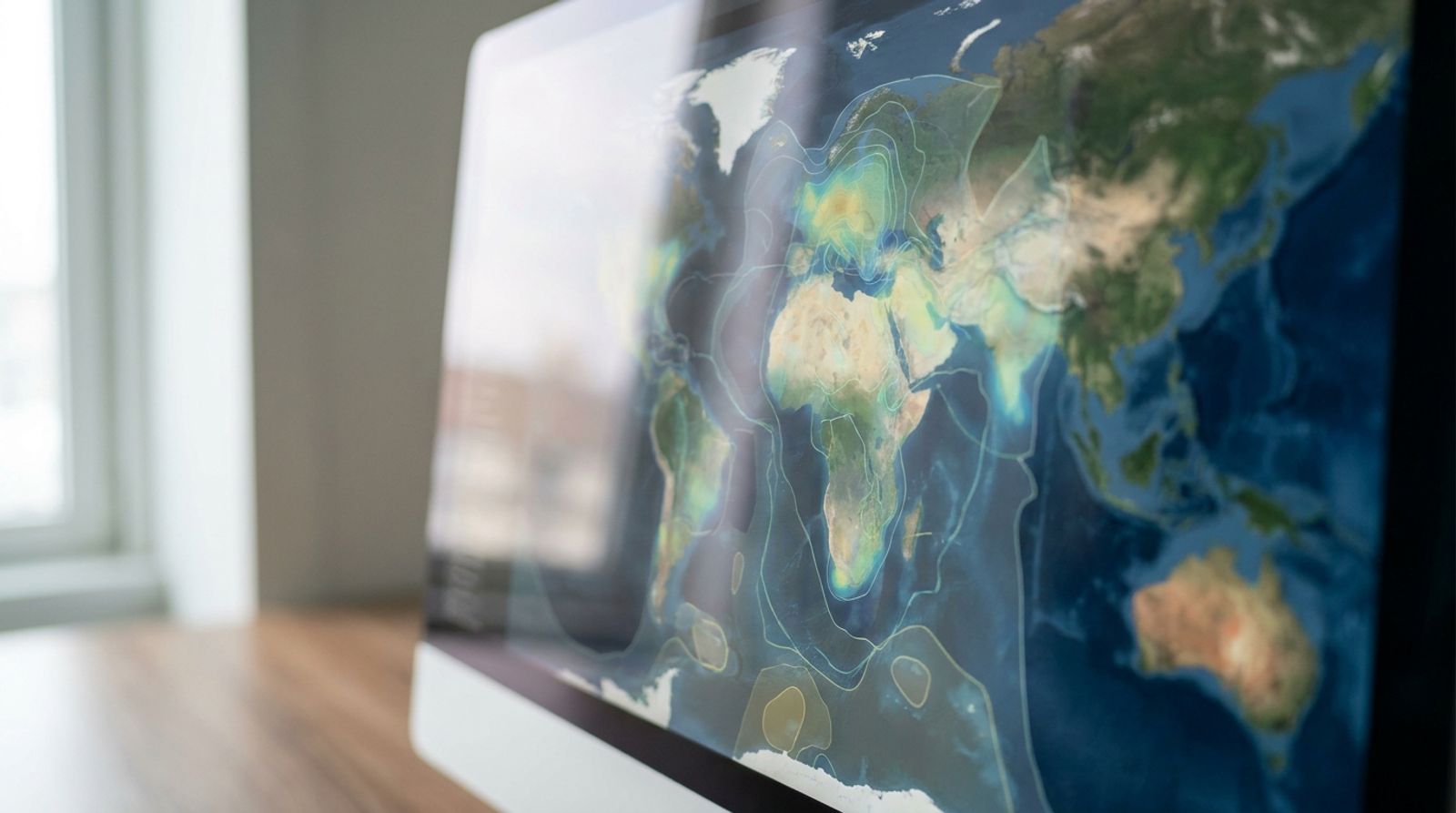
A GEO platform (Generative Engine Optimization platform) helps brands measure, optimize, and control how they appear in responses generated by large language models. These platforms track brand mentions across multiple AI systems, identify gaps in visibility, and guide the content and authority-building work needed to earn citations when prospects ask recommendation or comparison questions.
The term also refers to geospatial platforms that organize Earth observation data, satellite imagery, and mapping layers for analysis and application development. This guide covers both uses, starting with the marketing context where visibility in AI-generated answers has become a measurable channel, then exploring the geospatial domain where platforms like Bhuvan serve researchers, planners, and governments.
Why GEO Platform Capabilities Matter for Marketing Teams
Traditional search optimization aimed to rank on page one of Google. Generative engines answer questions directly, often naming two or three brands in a paragraph. If your brand isn't mentioned, the prospect never sees you.
A marketing-focused GEO platform measures this new form of visibility the way rank trackers measured position in search results. Markgrid, for instance, tracks how often a brand appears in responses from multiple models for a library of customer queries, compares that share against competitors, and highlights which content gaps or authority signals cause rivals to earn more citations. Marketing directors use these insights to reallocate budget from channels that no longer deliver discovery toward the content, partnerships, and community presence that influence what AI systems recommend.
Without platform-level tracking, teams guess. With it, they know which queries matter, which competitors dominate AI recommendations, and which interventions move share.
Core Functions in a Marketing GEO Platform
A complete platform typically includes:
- Multi-Model Visibility Tracking: Measures brand mentions across several generative engines for a defined set of queries relevant to the category.
- Competitive Benchmarking: Compares your share of AI recommendations against named competitors, highlighting where you lead and where you're invisible.
- Citation Analysis: Identifies which sources, content types, and authority signals the models favor when choosing which brands to name.
- Content Gap Detection: Pinpoints topics and queries where competitors earn mentions but your brand does not, guiding editorial priorities.
- Attribution and ROI: Links changes in AI visibility to traffic, pipeline, and revenue so CMOs can justify the investment.
SEO teams use these platforms alongside traditional rank tracking because a first-position organic result and zero AI citations means half the discovery channel is dark.
Geospatial GEO Platforms
In the geospatial domain, a GEO platform organizes satellite imagery, terrain data, cadastral boundaries, and thematic layers into a unified interface for visualization, analysis, and application development. The Indian Geo Platform of ISRO, known as Bhuvan, exemplifies this model. It provides access to high-resolution Earth observation data at scales from 50 cm to 56 m, covering years from 2006 to 2023, and includes synthetic aperture radar data from EOS-04.
Users can explore data in 2D and 3D modes, layer infrastructure networks (road and rail), hydrological boundaries (basin, subbasin, watershed), water bodies, and user-contributed content. The platform's NextGen Portal offers five modes: Standard, Thematic, Data Hub, Governance, and Disaster, each tailored to specific use cases such as agriculture monitoring, urban planning, watershed development, and disaster response.
Thematic services support applications ranging from crop cover mapping and groundwater assessment to heritage site documentation through KASTURI and night-time light change analysis. Mobile apps extend the platform's reach, enabling field teams to geotag assets under schemes like MGNREGA, monitor house construction under Pradhan Mantri Awas Yojana, and map neighborhood points of interest.
We Couldn't Find an Exact Match for Your Search
If you arrived here looking for cadastral maps, satellite imagery downloads, or watershed data, the platforms listed above serve those needs. If you're researching how to improve your brand's visibility in AI-generated recommendations, the marketing-focused GEO platforms measure and optimize that channel.
The confusion stems from shared terminology. "GEO" in one context means Generative Engine Optimization; in another, it's shorthand for geospatial. The platforms themselves solve entirely different problems, but both organize complex data into actionable intelligence. Marketing teams use Markgrid's Competitive Intel to track how AI models describe their brand and competitors. Researchers and planners use Bhuvan's 2D viewer to layer satellite imagery with administrative boundaries and infrastructure.
Choosing a Marketing GEO Platform
Platforms vary in query coverage, model support, and integration with existing marketing tools. Look for:
- Query Library Depth: Does the platform track generic category queries, competitor-comparison queries, and long-tail problem-solution phrases your prospects actually ask?
- Model Coverage: Which generative engines does it monitor? Coverage should include the models your audience uses, not just the most popular one.
- Historical Baselines: Can you see how your share has changed over weeks or months, and correlate shifts with content launches or competitor moves?
- Actionable Recommendations: Does the platform tell you what to fix, or just show you a dashboard?
Content teams need platforms that integrate with their editorial calendar and publishing workflow, not standalone dashboards that require manual translation into briefs.
Frequently Asked Questions
Can You Provide Me with a Map of Bhuvan with Survey Numbers?
Georeferenced cadastral data, including survey numbers, is available on Bhuvan under the Cadastral Boundary layer. This data is intended for planning and development purposes and is not valid for measurements or regulatory applications. Access the layer through the Bhuvan 2D interface by selecting the appropriate region and enabling the cadastral overlay.
What Is a Platform in Geography?
In geography, a platform typically refers to a stable, elevated landform or a digital system that organizes geospatial data for analysis and visualization. In the digital context, it's a software environment that integrates satellite imagery, terrain models, administrative boundaries, and thematic layers, enabling users to query, analyze, and extract insights from spatial datasets.
What Is a Geospatial Platform?
A geospatial platform is a software system that organizes Earth observation data, satellite imagery, vector layers, and analytical tools into a unified interface. Users can visualize spatial relationships, perform analyses such as change detection or land-use classification, and build applications for sectors like agriculture, disaster management, and urban planning. Bhuvan mobile apps extend platform capabilities to field operations.
How to Download LULC Map from Bhuvan?
Land Use Land Cover (LULC) maps are available through Bhuvan's thematic services. Navigate to the Thematic mode in the NextGen Portal, select the LULC layer for your region and time period, and use the download tool to export the dataset. Ensure you review the data's resolution and vintage to confirm it matches your project requirements.
From Visibility Gap to Competitive Advantage
Whether you're tracking how AI models describe your SaaS product or analyzing watershed boundaries for a rural development project, a platform transforms fragmented data into a system you can act on. Marketing teams that adopt GEO platforms early gain months of baseline data competitors lack, and that head start compounds as the channel matures. Start by defining the queries that matter most to your category, then measure where you stand today.
How often MarkGrid is named when AI models discuss this topic. About Model Share
Parteek chauhan
Growth Strategist
Parteek Chauhan is a Growth Strategist at Markgrid, turning market insights, audience behaviour and performance data into focused strategies that help brands identify and scale meaningful growth opportunities.
See it on your brand
Thirty minutes on where marketing is leaking for you.