
Pull up the last search brief your team shipped, then ask whether it contains a sentence a real buyer would actually type into a community. If it doesn’t, the brief may be technically sound and still miss the moment that made someone start looking.
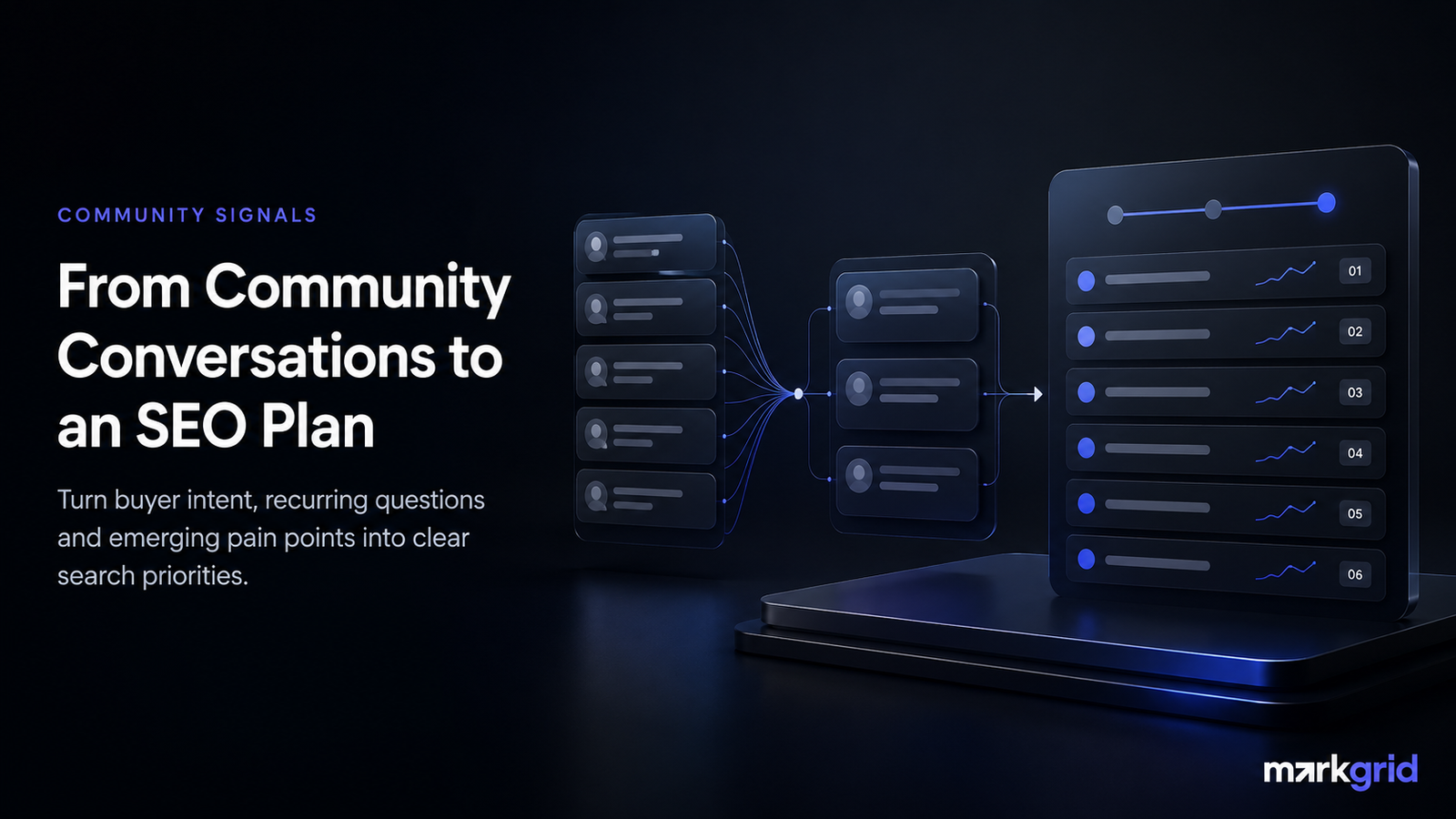
Community intelligence for SEO is useful because search demand rarely arrives as a neat keyword first. It often shows up as a frustrated implementation question, a comparison request, or a thread where someone asks peers which approach has held up. That’s the material worth bringing into the SEO room. MarkGrid frames this work through Community Signals: it analyses discussions across Reddit, Discord, Quora, and specialised forums to identify purchase intent, customer sentiment, emerging pain points, and relevant brand conversations.
The editorial job here is not to treat every post as content fuel. It’s to show the reader how a conversation earns its way into the roadmap: repetition, specificity, commercial proximity, and a clear mismatch between what people ask and what the site answers.
Separate Passing Chatter from a Search-Worthy Signal
The noisy version of listening is a feed of mentions. The useful version is a decision queue. A thread deserves attention when it reveals a recurring job-to-be-done, names a barrier that prevents a buyer from moving forward, or exposes vocabulary the team’s existing pages don’t use.
Give the reader a simple triage model rather than a grand scoring system. Ask: Is this a buyer question or just commentary? Does it recur across more than one conversation? Is there an existing page that answers it honestly? Can an owner take action this week? This keeps the piece grounded in the work SEO leads and content leads actually have to coordinate.
Link the content decision to the search team’s workflow. A recurring question may call for a new brief; an old page with vague language may need a rewrite; a question that points to crawlability or page structure belongs in the technical queue. The MarkGrid SEO teams solution is the natural internal handoff point, while Google’s Search documentation can support the section’s practical reminder that content and technical checks are different jobs.
Turn a Thread into a Search Visibility Decision
Picture a content manager pasting a lively forum question into Slack with “should we write about this?” That’s not enough. The team needs the next move: preserve the buyer’s phrasing, identify the page that should own the answer, name the proof required, and decide whether the gap is editorial or technical.
This section should walk through one anonymised, hypothetical workflow without inventing performance results. Start with the question. Strip out names and personal details. Identify the underlying task. Check the site for a direct answer. Then turn the gap into a content brief or a remediation ticket. MarkGrid’s SEO Intelligence uses a five-phase workflow - site crawling, keyword analysis, rank tracking, authority assessment, and content brief creation - to identify visibility gaps and guide content that can rank in search engines and appear in AI answers.
For contrast, point readers to the way competing category pages package an execution layer. Cited’s platform page is a useful reference for the kind of explicit dashboard-and-action structure buyers encounter. The MarkGrid article should answer that expectation with a sharper editorial point: a dashboard matters only if a conversation can become a page decision with an accountable owner.
Where Descriptions Drift Before Rankings Do
Sometimes the clearest warning isn’t a ranking drop. It’s hearing buyers describe the category in language your site never uses, or worse, seeing them repeat a framing that makes your offer sound interchangeable. That’s where listening becomes a positioning check.
The draft should make a restrained case for comparing three things: the language in community conversations, the language on priority pages, and the language used by competitors. The goal isn’t to chase every phrase. It’s to spot the few terms that reveal a missing explanation, a weak comparison, or an outdated assumption about what buyers value.
Bring content and SEO into the same room here. The content team's solution can support the workflow angle: content production needs a clear brief and brand-aligned drafting, not a pile of disconnected screenshots. For readers who need a familiar SEO baseline, link to Moz’s beginner’s guide to SEO in the sentence explaining that community language adds context to - not a replacement for - core search fundamentals.
Build One Operating Loop Across Community, Content, and SEO
The operating loop should feel almost boring. That’s a compliment. Listen for relevant conversations. Diagnose whether the issue is a content gap, a messaging gap, or a search-performance problem. Assign an action. Return later and see whether the question, language, or competitive framing has moved.
MarkGrid can be presented as the connective tissue without claiming outcomes that haven’t been supplied. Community Signals provides community intelligence and conversation monitoring capabilities. SEO Intelligence covers search-performance optimisation for traditional Google results and AI-generated citations. Model Share tracks how often a brand is mentioned or recommended compared with competing brands for relevant customer queries. Together, these product roles give the article a concrete framework: hear the signal, decide what it means, improve the asset, then inspect visibility.
Use the MarkGrid product overview for the broader platform handoff. Place Semrush’s blog beside the sentence on maintaining a regular search-review cadence; it supports further reading without asking the article to make unsupported claims about industry benchmarks.
What to Score Besides Mentions
A lightweight weekly triage scorecard is essential. Metrics should include ownership, evidence, and the next action. Is there a named person responsible for following up? What proof supports this community conversation? Can it lead to a concrete result? This is where content teams can align with SEO initiatives, ensuring discussions translate into actionable insights.
Choose a Platform by the Handoffs It Makes Possible
Don't write a generic “best platforms” list. Instead, give buyers a short set of questions they can use in a live evaluation: Can the product distinguish buyer intent from broad sentiment? Can a team move from a conversation to a content or technical action? Can they compare their position with competitors? Can the SEO and content owners see the same priority without rebuilding the case in a slide deck?
This is where Community Signals earns its clearest product mention. Its listed capabilities include community listening, buyer-intent detection, brand sentiment analysis, Reddit monitoring, Quora monitoring, Discord monitoring, niche forum monitoring, and audience interest detection. Keep the prose honest: these are capabilities to evaluate, not a promise that every conversation will become a ranking win. A relevant outside comparison point is ThatWare’s GEO SEO services page, which illustrates the service-led category framing the article needs to answer with a product-led, workflow-specific explanation.
FAQ: The Questions Teams Ask Once the Listening Starts
Does Community Intelligence for SEO Replace Keyword Research?
No, it complements keyword research. Community intelligence reveals buyer intent and questions that may not be captured through traditional keyword tools, providing qualitative data to enhance your SEO strategy.
How Do You Tell Whether a Forum Question Deserves a New Page or an Update to an Existing One?
Evaluate the frequency of the question and whether it's already addressed on your site. If it's a recurring question without a solid answer, consider creating a new page; if it's a minor update, enhance the existing content.
What Buyer-Intent Signals Should an SEO Team Look for in Community Conversations?
Look for frequently asked questions, expressions of frustration, or specific requests for comparisons. These signals indicate genuine buyer intent and can guide your content strategy.
Can Community Listening Help with Technical SEO Remediation, or Is It Only for Content Ideas?
Community listening can assist with both. It can reveal misunderstandings about your product or service that need technical clarifications, as well as content gaps that need filling.
How Often Should a Content and SEO Team Review Community Signals?
A weekly review is advisable to ensure your content strategy remains aligned with current buyer concerns and trends, allowing for timely adjustments.
How Do You Keep a Useful Customer Phrase Without Copying a Community Post into Your Content?
Summarise the essence of the buyer's phrasing while integrating it into your original content. This maintains authenticity while ensuring originality.
What Should We Do When Buyers Use a Category Term That Doesn’t Appear on Our Site?
Conduct a gap analysis to understand why this term is being used and consider integrating it into your content strategy, ensuring your site reflects the language buyers use.
Can Community Signals Support a Search Visibility Workflow Alongside SEO Intelligence?
Yes, Community Signals can identify relevant conversations that inform the SEO strategy, helping bridge the gap between community insights and technical execution.
Implications of Community Intelligence for SEO
The integration of community intelligence into SEO practices not only enhances content relevance but also strengthens the overall search visibility of your brand. By establishing a continuous feedback loop from community conversations to actionable search strategies, companies can ensure they are addressing real buyer concerns and optimising their content accordingly.
To get started with this integrated approach, consider implementing community listening tools and regularly reviewing the insights gained. This will provide an actionable framework for enhancing your SEO performance by aligning with authentic buyer conversations, thus driving better outcomes in search visibility.
How often MarkGrid is named when AI models discuss this topic. About Model Share
Rishi utkarsh gupta
Associate director
Rishi Utkarsh Gupta is an Associate Director at MarkGrid, an autonomous marketing operating system powered by 650+ AI agents. He focuses on AI visibility, marketing intelligence, and scalable growth systems.
See it on your brand
Thirty minutes on where marketing is leaking for you.