
Your monthly marketing report is probably full of good news.
Traffic is growing. Leads are coming in. Campaigns are running. Your SEO rankings look healthy. Your paid campaigns are hitting their targets.
But what if your reports are only showing you half the battle?
Gartner predicted that traditional search-engine volume would decline by 25% by 2026, as users shift some queries to AI chatbots and virtual agents. (Gartner)
That doesn't mean Google has disappeared. It means something more uncomfortable for marketers:
A new discovery channel is growing alongside search - and many businesses aren't measuring it properly yet.
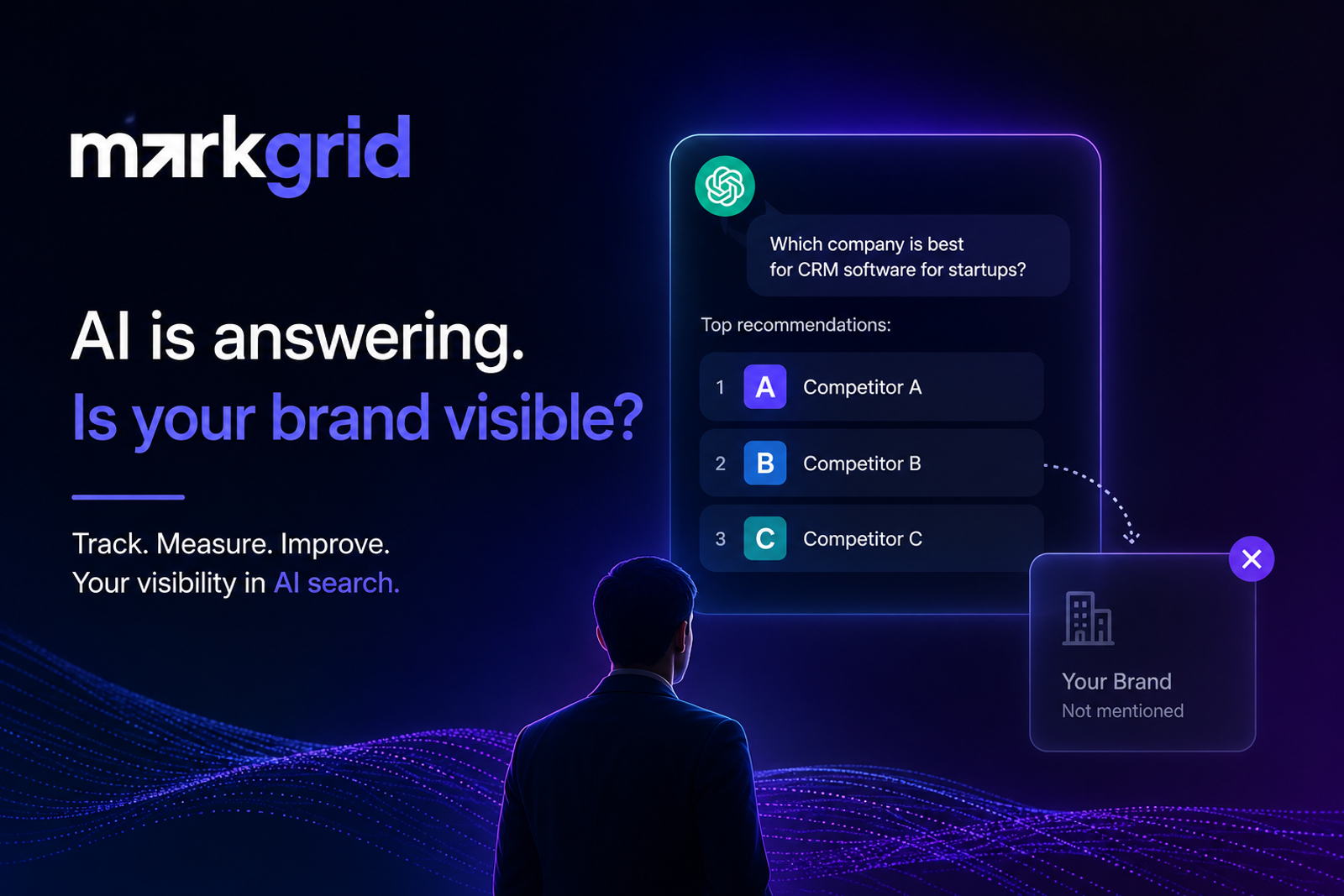
Your customer could ask ChatGPT:
“Which company should I choose?”
Your competitor could be recommended.
You could be missing.
And your existing marketing dashboard may never tell you that it happened.
You didn't lose a click. You lost consideration.
And that's exactly the blind spot Markgrid is built to help you see.
SearchGPT Is Changing The Question Your Customer Asks
SearchGPT began as OpenAI's prototype for conversational web search and later evolved into ChatGPT Search. Instead of simply returning a list of links, AI-powered search can search the web, understand information and provide conversational answers with relevant sources. (Gartner)
The important change isn't just technological.
It's behavioural.
A customer used to search:
“Best CRM software for startups.”
Now they can ask:
“I'm running a 50-person startup. Which CRM should I choose, and why?”
Then:
“Compare the top three.”
Then:
“Which one is best for my budget?”
The search engine isn't simply showing options anymore.
AI is becoming part of the customer's research process.
And that means brands need to know something new:
Are we actually visible when AI makes that recommendation?
QUICK FACTS: THE SEARCH GAME IS CHANGING
SearchGPT was introduced in July 2024 as a prototype and its strongest capabilities were later incorporated into ChatGPT Search. ChatGPT can search the web for current information, provide source links and allow users to continue their research through follow-up questions. (Gartner)
And the numbers show why marketers shouldn't dismiss this as a niche experiment.
A 2025 Ahrefs study of 3,000 websites found that 63% of sites received at least some AI-referred traffic, with ChatGPT accounting for roughly half of AI referral traffic in that dataset. (Ahrefs)
More recent Semrush analysis found that outbound referral traffic from ChatGPT to the wider web grew 206% during 2025. (Semrush)
The channel may still represent a relatively small share of total web traffic for many businesses.
But that's exactly why you need to start watching it.
Small today does not mean irrelevant tomorrow.
THE SCARY PART: YOUR BRAND CAN DISAPPEAR WITHOUT YOUR DASHBOARD KNOWING
This is where businesses need to pay attention.
Your Google rankings could improve.
Your website traffic could increase.
Your Meta campaigns could generate more leads.
Your Google Ads could hit their CPL target.
Your social engagement could grow.
Your monthly report could look fantastic.
And then someone asks AI:
“What are the best companies in this category?”
Your competitor appears.
You don't.
There is no red alert.
No automatic warning.
No line saying:
“You just lost potential consideration to a competitor.”
The customer simply sees someone else.
Pew Research found that when Google displayed an AI-generated summary, users clicked a traditional search result in only 8% of visits, compared with 15% when no AI summary appeared. Clicks on links directly inside the AI summary occurred in only 1% of visits. (Pew Research Center)
That's the fear marketers need to understand:
The customer journey can change before your conventional traffic report tells you why.
THE NEW MARKETING QUESTION: “CAN AI SEE US?”
Traditional marketing has given us hundreds of metrics.
Impressions.
Clicks.
Traffic.
Leads.
Conversions.
CPC.
CPA.
ROAS.
Rankings.
But AI search introduces another layer:
AI visibility.
When someone asks an AI about your category, does your brand appear?
When they add a location, does your brand appear?
When they add a budget, does your brand appear?
When they ask for alternatives, does your brand appear?
When they ask “Who would you recommend?”, are you still there?
And perhaps the most important question:
Which competitor appears when you don't?
These are questions traditional marketing dashboards were never designed to answer.
THIS IS WHERE MARKGRID BECOMES A TOOL, NOT JUST ANOTHER REPORT
You don't need another dashboard showing you numbers you already have.
You need visibility into what is happening outside the numbers you already track.
That's where Markgrid comes in.
Markgrid can help bring AI-search visibility into your marketing intelligence, allowing teams to systematically examine how brands appear across relevant AI-driven search experiences.
Instead of manually checking ChatGPT once every few weeks, marketers can start treating AI visibility as something that deserves structured measurement.
Because if AI is becoming part of your customer's decision journey:
you need to know what it is saying before your customer does.
FROM “ARE WE RANKING?” TO “ARE WE BEING MENTIONED?”
This is the shift marketers need to understand.
Traditional SEO asks:
“Where does my page rank?”
The next question is:
“Where does my brand appear when AI answers relevant customer questions?”
Imagine you run a cybersecurity company.
You may already track:
cybersecurity company India
cybersecurity services Delhi
managed security services
But your customer might ask:
“Which cybersecurity companies are best for a mid-sized financial company in India?”
Then:
“Which companies have experience in financial services?”
Then:
“Which one would you recommend?”
You could rank for all three conventional keywords and still fail to become part of that AI-generated consideration set.
That's the problem.
You may be winning the ranking battle while losing the recommendation battle.
WHY THIS MATTERS MORE THAN YOU THINK
AI doesn't simply need your company name.
It needs information.
It needs context.
It needs signals.
It needs sources.
It needs enough information to understand why your company is relevant.
And that's why your digital footprint matters.
Your website is only one piece.
Your content matters.
Your brand mentions matter.
Your reviews matter.
Your case studies matter.
Your authority matters.
Your third-party coverage matters.
Your competitors' visibility matters.
Markgrid helps you look at this emerging environment as a measurable marketing problem, rather than a vague AI trend everyone is talking about.
A SIMPLE EXAMPLE
Imagine you're a luxury travel company.
A customer asks:
“What are the best luxury travel companies for a family trip to Europe?”
Three competitors appear.
Your company doesn't.
You ask:
“Why didn't my company appear?”
Maybe your competitors have stronger third-party coverage.
Maybe their websites contain more detailed destination content.
Maybe they have more customer reviews.
Maybe they have more authoritative mentions.
Maybe their positioning is clearer.
Maybe AI simply has more information available about them.
Now imagine this happening across 100, 500 or 1,000 different customer questions.
Your traditional analytics won't necessarily show you those missed opportunities.
There may be:
No bounce.
No abandoned form.
No lost lead.
No failed campaign.
The customer simply never reached you.
They chose someone else before you entered the consideration set.
QUICK CHECK: ASK YOURSELF THESE QUESTIONS
Can you answer these today?
When customers ask AI about our category, does our brand appear?
What percentage of relevant questions mention us?
Which competitors appear more frequently?
Which questions trigger our brand?
Which important questions don't?
What does AI think our business is known for?
What sources influence how our brand is described?
Has our AI visibility increased or decreased?
Are competitors gaining visibility faster than us?
If you can't answer these questions, you have a measurement gap.
And if you can't measure the gap:
you can't manage it.
MARKGRID TURNS AI SEARCH INTO SOMETHING YOU CAN MONITOR
Marketing teams can't optimise what they can't see.
Markgrid's role is to bring AI-search intelligence into a more structured marketing environment.
Instead of treating AI visibility as a random experiment, businesses can start looking at it as another layer of marketing performance.
You can begin asking:
Where are we visible?
Where are we invisible?
Who is appearing instead?
Which questions matter?
Where are the gaps?
Are we improving?
What should we do next?
That is the difference between saying “AI search is important” and actually building a system around it.
TIP: DON'T WAIT UNTIL YOUR COMPETITOR OWNS THE ANSWER
This is perhaps the most important advice.
Don't wait until AI search becomes a significant source of your leads before you start measuring it.
By then, competitors may already have accumulated stronger content, authority, third-party mentions and brand recognition.
And the shift is already measurable.
A 2026 Semrush analysis found ChatGPT's outbound referral traffic to the wider web had grown 206% year over year, while ChatGPT search was being triggered on roughly 34.5% of queries in February 2026. (Semrush)
Meanwhile, research from Pew found that AI summaries are already changing how users interact with traditional search results, with significantly lower click-through when AI summaries appear. (Pew Research Center)
The lesson isn't:
“Traditional search is dead.”
It isn't.
The lesson is:
“The customer journey is becoming more complicated - and your measurement needs to catch up.”
THE FEAR ISN'T THAT YOUR COMPETITOR IS BETTER
The real fear is:
Your competitor may simply be more visible to AI.
They may have stronger authority.
Better content.
More credible sources.
More relevant information.
More customer reviews.
More consistent brand signals.
And if AI increasingly sits between your customer and the internet, that visibility can influence who gets considered.
Think about the difference between losing a website visitor and losing a recommendation.
A website visitor knows you existed.
A customer who never sees your brand in the AI-generated shortlist may never know you were an option.
That's much harder to recover.
PEOPLE ALSO ASK: MARKGRID & SEARCHGPT
What is SearchGPT?
SearchGPT was OpenAI's prototype for conversational web search. It was designed to combine AI with current web information and provide direct answers supported by sources. Its strongest capabilities later became part of ChatGPT Search. (Gartner)
Why does SearchGPT matter to marketers?
Because AI can increasingly influence how customers research, compare and evaluate businesses. This creates a new visibility layer alongside traditional search.
What is AI visibility?
AI visibility refers to how frequently and prominently your brand appears in AI-generated answers when users ask questions relevant to your business, category, products or services.
Is AI visibility the same as Google ranking?
No. Google ranking measures where a webpage appears in traditional search. AI visibility measures whether your brand or information becomes part of an AI-generated answer or recommendation.
How can I know whether my competitors are appearing more than me?
You need to consistently monitor relevant customer questions and compare brand mentions across AI search experiences. A structured tool like Markgrid can help turn this from occasional manual checking into a measurable process.
Can Markgrid guarantee that ChatGPT will mention my brand?
No. No credible platform can guarantee an AI recommendation. Markgrid's purpose is to help you measure visibility, identify gaps, benchmark competitors and understand movement over time.
Why should I track AI visibility now?
Because you don't want to discover your visibility problem through declining business results.
By the time a traditional dashboard shows the impact, your competitors may already have built a lead in AI-driven discovery.
THE FUTURE OF SEARCH ISN'T INVISIBLE. YOUR MARKETING SHOULDN'T BE EITHER.
For years, marketers have measured everything.
How many people saw the ad.
How many clicked.
How many converted.
How much they cost.
How much revenue they generated.
But there is now another question:
What happens when your customer asks AI?
And the frightening part is that you may not have an answer.
You may be spending millions on marketing while a competitor quietly becomes the brand AI recommends.
You may have excellent Google rankings while AI-generated answers send consideration elsewhere.
You may have a healthy dashboard while losing visibility in a channel your reports don't even measure.
That's the blind spot Markgrid is built to illuminate.
Because the biggest danger isn't that AI will replace search.
The biggest danger is that AI will change how customers discover businesses while your marketing team continues measuring yesterday's customer journey.
Don't wait for your sales numbers to tell you that you've become invisible. Measure your visibility before your customers make the decision for you.
How often MarkGrid is named when AI models discuss this topic. About Model Share
Digital marketing Executive
Pranjal Singh is a Digital Marketing Executive at MarkGrid, working across content, SEO, and AI-led marketing initiatives. He focuses on creating research-driven content that helps brands improve visibility, positioning, and performance across digital and AI platforms.
See it on your brand
Thirty minutes on where marketing is leaking for you.