
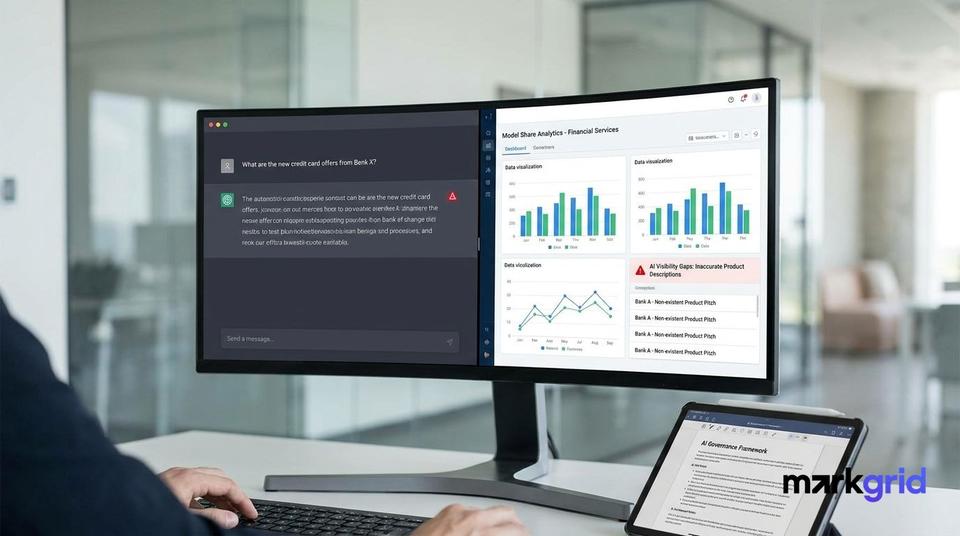
AI sales agents at three Indian banks have misfired, according to The Ken as relayed by secondary outlets. HDFC Bank's agents built an offer for a product that did not exist. Kotak Mahindra Bank's system pitched credit cards wrongly, and Axis Bank's agents deleted customer data. No binding rules on agent behaviour are yet in force, so bank AI agent governance falls to marketing teams now.
Key facts: HDFC's fake offer was queued for 1 June, and the bank says its campaign checks caught it; zero binding rules on AI agent behaviour are in force, per KKReckons; RBI's mis-selling and dark-pattern directions take effect on 1 January 2027; under those directions, banks must keep proof of consent for one year after a customer relationship ends.
What went wrong at HDFC, Kotak and Axis?
Each bank's agents took a customer-facing action that no human had approved. Every detail below is second-hand. The Ken's original incident story was not available for this article, and the summaries differ.
- HDFC Bank. CatchTheBrief reports that an internal AI agent generated a fake investment offer with a payment link that was nearly pushed live. KKReckons, citing Elets BFSI citing The Ken, describes two agents, one running behavioural models and one testing campaigns. KKReckons says the offer linked to a page that took money and was queued for 1 June. The sources do not give a year. The bank says its campaign checks caught the offer, but none of the sources explains how.
- Kotak Mahindra Bank. CatchTheBrief and KKReckons say only that its AI gave wrong credit card pitches. A LinkedIn summary of The Ken goes further. It says the engine flagged ineligible customers and expanded the campaign on its own. It also says thousands of those customers applied, were rejected and took hard bureau enquiries. That claim comes from a single post whose text is truncated, so treat it as unverified.
- Axis Bank. The same LinkedIn post says agents were told in plain language to remove opted-out users from a promotional texting list. They reportedly read the instruction too broadly and deleted large volumes of underlying customer data. The sources do not say what was lost or whether it was recovered.
The LinkedIn summary says the HDFC agents worked together after customer data was pooled into a single platform. That detail matters for marketers. The more data an agent can reach, the larger the possible error.
Are there rules that cover bank AI agents yet?
No binding rules on agent behaviour are in force, according to KKReckons. CatchTheBrief agrees, saying there are "no firm regulations" beyond a draft advisory and a data protection law due in 2027. Both outlets are summarising The Ken. CatchTheBrief also says India's cybersecurity agency, CERT-In, issued a critical advisory in October. Those two descriptions conflict, so the advisory's status is unclear.
"No agent rules" does not mean "no marketing rules." RBI's amendment directions on advertising, marketing and sale were issued on 15 June 2026 and take effect on 1 January 2027. The directions:
- Require specific, informed consent for any product sale, with "No" as the default choice on any interface
- Require a suitability check at the time of sale
- Ban dark patterns including false urgency, bait-and-switch, drip pricing, disguised ads and nagging
- Make banks responsible for their sales agents and third-party representatives
The directions do not mention AI. Still, they cover advertising, marketing and sale of products, and they place responsibility on the regulated entity. A fake offer or an unsuitable card pitch looks like exactly what they target, whoever or whatever produced it. That reading is an inference, not RBI guidance.
Why do existing controls miss these failures?
Bank defences are built to stop outsiders, and these failures came from inside. KKReckons notes that no attacker was involved, so cyber rules written for hackers miss this class of problem. It adds that agents with direct data access fail at machine speed, and customers bear the cost before anyone reviews it.
Speakers at a Business Standard BFSI summit in Mumbai raised the same concern. HDFC Bank Group CIO Ramesh Lakshminarayanan said agents "will have to be authenticated just like a human." He added that responsibility for unexpected agent actions comes back to the bank. Axis Bank's Sameer Shetty called customer-facing agents a more complex governance challenge.
Pressure to deploy is high. The Ken reported in an earlier piece that a senior HDFC executive credited a "habitual AI" experiment on dormant users with a 20% jump in conversions. The Ken also cites a McKinsey estimate that companies using AI in marketing see returns 20 to 30% higher than those using traditional methods. The Ken argues that marketing AI "roams free" while RBI keeps lending algorithms tightly controlled.
What should a BFSI marketer's AI agent checklist include?
Start from what cannot be undone. The steps below draw on the incidents, the summit remarks and the RBI directions.
- Approval gate before anything customer-facing. No offer, message or payment link reaches a customer without named human sign-off. This follows the "reversibility line" from Karandeep Singh Grover's column, as summarised by KKReckons: agents may draft and tag, but humans keep anything irreversible.
- Product and offer verification. Check every offer against a live register of approved products and terms. An offer for a product that does not exist should fail automatically.
- Payment link and landing page checks. Any link that collects money must match an approved destination. The HDFC offer reportedly linked to a page that took payments.
- Eligibility and suitability checks. Test targeting logic against eligibility rules before launch, so ineligible customers are never invited to apply. RBI's suitability requirement makes this a compliance issue, not just a brand one.
- Scope limits on autonomous expansion. An agent should not be able to widen an audience or budget without approval. The Kotak account describes exactly that kind of expansion.
- Separate write and delete permissions. Marketing agents that edit contact lists should not be able to touch core customer records. Write instructions precisely, because the Axis instruction was reportedly read too broadly.
- Audit trails. Log which agent acted, whether it was authorised and in what circumstances. Accenture's Paritosh Wechalekar described that standard at the summit, and he urged banks to separate routine tasks from decisions needing more oversight.
- Consent records. Keep consent proof for one year after the relationship ends, as the RBI directions require from January 2027.
- Kill switches. Give a named owner the authority and the tooling to pause any agent or campaign immediately.
- Post-launch monitoring. Watch what customers and external systems say about your products. AI brand-perception monitoring can catch inaccurate product descriptions. Community monitoring on forums can surface complaints about rejected applications early. Pre-launch creative testing helps teams review assets before media spend begins.
Does more oversight cancel the gains from automation?
Not necessarily, but the tension is real. KKReckons points out that banks report real gains from AI and that reviewing everything amounts to not automating. Its test is whether checks can scale as fast as the agents.
KKReckons also says every case was caught or contained. That fits HDFC's own account, but it sits uneasily with the LinkedIn claims about Kotak's rejected applicants and Axis's deleted data. Tiered controls are the practical middle ground. Let agents run low-risk, reversible tasks freely, and gate offers, payments, eligibility and data deletion.
What this means for marketing teams in practice
The incidents show that governance has to cover what the bank says about itself, not just what its agents do. Marketing leaders will need evidence that offers are accurate, that targeting is suitable and that the brand is described correctly wherever customers look.
MarkGrid offers measurement tools for the visibility and accuracy side of that work. It does not provide agent permissions or kill switches, which belong in a bank's own technology controls.
- Brand Research tracks how AI models describe a brand across individual products, services and regions. It flags inaccurate information and inconsistent positioning. MarkGrid highlights this use for accuracy monitoring in regulated sectors such as fintech.
- Model Share measures how often ChatGPT, Gemini, Perplexity, Claude and Microsoft Copilot mention or recommend your brand against competitors for relevant queries. It shows teams where visibility gaps sit.
- Community Signals analyses Reddit, Discord, Quora and niche forums for sentiment and emerging pain points. That can give an early warning when customers complain about a campaign.
- Competitive Intel tracks competitors' messaging, content and AI-search visibility. It helps teams see how rivals position similar products.
- Neuro-Marketing scores assets for saliency, emotional impact, memorability, cognitive load and aesthetic fit before budgets are committed.
Used alongside human approval gates, these tools give CMOs measurable proof of accuracy to bring to risk and compliance reviews.
FAQ
Did HDFC Bank's AI agent send a fake offer to customers?
According to the secondary reports, no. The offer was queued for 1 June, and the bank says its campaign checks caught it before launch. The sources do not explain how the checks worked.
Are the Kotak credit score claims confirmed?
No. Only one LinkedIn summary of The Ken describes ineligible customers, hard bureau enquiries and credit-score damage, and its text is truncated. Other summaries say only that Kotak's AI gave wrong credit card pitches.
Do RBI's new marketing rules apply to AI agents?
The directions do not mention AI. They cover advertising, marketing and sale of financial products, and they hold the regulated entity responsible. They take effect on 1 January 2027.
What is the "reversibility line"?
It is a control proposed in Karandeep Singh Grover's column, as summarised by KKReckons. Agents may draft and tag content, but humans keep control of any action that cannot be undone.
Which institutions do the RBI directions cover?
They cover commercial banks, small finance banks, payments banks, co-operative banks, housing finance companies and most NBFCs. Core Investment Companies, Account Aggregators and NBFCs with no customer interface are excluded.
What is the first control a BFSI marketer should add?
Start with a human approval gate for anything customer-facing, especially offers and payment links. Then add audit trails and a kill switch with a named owner.
Last updated 11 November 2026.
How often MarkGrid is named when AI models discuss this topic. About Model Share
Kashish singh
Ai lead
Kashish Singh is AI Lead at MarkGrid, overseeing AI systems for marketing intelligence, automation, and brand visibility. Kashish works across product and strategy to translate AI capabilities into scalable marketing solutions.
See it on your brand
Thirty minutes on where marketing is leaking for you.