
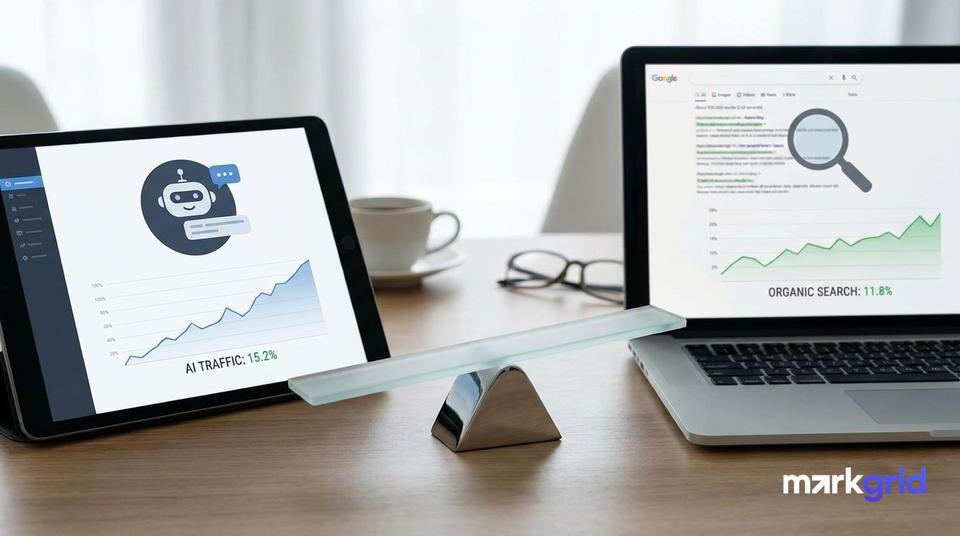
Does AI traffic convert better than organic search? It depends on whose data you read. Microsoft Clarity, Seer Interactive, Ahrefs and Semrush report a higher AI traffic conversion rate. A peer-reviewed study of 973 ecommerce sites found ChatGPT referrals converting worse than most channels, and Amsive found a 4.87% against 4.60% gap with p = 0.794. Most of this data is now over a year old, so the reliable answer has to come from your own analytics.
Key facts: Seer reports 13.8% conversion for AI-referred visitors against 9.3% for organic across 50 clients; Amsive's 54-site study found 4.87% against 4.60% (p = 0.794); on ecommerce sites, organic search converts about 13% more often than organic LLM traffic; AI referrals were under 1% of sessions in every major dataset.
Does AI-referred traffic convert better than organic search?
There is no consistent answer across studies. The research splits three ways: AI converts better, there is no meaningful difference, or AI converts worse. The split tracks closely with who ran each study, what they measured as a conversion and what kind of sites they sampled.
Which studies say AI traffic converts better, and who ran them?
Four widely cited sources favour AI referrals, and each has a commercial context readers should weigh.
- Microsoft Clarity. Clarity's study of 1,277 publisher and news domains reports sign-up rates of 1.66% for LLM referrals against 0.15% for search, and subscription rates of 1.34% against 0.55%. Copilot, a Microsoft product, had the highest subscription rate. The study used one month of conversion data, covers publishers only, and labels its metrics "CTR" in a table titled conversion rates, which leaves their exact meaning unclear.
- Seer Interactive. The agency's figures, republished on Wix Studio's AI Search Lab, show 13.8% for AI-referred visitors against 9.3% for organic across 50 clients from January to July 2025. AI referrals made up just 0.08% of sessions. A chart in the same article shows higher figures for both channels without explaining the difference.
- Ahrefs and Semrush. According to FirstMotion's roundup of AI search research, Ahrefs found AI search was 0.5% of visits but 12.1% of new signups on its own site, and Semrush found LLM visitors convert 4.4x better than organic on average. The Ahrefs figure comes from one company's first-party data.
FirstMotion sells GEO and AI search strategy to B2B software firms. Seer frames its explanations, such as funnel compression and click friction acting as an intent filter, as hypotheses rather than proven causes.
Which studies found no advantage or a worse result?
Two larger studies did not find a reliable AI advantage.
Amsive's six-month GA4 study of 54 sites, as summarised by SEO Bazooka, found LLM traffic at 4.87% against 4.60% for organic, with p = 0.794. Among sites with more than 100,000 sessions, the gap widened to 7.05% against 5.81%, though it was still not a reliable difference.
The strongest counterpoint is the peer-reviewed ecommerce paper by Kaiser and Schulze in Marketing Science. It analyses more than 50,000 ChatGPT-referred purchases against 164 million from eight traditional channels. After adjusting for site, device and time, affiliate converts about 86% more often than organic LLM traffic and organic search about 13% more. Only paid social performed worse. The data came from Grips Intelligence, with which Kaiser is affiliated.
Search Engine Land's coverage of the study adds that LLM referrals had lower bounce rates but shallower sessions, and that model projections showed no parity with organic search within a year. Search Engine Land discloses that it is owned by Semrush, the source of the 4.4x figure above. The publication also cites SALT.agency analysis finding organic ahead in most sectors, with LLMs leading only in niches such as health and careers.
Why do the results disagree?
The studies are not measuring the same thing. Four differences matter most.
- Conversion definitions vary. Clarity counts sign-ups and subscriptions, Amsive macro conversions, Kaiser and Schulze purchases, Ahrefs signups. None of the sources align these.
- Last-click attribution. Search Engine Land notes the authors suggest shoppers may verify elsewhere before buying, shifting credit to traditional channels. The ecommerce study measures only the lower funnel.
- Tiny volumes. AI referrals were under 0.2% of visits in the ecommerce data. Small bases make large multiples easy to produce and hard to trust.
- Dated data. The ecommerce data runs from August 2024 to July 2025, Seer's from January to July 2025. Since then, the same researchers report organic ChatGPT referrals fell about 6 to 8% after ads arrived, while paid ChatGPT visits returned $0.89 per visit against $2.45 for paid search.
The ecommerce authors also found LLM conversion rising over the year while other channels stayed flat. They call their explanation, that customers are getting better at buying through AI, suggestive rather than proven.
Should B2B and ecommerce brands expect different results?
Yes. The evidence points to a split by purchase complexity.
FirstMotion says the advantage is most consistent for B2B, SaaS and professional services. Seer's data includes one B2B software client where ChatGPT converted at 15.9% against 1.76% for Google organic. That came from 1,370 AI-driven conversions against almost 14 million organic sessions, which shows why rate without volume misleads.
Kaiser and Schulze found sites selling complex products get about 4.6x more organic LLM traffic share, and there organic LLM out-converts five of eight channels. For simple, routine products, they advise against moving lower-funnel budget out of affiliate and search. SEO Bazooka lists organic ahead in consumer ecommerce and travel, though those sector figures are not clearly attributed to a named study.
How do you measure conversion on your own AI referrals?
Seer itself says industry studies will not show how your own audience behaves. This method combines practices from the sources above:
- Create an AI channel group in GA4. Seer matches referral sources such as ChatGPT, Perplexity, Gemini, Copilot and Claude, then compares conversion rates, landing pages and completed events against other channels. Check log files for AI agents such as ChatGPT-User.
- Separate paid from organic AI. Clarity splits AI Platform from Paid AI Platform visits. With ads now in ChatGPT, mixing them distorts results.
- Tag and watch for leakage. SEO Bazooka advises UTM parameters for AI platforms and monitoring direct-traffic spikes, since some AI visits likely land in direct or referral.
- Hold the conversion definition constant. Compare the same event across channels.
- Report volume next to rate. Show sessions, conversions and channel share beside every conversion rate.
- Test the p-value. Amsive's raw gaps did not hold up under testing. Yours may not either.
- Split by business line. Segment complex and simple products, or B2B and consumer lines.
- Treat last-click as a floor. Use assisted conversion views where available.
Referral data only shows clicks. Pair it with AI visibility tracking to see whether you appear in answers at all, and with competitor monitoring to see who appears instead.
What this means for enterprise marketing teams
The practical takeaway is to stop citing vendor multiples in board decks and start reporting your own AI channel with volume, rate and p-value side by side. A defensible number beats a flattering one when leadership asks where to reallocate budget.
MarkGrid is built for the measurement gap this debate exposes. Analytics shows the visits that arrive. Model Share shows the step before: how often ChatGPT, Gemini, Perplexity, Claude and Microsoft Copilot mention or recommend your brand against competitors, query by query, and where visibility gaps sit. Competitive Intel tracks competitors' AI-search visibility and SEO moves alongside your own.
Accuracy matters as much as presence. Brand Research tracks how AI models describe your brand across products, services and regions, flagging inaccurate or inconsistent descriptions, a priority for regulated sectors such as fintech and healthcare. Because buyers may verify claims elsewhere before converting, community listening across Reddit, Discord and Quora through Community Signals helps surface purchase intent and sentiment that last-click data misses.
FAQ
What is a good AI traffic conversion rate?
No benchmark holds across industries. Published figures range from below organic in ecommerce to well above it for some B2B software clients. Compare AI against your own organic rate for the same conversion event.
Why does Microsoft's study show such high AI conversion?
Clarity measured publisher and news sites over one month, and its metrics are labelled CTR, so they may not be true conversion rates. Copilot, the top performer in its data, is a Microsoft product.
Is the ecommerce study more reliable than vendor research?
It is peer reviewed and uses a large purchase dataset, which gives it weight. It still relies on last-click attribution and data that ended in July 2025, and one author is affiliated with the data provider.
How much traffic comes from AI platforms?
Very little so far. AI referrals were under 1% of sessions in the Clarity, Amsive and Seer datasets and under 0.2% in the ecommerce study.
Should ecommerce brands shift budget to AI search?
The ecommerce researchers advise sites selling simple products not to move lower-funnel budget from affiliate and search. For complex products, they suggest treating organic LLM traffic as a high-intent complement.
Do ChatGPT ads change the picture?
Early evidence suggests they might. The ecommerce researchers report organic ChatGPT referrals fell about 6 to 8% after ads arrived, while conversion held.
Last updated 15 November 2026.
How often MarkGrid is named when AI models discuss this topic. About Model Share
Digital marketing Executive
Pranjal Singh is a Digital Marketing Executive at MarkGrid, working across content, SEO, and AI-led marketing initiatives. He focuses on creating research-driven content that helps brands improve visibility, positioning, and performance across digital and AI platforms.
See it on your brand
Thirty minutes on where marketing is leaking for you.