
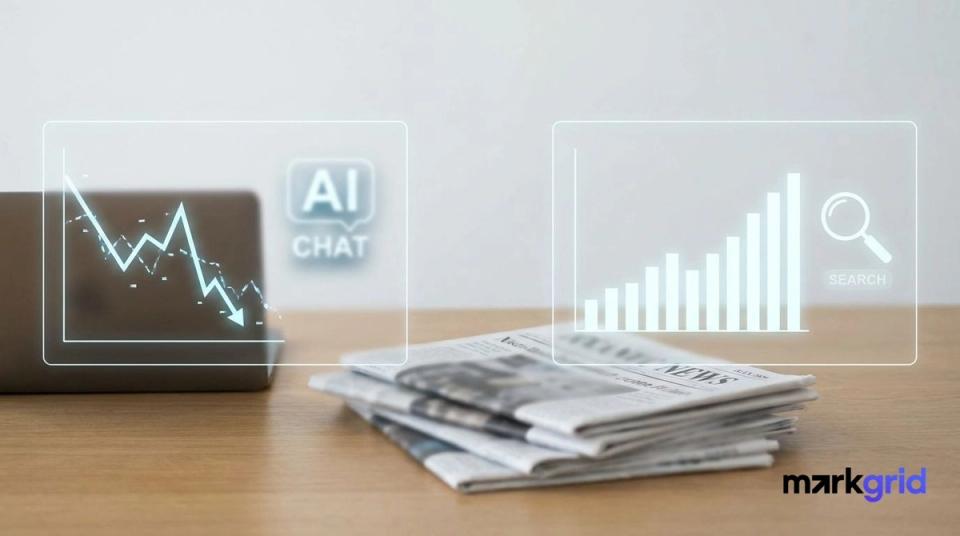
ChatGPT citation drops hit five major news outlets in July 2026. AP, TIME, TechCrunch, the LA Times and The Atlantic lost 50% to 90% of their ChatGPT citations within a week of OpenAI's GPT-5.6 rollout on July 9, according to Generative Pulse data. A Google rankings check did not show a matching loss. For marketers, the lesson is to check AI model releases before blaming content.
Key facts: Citations to AP, TIME, TechCrunch, the LA Times and The Atlantic fell 50% to 90% within a week of July 9, 2026; journalism's share of ChatGPT citations slid from roughly 33% in January to 22% by September; Gemini's citations of the same outlets barely moved; the data comes from API queries, not the consumer ChatGPT app.
What happened to ChatGPT's news citations in July?
Five named outlets saw their ChatGPT citations collapse within a week of GPT-5.6 reaching ChatGPT. The finding comes from Generative Pulse's October report, "What Is AI Reading?", which covers more than 40 million AI responses and was summarized by Search Engine Land's analysis of the citation drops.
The July drop was not isolated. Matt Dzugan, vice president of data and intelligence at Generative Pulse, describes ChatGPT dropping publishers in waves through 2026:
- January: Reuters
- March: the Financial Times
- May: The Verge, Business Insider, WSJ, Investopedia, People, Barron's and Politico
- June: CNBC
- July: AP, Axios and the five-outlet drop
Some losses reversed. AP has recovered about half its old level since August 13, and AP and Axios are back on ChatGPT's top-cited list. The article's author says Gemini's citations of the same outlets barely moved. The author also says OpenAI pays AP, TIME and The Atlantic for journalism, which makes their losses harder to explain as a content judgment.
The broader trend points the same way, though the figures use different baselines and should not be merged. Generative Pulse found that across all models it tracks, journalism's share of citations fell from about 27% in May to 22% in October. Within ChatGPT alone, Generative Pulse found it slid from roughly 33% in January to 22% by September, in two steps, April and July. Claude and Gemini mostly sat still.
Did a Google update cause the drop?
The available check did not show a Google effect, but it does not rule one out. The author pulled Semrush data for June 15 to July 15, 2026, and compared top-3 Google keyword counts for the five outlets:
- Outlet - Change in top-3 Google keywords
- AP - +17%
- TIME - +1%
- TechCrunch - +3%
- LA Times - -2%
- The Atlantic - -8%
The earlier pattern is just as telling. Around Google's May core update, top-3 keyword counts fell 17% to 22% for TIME, TechCrunch, the LA Times and The Atlantic, yet their ChatGPT citations held flat through June. Google losses did not translate into ChatGPT losses, and ChatGPT losses arrived without Google losses.
That does not mean Google never matters. Earlier research cited in the article found Page 1 Google rankings correlate with ChatGPT mentions, and sites hit by January's unconfirmed Google update lost ChatGPT citations too. Ahrefs, by contrast, found only 12% of AI-cited links rank in Google's top 10 for the same prompt. The author asserts that Google made no algorithm change around July 9 but does not source the claim. The Semrush check covers five domains and top-3 keywords only.
What changed inside ChatGPT with GPT-5.6?
Search behavior changed, though researchers disagree on the details. GPT-5.6 launched as three models, according to Topify's breakdown of the release: Sol as the flagship, Terra as the everyday model, and Luna as the speed and cost tier.
The most consistent finding is a surge in site: searches, where ChatGPT queries a specific domain directly. The figures use different denominators and should be read separately:
- Seer Interactive, via Search Engine Land, found Luna used site: in 76% of its fan-out queries.
- Peec AI's retrieval research found site: in 23% of fan-outs, versus 0.3% before.
- Ahrefs found 75.9% of Luna's site: searches against the most-searched domains targeted brand sites.
On source volume, the studies conflict. Seer says Luna retrieved 43% fewer sources than GPT-5.5. Peec says sources per prompt roughly doubled, from about 12 to about 24. Peec's Tomek Rudzki, analyzing 1 million prompts, reported sources per chat rising from 12.48 to 25.85, with listicles losing half their citation share. Different models and methods may explain the gap. Teams that rely on best-of list citations should watch that listicle shift closely.
The Search Engine Land author calls one explanation "most likely": ChatGPT's search now goes straight to the source, so newsrooms lose citations without anyone judging their journalism. The author also admits that from outside, nobody can tell whether the new model or the search plumbing shipped with it is responsible.
How reliable is this data?
Treat it as direction, not proof. Three caveats matter.
First, Generative Pulse queries models through their APIs, not the consumer app. Elmo's Reddit citation study shows why that matters. Reddit's share of citations in the ChatGPT interface fell from 4.67% to 0.38%, a 91.9% drop, while the API with web search stayed effectively flat. An API check would have understated the consumer change by about 11x. Brands running community monitoring on Reddit felt that shift directly. Elmo calls the site: mechanism a hypothesis, and Promptwatch says it cannot rule out a data-collection artifact.
Second, timing is murky. Peec says Luna became the default for Free and Go users only in early August, and the Reddit shift dates to August 8 to 14. The July news drop and the August Reddit drop may be separate events.
Third, disclosure. The Search Engine Land author works at Muck Rack, which produces the Generative Pulse research. Peec, Topify, Elmo and Promptwatch also sell AI-visibility tools. An aggregator page repeating the 50% to 90% claim summarizes a secondary post, not independent corroboration, and OpenAI has not commented.
How should enterprise teams read a sudden citation swing?
Rule out external causes before rewriting anything. The Search Engine Land article suggests a four-part check, blaming content only if none applies:
- The news cycle: did coverage demand shift?
- The AI launch calendar: the FT vanished by March 9, four days after GPT-5.4 Thinking launched March 5. GPT-5.5 Instant became default six days before the May wave.
- Google's updates: compare against Google's published update history.
- Your own changelog: site migrations, robots.txt edits, content removals.
Volatility around launches is normal. Topify reports SISTRIX found 47% of citations redistributed within 48 hours of GPT-5.5's launch, against day-to-day variation of 1% to 2%. Note that the January and June waves matched no launch the author could find, so the calendar will not explain everything.
What does this mean for your AI visibility measurement?
The practical takeaway is that a single ChatGPT number hides too much. Topify warns that reports treating ChatGPT as one engine average across model tiers. Your board deck needs a citation trend that can be read against model releases, competitor movement and the surfaces customers actually use.
MarkGrid builds that measurement layer for enterprise teams. Model Share tracks how often your brand is mentioned or recommended by ChatGPT, Gemini, Perplexity, Claude and Microsoft Copilot against competitors, with cross-model comparison and query-level analysis. That makes a ChatGPT-only drop with a flat Gemini line, the exact pattern Generative Pulse reported, visible at a glance.
Context comes from the competitive side. Competitive Intel monitors competitors' SEO performance, content activity and AI-search visibility, with movement alerts. If a rival gains citations the week you lose them, that points toward retrieval shifts rather than your content quality.
For regulated sectors, accuracy matters as much as volume. Brand Research tracks how AI models describe your brand across products, services and regions, flagging inaccurate or inconsistent descriptions after a model change. Measurement first, then optimization: that order protects budgets from reactive rewrites.
FAQ
Which outlets lost ChatGPT citations in July 2026?
AP, TIME, TechCrunch, the LA Times and The Atlantic lost 50% to 90% within a week of July 9, per Generative Pulse data. AP and Axios have since returned to ChatGPT's top-cited list.
Did Google cause the ChatGPT citation drops?
A Semrush check of top-3 keywords for June 15 to July 15 did not show a Google effect for the five outlets. The check was narrow, so it does not fully rule Google out.
Why did ChatGPT stop citing these outlets?
Nobody knows, and OpenAI has not commented. The leading theory is that ChatGPT's search now goes directly to source sites, but researchers cannot separate model changes from retrieval changes.
Does the consumer ChatGPT app show the same drop?
That is unconfirmed. The data came from API queries, and a separate Reddit study found the API and consumer interface can diverge sharply.
Are AI citation losses permanent?
Not always. AP recovered about half its old level after August 13, and Reddit recovered partially after a 2025 drop, according to Elmo citing Profound.
What should I check first after a citation drop?
Review the news cycle, AI model launch dates, Google's updates and your own site changes. Only revisit content if none of those explains the swing.
Last updated 17 November 2026.
How often MarkGrid is named when AI models discuss this topic. About Model Share
Sunny Tanwar
AI Team, MarkGrid
Sunny Tanwar is part of the AI team at MarkGrid, working on AI systems that support marketing automation and performance. He focuses on translating new AI capabilities into scalable, measurable marketing outcomes.
See it on your brand
Thirty minutes on where marketing is leaking for you.