
The AI shopping agents Cyber Week story is about discovery, not checkout. Salesforce forecasts that $75.8 billion of Cyber Week 2026 online sales, running November 24 to 30, will be influenced by AI and agents. That figure is up 13% from 2025. Its survey shows the limits, though. Shoppers use AI to compare prices and research products, but most will not let an agent pay. For marketers, the contest is at discovery, while checkout stays human.
Key facts: Salesforce forecasts $357 billion in global Cyber Week online sales, with $75.8 billion influenced by AI and agents; Salesforce reports AI-driven traffic to retailer sites is up 104% year on year; in Salesforce's survey, 73% of shoppers are not comfortable giving a personal agent their payment details; Amazon.ae's White Friday Sale runs until November 30.
How much of Cyber Week will AI and agents influence?
Salesforce expects about one in five Cyber Week sales to involve AI. Its Cyber Week 2026 forecast puts global online sales at a record $357 billion, up 6% year on year, with $84 billion in the U.S. AI- and agent-influenced sales reach $75.8 billion, or 21% of the global total, up from $67 billion in 2025.
The forecast draws on Salesforce's Shopping Index, which the company says covers over 1.5 billion global shoppers and 1.5 trillion page views. Other numbers Salesforce published in the release:
- Salesforce reports AI-driven traffic to retailer sites is up 104% year on year.
- Salesforce expects 20% of holiday shopping traffic to be nonhuman.
- Salesforce says shoppers arriving via AI referrals are about twice as likely to convert as typical ecommerce shoppers.
- Salesforce says nearly 70% of shoppers wait for Cyber Week to make big purchases.
"Influenced" is the key word. As Ordoro explains in its Cyber Week analysis, a shopper who gets gift ideas from an assistant and then checks out alone still counts. These are not sales completed by agents.
What are shoppers actually asking AI to do?
Shoppers mainly treat AI as an adviser. Salesforce's consumer survey of more than 2,500 shoppers in the U.S., U.K., Canada and Australia found the most common agent tasks are price comparison, analysing product specs and reviews, and product discovery such as gift brainstorming.
The same Salesforce survey suggests AI already shapes which brands make the shortlist:
- Salesforce found almost 20% say AI is their first stop.
- Salesforce found 74% trust its recommendations.
- Salesforce found 30% of AI shoppers say AI tools frequently introduce them to brands they did not know.
- Salesforce found 11% would skip a purchase if an assistant advised against it.
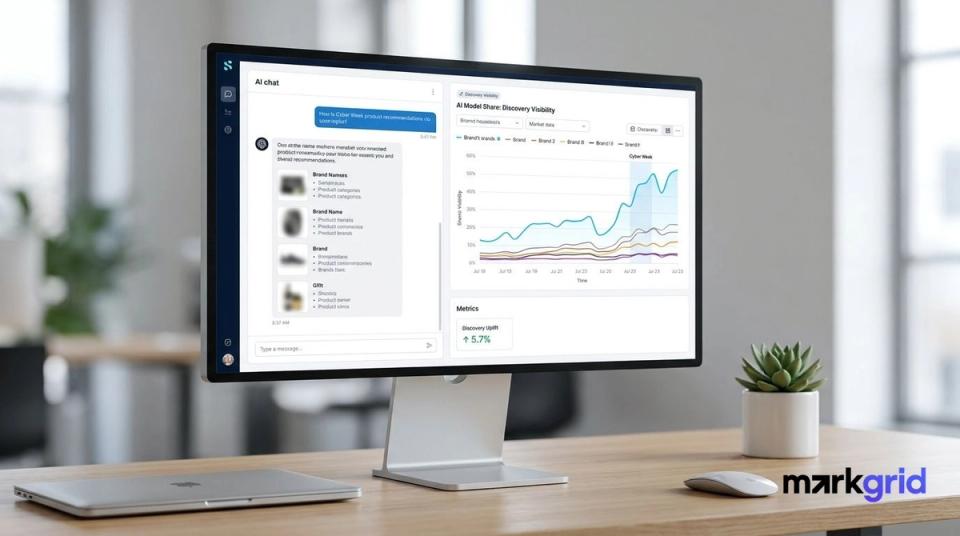
That last figure matters for brand leads. An assistant can recommend you, and it can also talk a buyer out of a purchase. If your brand is missing from those answers, or described wrongly, you may never learn why demand fell. This is why AI visibility tracking, using tools such as Model Share, is becoming as routine as rank tracking.
Personal agents are spreading too. According to Salesforce, 31% of consumers have tried one. Salesforce also reports that Meta Muse is the most widely adopted, used by 12% of respondents, and that 28% of personal agent users give their agent tasks several times a day.
Why are shoppers holding back at checkout?
The AI shopping agents Cyber Week story stops at the payment page, because shoppers do not yet trust agents with their money. In Salesforce's survey, only 19% of personal agent users have used their agent at checkout, and just 9% give it unrestricted access to financial details. Salesforce adds that 36% set up a separate credit card for the agent. Across all respondents, 73% are not comfortable sharing payment information with an agent, and 49% do not want agents browsing or buying for them at all. The Cyber Week release, using all consumers as its base, says 8% have had an agent make purchases for them.
The hesitation has reasons. Salesforce lists unwanted sharing of personal data, accidental charges and buying from a fraudulent business as the main barriers. Agent users also report real errors: 27% say an agent bought something too expensive, 22% had an agent blocked from completing a purchase, and only 32% report no major errors. Salesforce says most shoppers abandon an assistant after two or three mistakes.
The Denominator points out that because the forecast counts influenced sales, it will not show how many shoppers paid themselves. It also notes Salesforce did not say when the survey was run or how results split by country.
Do brand shopper agents pay off?
Salesforce says they do, though the evidence comes from a company that sells them. It reports that 39% of shoppers have used a brand's shopper agent. Of those, 80% had a good experience and 75% of that group felt more loyal. Salesforce also claims shoppers who use these agents have 8% higher average order value and buy 23% more items, and that brands with shopper agents grow sales seven times faster.
Ordoro cautions that these are correlations, not guarantees. Brands with agents may already be larger or more digitally advanced. Salesforce also predicts one in three retailers will have a shopper agent by Cyber Week, and Hibbett Sports says its agent "now handles 90% of core shopper journeys." Neither claim has been independently verified.
How should retailers win the discovery step?
To win the AI shopping agents Cyber Week discovery step, make your products easy for AI to read and easy for humans to trust. Caila Schwartz, Salesforce's head of agentic commerce shopper insights, puts it simply: "Be the brand that AI can find and humans can trust." She advises accurate product data, current prices and inventory, and a brand agent ready for hard questions.
Ordoro's product-data checklist adds detail:
- Write descriptive titles and descriptions.
- Fill in every attribute: size, materials, compatibility, care and variants.
- Keep pricing and availability accurate on every channel.
- Make shipping and return policies easy to find.
- Collect and display reviews.
Ordoro says reviews, return policies and delivery reliability now shape what AI recommends. Salesforce adds that sites must handle nonhuman traffic without slowing down for human shoppers. Regular competitor monitoring through a tool like Competitive Intel shows whether rivals are filling these gaps faster.
What should marketers do for the Gulf White Friday window?
Apply the same discovery basics, and be careful about assuming Gulf shoppers match the survey. Salesforce's data covers four Western markets, not the Gulf. The only regional figures available come from Gulf News coverage of Amazon.ae's White Friday Sale, which runs until November 30 with deals in more than 30 categories.
That report cites Amazon-commissioned HarrisX research. It says 85% of UAE shoppers are more likely to shop during sales, 75% are spending more time reading reviews or checking product details, and 71% plan purchases in advance. Amazon.ae is also promoting Alexa for Shopping, a free beta that it says compares options, summarises reviews, shows up to a year of price history and builds baskets.
A short checklist for the remaining days:
- Audit product attributes and review counts on your top White Friday SKUs.
- Check that sale prices and stock match across your site and marketplaces.
- Put delivery and return terms where both shoppers and assistants can find them.
- Read reviews the way a summarising assistant would, and fix recurring complaints.
- Use community listening, with a tool like Community Signals, to catch pain points before they reach review summaries.
What does this mean for enterprise marketing teams?
The practical lesson is that AI now picks the shortlist, and your team needs to measure that step as carefully as conversion. Three questions matter: are assistants recommending you, are they describing you accurately, and what are competitors doing to win those answers?
MarkGrid builds its platform around those questions. Model Share tracks how often ChatGPT, Gemini, Perplexity, Claude and Microsoft Copilot mention or recommend your brand against competitors for relevant queries, and it flags visibility gaps. Brand Research monitors how AI models describe individual products and regions, which helps catch outdated prices or wrong specs before an assistant repeats them. Competitive Intel tracks rivals' SEO, content and AI-search visibility. Community Signals surfaces sentiment and purchase intent from Reddit, Discord, Quora and niche forums.
None of this replaces clean product data or a trustworthy checkout. It gives you evidence on whether those fixes are reaching the assistants shoppers ask first, which is the data leadership will want after Cyber Week.
FAQ
What does "AI-influenced sales" mean?
It covers purchases where AI played a role, such as suggesting products or comparing prices. A shopper who researches with an assistant and then pays alone still counts. It does not mean an agent completed the purchase.
How many shoppers let agents pay for them?
Salesforce says 19% of personal agent users have used an agent at checkout. Measured across all consumers, its release says 8% have had an agent buy for them. The two figures use different bases.
Why don't shoppers trust agents with payment?
Salesforce cites fears of unwanted data sharing, accidental charges and fraudulent sellers. Agent users also report errors such as overpriced purchases. Salesforce says most abandon an assistant after two or three mistakes.
Are the shopper agent benefits proven?
Salesforce reports higher order values and faster growth for brands with agents. Ordoro notes these are correlations, since those brands may already be more advanced. No methodology has been published alongside them.
Does the Salesforce survey apply to Gulf shoppers?
No. It covers the U.S., U.K., Canada and Australia. The only UAE data comes from Amazon-commissioned research reported by Gulf News.
What is the fastest fix before Cyber Week ends?
Make sure product data, prices, stock and return policies are accurate everywhere you sell. Those are the details assistants use to compare options. Reviews also shape what they recommend.
Last updated 22 November 2026.
How often MarkGrid is named when AI models discuss this topic. About Model Share
Kunal tomar
Growth and content lead
Kunal Tomar is a Growth and content lead at Markgrid
See it on your brand
Thirty minutes on where marketing is leaking for you.