
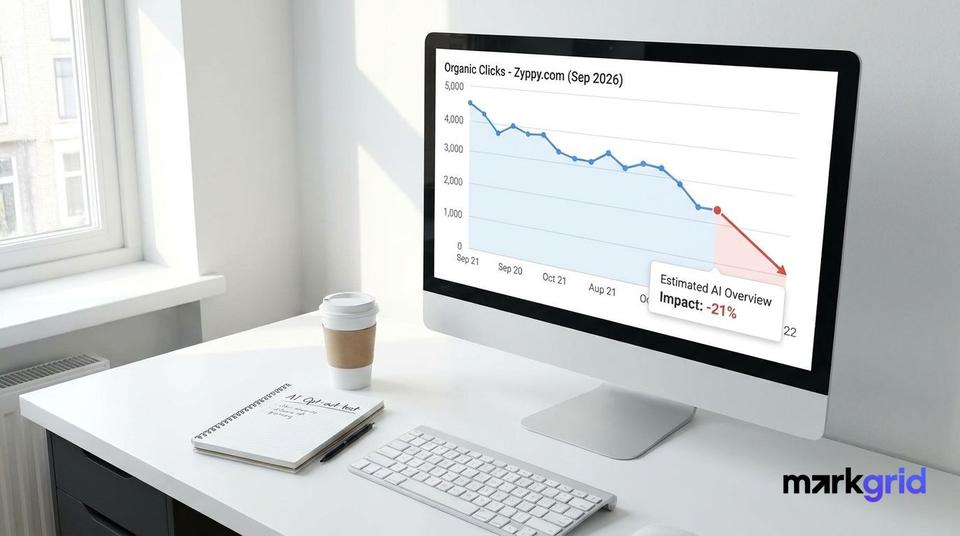
SEO consultant Cyrus Shepard used the Google AI Overviews opt-out on Zyppy's site for four weeks in September 2026, then opted back in. He estimates AI Overviews and AI Mode drove about 21% of the site's Google clicks. For enterprise SEO teams weighing the control, the single-site test is a warning, not a verdict. Google's own click data is still due.
Key facts: Shepard estimates about 21% of Zyppy's Google clicks came from AI Overviews and AI Mode; the opt-out control has been available to all websites worldwide since Aug. 31, 2026; Search Console counts AI feature clicks as standard clicks; the UK CMA deadline for Google to provide AI click data is Dec. 3, 2026.
What did the Zyppy test find?
Excluding the site from Google's AI features appears to have cost it roughly a fifth of its Google clicks. Shepard, founder of Zyppy SEO, switched on Search Console's Search generative AI control on Sept. 1, 2026 and reversed it on Sept. 29, Search Engine Journal reports.
The headline findings, all Shepard's estimates:
- About 21% of Google clicks came from AI Overviews and AI Mode.
- About 23% once a small lift in regular-listing clicks, which he attributes to AI visibility, is added.
- AI impression CTR of about 0.9%, with 0.7% to 1.1% described as a reasonable range, against a site average near 0.4%.
- Fast removal: the site vanished from AI features in under an hour, and AI impressions returned almost as quickly after opting back in.
One example stands out. In a sample search, the site held the No. 1 standard result yet did not appear in the AI features at all, not even as a link. Ranking first did not protect it.
Shepard's conclusion: Zyppy is staying opted in, calling AI citations work "the only reasonable action to take."
How was the 21% estimated, and how solid is it?
The figure is a derived estimate, not a measured count of AI clicks. Shepard compared total clicks in the 28 days opted out with the following 28 days opted in, and says he used the same searches and positions to limit ranking and query changes. When he first shared the result on LinkedIn, Search Engine Roundtable reported that the CTR figure came from overall site CTR and impressions, minus known AI impressions.
The accounts do not fully agree on the method. Search Engine Roundtable quotes Shepard saying sitewide average position actually rose during the test, driven by new posts and brand searches, with URL-level drops where AI visibility was lost. So position and query mix were not perfectly controlled.
The inputs also differ. Search Engine Roundtable put AI impressions at about 8% of the total; SEJ and Magica say about 10%. That gap matters. By our own rough arithmetic, 10% of impressions at 0.9% CTR against a 0.4% average implies about 22% of clicks, while 8% implies about 18%. Treat 21% as Shepard's estimate, sensitive to which share is right.
Magica's analysis adds further caveats:
- The 0.7% to 1.1% range is not a formal confidence interval.
- No raw click totals or full statistical model were published, so the result cannot be reproduced.
- The 0.4% site CTR includes AI impressions, so the two CTR figures overlap.
- The halo lift, which Magica puts at roughly 2.3%, is unclear on whether it is relative or in percentage points.
Two more cautions are ours, not the sources': the opt-out month always came before the opt-in month, and seasonality was not addressed.
What does the test not prove?
It measures the value of being cited inside AI answers, not the value of search without AI answers. AI Overviews appeared on results pages before, during and after the test. Barry Schwartz notes it does not compare clicks with and without AI Overviews on the page.
Magica adds that the test cannot show whether AI answers raised or lowered publisher traffic overall, and reports Shepard noting that AI answers push regular listings further down.
Shepard himself calls the work "a directional yardstick than Google gospel," and says Zyppy's AI citation optimization may explain its high click share. Magica also points out that Zyppy sells AI-visibility expertise, so it tested a channel central to its own business. Sites with weaker citation performance could see very different numbers, which is why ongoing AI visibility tracking of your own queries matters more than any outside benchmark.
Wider research points the same cautious way. Pew Research Center data from 2025, cited by Magica, found traditional links clicked on 8% of visits to pages with an AI summary versus 15% without. But those are panel page-visit rates, not per-impression CTR, and cannot be compared directly with Zyppy's figures.
Why can't you see your own AI click data yet?
Search Console does not separate AI clicks from regular clicks. SEJ says clicks on AI Overview and AI Mode links are counted as standard clicks, and neither the generative AI performance report documentation nor the Performance report lists a way to split them.
Google's insights currently cover impressions, which pages appear in AI responses and in which countries. Google's announcement says more metrics will follow. It also says opted-out sites "will not receive traffic or impressions" from AI Overviews, AI Mode and AI Overviews in Discover, and that the choice is not a ranking signal elsewhere.
On timing, Google's help center says exclusions generally take several days, which contrasts with Shepard's under-an-hour experience.
The UK CMA set Dec. 3, 2026 as the deadline for Google to give UK publishers AI-feature impressions, clicks and CTR, aggregated across features. As of today, no source confirms the data has arrived, and Google has not said whether it will extend outside the UK.
Why are big publishers holding off?
Most are waiting for data and for finer controls. Digiday reports that the control is bundled: you cannot opt out of one feature and keep another.
- Chris Dicker of Candr Media says publishers are holding off until click data arrives, and are unlikely to test during Black Friday.
- David Buttle of SPUR doubts many will opt out without granular options, and warns Google could boost AI referrals in Discover, which shares the same control.
- Some publishers expect opted-out sites to lose the Top Stories carousel inside AI Overviews. Google has not said.
- The Professional Publishers Association is pressing the CMA for unbundling. Page-level controls are due by March 3, 2027.
The Economist Group's Josh Muncke favors testing and structured, data-driven calls over one in-or-out switch. The Daily Mail's Carly Steven summed up the bind: "It does still matter that we're on the surfaces where users are."
Google, for its part, says AI Overviews has over 2.5 billion monthly users and AI Mode over one billion, figures no other source verifies. Greg Sterling of Near Media argues AI Overviews create brand awareness that leads to later clicks, "not consistently but many times."
How should enterprise teams measure exposure before deciding?
Start with what you can see now. Digital Influence suggests checking what share of impressions the generative AI performance report attributes to AI features, then watching for the Dec. 3 data.
A practical sequence:
- Size your AI impression share by section and country.
- Find pages where you rank well but are not cited, as in Shepard's No. 1 example.
- Benchmark rivals' citations through competitor monitoring, since an opt-out may hand them your AI slots.
- Check accuracy, by auditing how AI answers describe your brand, especially in regulated categories.
- Wait for click data before any test, and avoid peak trading periods.
What this means for your team in practice
For most enterprises, the decision is not ready to make, but the measurement is. The Zyppy test suggests that being cited can carry more click value than impression share implies, and that ranking first does not guarantee a citation. Neither point can be confirmed for your site until you measure it.
MarkGrid is built for this gap. Model Share tracks how often your brand is mentioned or recommended by ChatGPT, Gemini, Perplexity, Claude and Microsoft Copilot against competitors, at query level, with visibility gap detection and AI citation analysis. That gives leadership a baseline before anyone touches the opt-out.
Competitive Intel tracks competitors' SEO performance, content and AI-search visibility, with movement alerts if rivals gain ground. Brand Research flags inaccurate or inconsistent AI descriptions by product and region. SEO Intelligence covers both Google rank tracking and AI citation optimization, the work Shepard credits for Zyppy's result.
Halo effects remain a hypothesis, so look for supporting signals too. Community signals from Reddit, Discord, Quora and forums show whether brand conversation and buyer intent move alongside AI visibility.
FAQ
What is the Google AI Overviews opt-out?
It is a Search Console control that excludes a site from AI Overviews, AI Mode and AI Overviews in Discover. Google began testing it in the UK on Jun. 3, 2026 and made it available worldwide by Aug. 31, 2026.
Does opting out hurt regular rankings?
Google says the control is not a ranking signal outside the AI features. Shepard did, however, report a small drop in regular-listing clicks while opted out, which he links to lost AI visibility.
Does the opt-out stop Google training on my content?
No. According to Magica, AI training has separate controls, and this setting does not cover it.
Can I opt out of AI Mode but keep AI Overviews?
Not currently. The controls are bundled, and publishers are lobbying the CMA for feature-level options, with page-level controls due by March 3, 2027.
Will the 21% figure apply to my site?
Probably not exactly. Shepard says it comes from one site with heavy citation optimization, and other sites could come in higher or lower.
When will AI click data be available?
The CMA deadline for UK publishers is Dec. 3, 2026. Google has not confirmed whether the data will be offered outside the UK.
Last updated 21 November 2026.
How often MarkGrid is named when AI models discuss this topic. About Model Share
Harsh Mishra
AI Team, MarkGrid
Harsh Mishra is part of the AI team at MarkGrid, working on the models and data pipelines behind its marketing intelligence tools. He focuses on making AI insights accurate, explainable, and useful for marketing decisions.
See it on your brand
Thirty minutes on where marketing is leaking for you.