
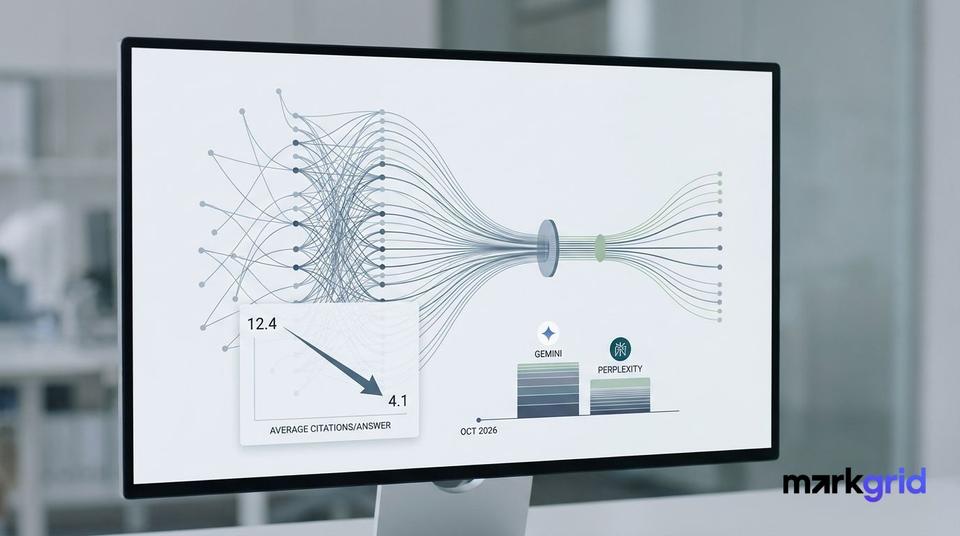
Meltwater's October 2026 report, published 13 November, found that Gemini and Perplexity cut the number of sources they cite per answer. Those AI search citation changes explain much of the month's movement, including a slip in news citations. For marketing leaders, fewer slots per answer can make a citation count for more. It also means AI-visibility reports built on the old link counts need re-baselining.
Key facts: Earned/News fell from 31.1% to 26.8% of the citation mix between the first and second halves of October; Perplexity's Earned/News share dropped 9.7 points, while no other model moved more than 1.3 points; Gemini's Reddit citations fell 88% between the two halves; the dataset covers about 120,000 prompts and 88.6 million citations across eight platforms.
What did Gemini and Perplexity change in October?
Both engines shortened their source lists. Meltwater's October AI search visibility report says the reduced source counts account for much of the month's shift in which domains get cited.
The specific figures come from a secondary summary. Reputation Insider's coverage of the findings reports that:
- Gemini fell from about 9.8 links per answer to 3.7, starting around 15 October, alongside a 66% drop in its total citations in the tracked dataset.
- Perplexity moved earlier, cutting from about 24 links to a maximum of 10 around 6 October.
Readers should treat these numbers with care. They appear in Reputation Insider's summary and have not been checked here against the full Meltwater post. No source explains why either engine made the change.
Did news outlets lose ground in AI answers?
They did in this dataset, but mostly because of one engine. Earned/News, a category covering outlets such as Yahoo and Forbes, fell from 31.1% of the citation mix in 1 to 15 October to 26.8% in 16 to 31 October.
Meltwater breaks that 4.3-point drop into two parts:
- About 1.7 points came from model mix. Perplexity's news-heavy volume shrank while Copilot's grew.
- About 2.6 points came from changes within models, mainly Perplexity, whose Earned/News share fell from 39.2% to 29.5%.
Meltwater is clear about the limits. Because no other model moved Earned/News share by more than 1.3 points, it says it is too early to call the slip a trend. Reputation Insider likewise says the findings do not establish a broad decline in news citations across AI services.
Which other domains won or lost?
The biggest swings showed up at the model level, not in the totals. Meltwater highlights these shifts:
- Reddit in Gemini: citations down 88% between the halves. Reputation Insider puts Reddit's share of Gemini references at 3.6% falling to 1.3%.
- Reddit in Perplexity: share rose from 0.9% to 1.4%.
- Reddit overall: barely moved, from 1.43% to 1.32%.
- LinkedIn in Perplexity: down about 99%. Reputation Insider reports LinkedIn's overall decline was only 7.4%, because other services kept citing it.
Google AI Overviews leaned further into social content, according to Reputation Insider. Social rose from 19.9% to 22.1% of its citations, YouTube from 6.7% to 8.2%, and Facebook from 5.1% to 6.1%.
The Reddit example carries the main lesson. A flat aggregate figure hid an 88% collapse in one engine and a rise in another. Any team reporting a single blended number would have missed both.
Why does a shorter source list raise the stakes?
When an engine shows three or four links instead of ten, each remaining slot represents a larger share of what the reader sees. That is an interpretation, not a finding in the report. Meltwater does not measure traffic or influence, and no source shows that a citation in a short list drives more clicks.
The nearest support is Meltwater's own distinction between volume and share. Its September visibility report notes that when the overall citation pool contracts, a source can receive fewer citations yet account for a larger portion of what remains. The reverse also holds. A domain that drops out of a short list loses a bigger piece of the answer, which makes the loss easier to spot and harder to explain away.
That dynamic plays out at the domain level in the data. Brands face a related problem: engines can draw on content about you without linking your site, a pattern covered in this analysis of why AI engines pick a brand and then skip its site.
How should teams re-baseline AI-visibility reporting?
Start by treating a source-count change as a break in the series, not as a performance result. Meltwater's own report shows why. It expanded from about 4,000 prompts to 120,000, added prompts that name brands, and said month-over-month comparisons with earlier reports would be inaccurate. So it compared the two halves of October instead.
A practical re-baselining approach:
- Mark the change date per engine. Gemini's reported cut lines up with Meltwater's 15 October split. Perplexity's reported cut around 6 October falls inside the "before" window, so that half likely mixes old and new behaviour. No source states this, but teams should check their own data for the same overlap.
- Report share within each model. Copilot's answer volume grew about fourfold, from 253,501 to 1,049,611 answers, lifting raw counts for every source it cites. Meltwater points to within-model share where this matters.
- Separate mix effects from real shifts. Meltwater warns that platforms generating the most citations dominate category percentages. Break blended figures down before drawing conclusions.
- Run prompts more than once. A separate Muck Rack and Generative Pulse study found same-day reruns of one prompt reproduced 41% of cited domains in ChatGPT and 45% in Gemini, against 94% in Perplexity. Single checks are unreliable.
- Do not splice old and new benchmarks. Meltwater's August (29.4%) and September (35.6%) Earned/News figures used the old method and cannot be compared with October's.
Consistent AI visibility tracking by engine and by query makes these breaks visible instead of burying them in an average.
How reliable are these findings?
They are useful signals with clear limits. Meltwater says the results describe its tracked prompts and reporting period. They do not rank trusted sources universally or measure answer quality. Reputation Insider adds that they do not measure website traffic or show the changes will last.
Readers should also note the vendor relationship. Meltwater built the analysis on its own GenAI Lens product, and the report is authored by Nathaniel Pallen, Senior Director, Product Management. The Muck Rack study uses a different method, covers four providers and a September analysis, and says nothing about source-count cuts. Its finding that over 84% of citations come from earned and third-party sources uses a different definition from Meltwater's Earned/News category, so the two should not be compared directly.
The data also contains no brand-level results. It shows domains and categories, not whether specific brands fell out of answers. Answering that question requires your own measurement. Watching rivals through competitor monitoring helps separate an engine change that hit everyone from a loss specific to you.
What does this mean for your AI-visibility program?
The October data points to three practical needs: measure each engine separately, compare yourself with competitors on the same prompts, and check what engines say about you, not just whether they link to you.
MarkGrid's Model Share measures how often a brand is mentioned or recommended by ChatGPT, Gemini, Perplexity, Claude and Microsoft Copilot compared with competing brands, with query-level analysis and cross-model comparison. That per-engine view is what a Gemini-style cut demands. A drop confined to one model points to a platform change. A drop across all five points to something closer to home. Visibility gap detection then shows where competitors are earning the citations you are not.
Competitive Intel tracks competitors' SEO performance, content activity, messaging and AI-search visibility in real time, with movement alerts. When source lists shrink, it shows whether a rival took the remaining slots.
Two other products address the domain shifts in the report. Community Signals analyzes discussions across Reddit, Discord, Quora and specialized forums. With Reddit's citation share swinging sharply by engine, knowing what those communities say about your category matters. Brand Research tracks how AI models describe a brand across products, services and regions, flagging inaccurate information. That is useful when fewer sources feed each answer, and regulated sectors such as fintech and healthcare depend on accuracy. For teams building community programs, community listening is the starting point.
FAQ
Did Gemini and Perplexity really cut their sources?
Meltwater's October report says both engines reduced the number of sources cited per answer. The specific figures, Gemini falling from about 9.8 to 3.7 links and Perplexity from about 24 to a maximum of 10, come from Reputation Insider's summary of the report.
Are AI engines citing less news overall?
Not clearly. Earned/News fell 4.3 points in Meltwater's dataset, but most of that came from Perplexity. Meltwater says it is too early to call the slip a trend.
Why is my AI-visibility benchmark no longer valid?
If an engine changes how many links it shows, before and after figures measure different things. Treat the change date as a break in the series and rebuild comparisons from that point, using share within each model.
Should I compare October's figures with earlier Meltwater reports?
No. Meltwater expanded its prompt set from about 4,000 to 120,000 and added branded prompts. It says month-over-month comparisons with earlier reports would be inaccurate.
Is one test prompt enough to check my visibility?
No. Muck Rack's study found that same-day reruns repeated fewer than half of cited domains in ChatGPT and Gemini. Repeated runs across many prompts give a more reliable picture.
Do shorter source lists send more traffic to cited sites?
No source measures this. Reputation Insider notes the Meltwater findings do not measure website traffic, so any traffic benefit remains unproven.
Last updated 15 November 2026.
How often MarkGrid is named when AI models discuss this topic. About Model Share
Parteek chauhan
Growth Strategist
Parteek Chauhan is a Growth Strategist at Markgrid, turning market insights, audience behaviour and performance data into focused strategies that help brands identify and scale meaningful growth opportunities.
See it on your brand
Thirty minutes on where marketing is leaking for you.