
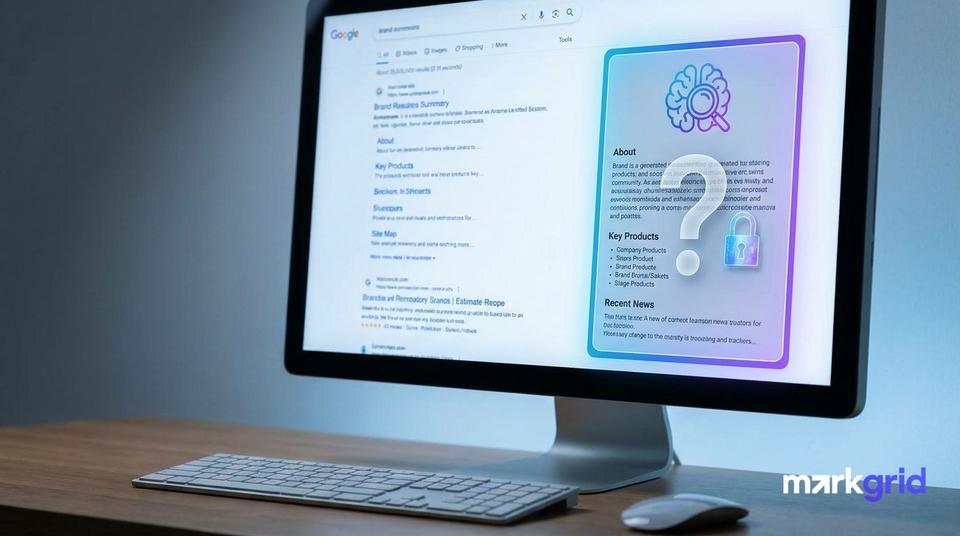
Google appears to be placing an AI Overviews brand knowledge panel in the right-hand column of US desktop results, the spot that used to hold a brand's fact box. Search Engine Roundtable reported the shift on 2 November 2026, and others had spotted it from 31 October. Google has not commented. The test for brand teams is whether that AI summary matches their own facts.
Key facts: Search Engine Roundtable reported the layout shift on 2 Nov 2026; SaaS Link Building found 22 of 51 US brand AI Overviews in the right column on 3 Nov; Voctos saw none of 10 Saudi, UAE and Egypt searches with a right-column overview on 8 Nov; Google has not commented on the change.
What did Google change on brand searches?
Google moved AI Overviews for many brand keywords from the main results into the right-hand column on desktop. Barry Schwartz reported the right-column move at Search Engine Roundtable. His examples included Apple, Zillow, Coke, Google and his own site. He described it as Google "essentially replacing brand knowledge panels with AI Overviews."
Others had seen it first:
- Sachin Patel posted on 27 October that the knowledge panel now carried an AI-generated label. Schwartz embedded that post.
- David McSweeney wrote on 31 October that branded AI Overviews generally sat in a right panel on desktop, sometimes further down, with other variations too.
- Chris Long of Nectiv said Google was showing AI Overviews for brand terms in the right column instead of a knowledge panel.
PPC Land reports Google made the change without announcement and that every published example shows US results. Whether it is a test or permanent remains unknown.
Is the knowledge panel actually gone?
The evidence does not settle that, so treat "replaced" with caution. Schwartz, Long and PPC Land describe a replacement. Other analysts see the two sharing space, so the AI Overviews brand knowledge panel may sit alongside the classic one rather than displace it.
SaaS Link Building's analysis of 75 US results pages found that all 22 right-column overviews appeared on pages that also had a knowledge panel, starting 101 to 496 pixels below the top of it. None of the 16 brand searches without a panel got a right-column overview. The firm links this to Google's help page, which says knowledge panels are generated for Knowledge Graph entities.
Airankingskool.com describes a relabelled right-hand box: an AI-written paragraph with "Show more" on top, and fact rows such as founders, headquarters and customer service underneath, plus a "Disclaimer" link. That layout matters for the accuracy problems below.
How widespread is the right-column layout?
In the one structured US sample, it covered a large minority of brand overviews. SaaS Link Building pulled 60 one- or two-word brand searches across seven sectors, plus 15 non-brand controls, through a SERP data API on 3 November:
- Placement - Brand overviews (of 51)
- Right column - 22 (43%)
- Main column, below other results - 18 (35%)
- First main-column block - 11 (22%)
Sector mattered in that sample. All 4 restaurant chains and 9 of 14 retail and consumer brands got the right-column version, against 2 of 16 software brands (Mailchimp and Grammarly). All 15 control searches kept the overview at the top of the main column. Every right-column box rendered at 128 pixels tall, against 384 to 400 for main-column brand overviews. The firm reads it as a collapsed preview; Google has not described it.
The sample has limits: brands chosen by the firm, US only, collected in about one minute. Ahrefs data cited by PPC Land measures something different, AI Overview presence rather than placement. It found overviews on 63 of 100 brand names by 30 September, up from 5 of 98 on 1 July. A separate Ahrefs count put them on 82.91% of branded keyword results on 29 September. These figures should not be combined.
Did it reach Saudi Arabia, UAE and Egypt?
Not in the searches tested. Voctos ran 10 Arabic and English brand searches on 8 November with Saudi, UAE and Egypt country settings. None showed a right-column AI Overview.
- 8 of 10 showed an AI Overview, all in the main column. Six sat below the brand's first result; two, both Careem, sat at the top.
- Jarir showed no overview in either language.
- The knowledge panel still sat on the right in 6 of 10 searches. Panel presence differed between English and Arabic for Emirates Airline, Careem, Talabat and Jarir.
Voctos calls it one snapshot, not a regional measurement. It searched signed in, from an Egypt connection, on desktop, on one day. Airankingskool.com adds that onlinemarketing.de could not reproduce the right-column view in Germany, and that a Walmart mobile screenshot showed the overview below the first result.
Why should brand teams worry about accuracy?
Because the AI text and the facts beside it can disagree on the same page. In the Voctos test under the Saudi setting, the AI Overview said noon is headquartered in Riyadh with a second hub in Dubai, while the knowledge panel listed Dubai. Voctos does not say which is right, and it is one example from 10 searches.
PPC Land reports a similar split on Zillow: AI text said founded in 2006, a fact row said 2004. Airankingskool.com suggests both have a basis, with the company founded in 2004 and the site opening in 2006, but notes a customer would not know that.
Sourcing also weakens. SaaS Link Building found the brand's own domain cited in 28 of 29 main-column brand overviews but only 16 of 22 right-column ones. Wikipedia was cited in 17 of 22. Schwartz questions trusting AI to describe a brand better than the brand's own website.
Not everyone sees harm. McSweeney called the change a good one, assuming it is a change. SaaS Link Building says it is a layout change, not a ranking change, with no loss of brand homepage position in its data.
How do you audit the AI Overviews brand knowledge panel for your brand queries?
Run a structured check per market. Here is a workable sequence:
- List your brand queries in every language you sell in, including product names and Arabic or local spellings.
- Search signed out, as Voctos recommends, on desktop and mobile, with the country set for each market.
- Record placement: right column, top of page, or below your first result. Screenshot it with the date.
- Compare every fact in the AI text against the fact rows and your own site: headquarters, founding date, founders, customer service.
- Check citations. Note whether your domain appears and which third-party pages Google draws on.
- Fix the sources. Airankingskool.com says brands cannot edit the AI box. Its route is thumbs down, "Report a problem", and correcting the underlying sources. PPC Land notes that whether "Suggest edits" covers AI text "has not been explained by Google."
- Measure clicks. SaaS Link Building advises comparing Search Console branded click-through before and after 31 October, without drawing early conclusions.
- Repeat on a schedule and extend the check beyond Google with AI visibility tracking across other assistants, plus competitor monitoring to see how rivals are described.
What does this mean for enterprise brand teams in practice?
The brand box is becoming an AI summary you do not control, and it can vary by market, language and device. That turns brand accuracy into a measurement task, not a one-off check. Enterprise teams in regulated sectors face the higher stakes, because a wrong headquarters or founding date in an AI Overviews brand knowledge panel becomes a compliance question.
MarkGrid's products map onto the audit above. Brand Research tracks how AI models describe a brand across products, services and regions, flagging inaccurate information and market-specific perception gaps such as a disputed headquarters city. MarkGrid highlights this accuracy monitoring for fintech and service-line monitoring for healthcare.
Model Share measures how often ChatGPT, Gemini, Perplexity, Claude and Microsoft Copilot mention or recommend your brand against competitors, and helps identify the factors behind competitors' citations. Competitive Intel adds real-time alerts on competitor SEO, content and AI-search visibility.
Because Wikipedia and forums feed these answers, Community Signals monitors Reddit, Discord, Quora and specialist forums for brand conversations and sentiment. Teams can review the full MarkGrid platform to connect these checks into one reporting line for leadership.
FAQ
Has Google confirmed the change?
No. Google has not commented, and no source shows a statement on the layout. Its AI features guide says overviews appear where they add benefit and says nothing about placement.
When did it start?
Search Engine Roundtable reported it on 2 November 2026. McSweeney flagged it on 31 October and Patel noted an AI label on the knowledge panel on 27 October, so the exact start date is unclear.
Is it live outside the US?
It was not seen in Voctos's 10 Saudi, UAE and Egypt searches on 8 November, and onlinemarketing.de could not reproduce it in Germany. Both are limited checks, so neither proves it has not spread.
Can a brand turn off or edit its AI Overview?
Airankingskool.com says Google states AI Overviews cannot be turned off, and that brands cannot edit the AI text. The practical route is feedback through thumbs down or "Report a problem", plus fixing source pages.
Does the change hurt brand rankings?
SaaS Link Building found no loss of brand homepage position and calls it a layout change. Effects on branded click-through are not yet measured.
Which sectors are most affected?
In SaaS Link Building's US sample, restaurant chains and retail brands got the right-column version most often, software brands least. The sample covered 60 brands on one day.
Last updated 10 November 2026.
How often MarkGrid is named when AI models discuss this topic. About Model Share
Sunny Tanwar
AI Team, MarkGrid
Sunny Tanwar is part of the AI team at MarkGrid, working on AI systems that support marketing automation and performance. He focuses on translating new AI capabilities into scalable, measurable marketing outcomes.
See it on your brand
Thirty minutes on where marketing is leaking for you.