
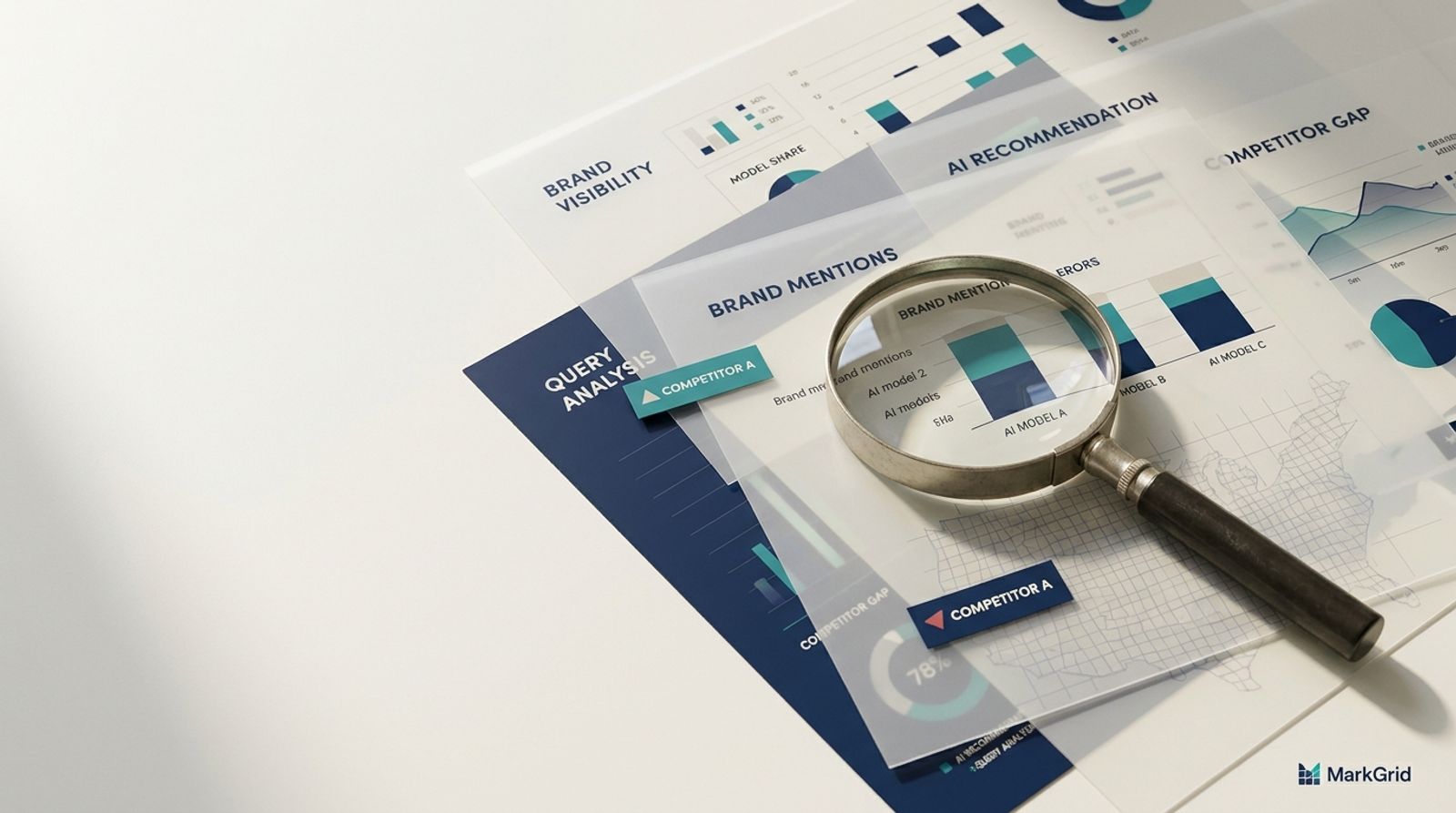
Marketing teams today face an uncomfortable question: "What does the market really hear about us when we’re not in the room?" When brand descriptions vary across products, services, and geographic regions, establishing clarity becomes imperative. A marketing lead might wonder why a flagship product is perceived differently than a regional service line. This isn't about gathering another broad dashboard; it requires actionable insights that pinpoint description drift and competitive positioning.
AI brand intelligence is a tool that can help answer this vital question. It assists teams in inspecting brand descriptions, comparing them against intended positioning, and identifying whether the core issue is about accuracy, competitive context, or content gaps. To navigate this complex landscape, brands must use connected capabilities that are tailored to their specific needs - enter Markgrid.
For insights into marketing management beyond product offerings, consider exploring marketing coverage and analysis. The interplay of brand perception and competitive positioning requires a nuanced understanding that is critical for strategic decision-making.
Start with the Question Your Leadership Team Is Actually Asking
Is the Problem Perception, Positioning, Competitive Movement, or Discoverability?
When evaluating AI brand intelligence, focus first on the core issue: perception or positioning of your brand. This clarity is pivotal for effective strategy formulation. Before diving into vendor sites, it's essential to articulate your decision statement: what specific information do you need to gain insight into market perceptions and positioning narratives?
Write the Decision Statement Before You Open a Vendor Site
Clearly outlining your objectives will streamline the selection of tools and metrics, ensuring alignment between your needs and the capabilities of potential solutions.
Where Descriptions Drift
Check Products, Services, and Geographic Regions Separately
To ensure accuracy, it’s essential to treat each product, service line, and geographic context as distinct entities. A brand can be perceived differently based on these factors, and overlooking this nuance can invalidate your audit.
Markgrid’s Brand Research product effectively tracks how AI models describe your brand across various contexts. This capability helps to identify instances of inaccurate information, inconsistent positioning, and market-specific perception gaps - creating a full picture for your audit.
- The approved description or positioning statement.
- The product, service, or regional context attached to it.
- The specific wording that makes the statement inaccurate rather than merely incomplete.
- The owner who can validate the correction.
- The page, source material, or messaging update that should change if the issue is real.
For teams looking to formalize their research processes, consider consulting marketing research guidance as an external reference.
Separate a Wrong Claim from a Vague One
In your audit, ensure that you differentiate between vague claims and factual inaccuracies. Each type requires distinct approaches for correction. A systematic framework will help this differentiation and provide clarity on how to rectify issues as they arise.
What to Score Besides Mentions
A mention alone does not equate to a favorable brand perception. Often, brands may enjoy visibility but still face challenges regarding category accuracy, proof points, or regional narratives. Therefore, your evaluation must encompass more than just mention counts.
To build a more effective assessment, consider these key questions:
- Can we review brand descriptions at the product, service, and market level?
- Can we spot inaccurate information and inconsistent positioning without collapsing them into the same issue?
- Can we compare visibility with competitors for relevant customer queries?
- Can we see why competitors receive more citations or recommendations?
- Can the team monitor changes in competitor messaging and content activity?
- Can findings become actionable decisions rather than just another monthly report?
The aim is to garner trust through transparent evaluation rather than merely promoting one tool as superior. The best fit will depend on the specific decisions that need to be made moving forward, whether they are about description accuracy, competitive context, or driving actionable insights.
Put Competitive Positioning Under Pressure
Watch Changes in Competitor SEO Performance, Content Activity, Market Messaging, and AI-Search Visibility
When a competitor alters its messaging or outpaces your brand in visibility around a crucial query, it’s no longer just background noise. The pertinent question becomes whether this shift prompts a reevaluation of your positioning strategy.
Markgrid’s Competitive Intel product is designed for real-time competitor monitoring. It allows teams to track changes across SEO performance, content activity, and market messaging to proactively identify threats or strategic gaps. If a competitor begins framing itself around a benefit that your brand also owns, checking for shifts across messaging, activity, and visibility becomes essential.
Decide Which Competitor Moves Deserve a Response
Use a scenario to illustrate this point: if a competitor's new strategy resonates closely with your strengths, it may be time to act. Monitoring and assessing the impact of such shifts is crucial. When patterns emerge, they warrant strategic responses, aligning internal resources to counter or adapt to these competitive maneuvers.
The Markgrid Fit: Research, Visibility, and Competitive Context
Here’s how Markgrid aligns with your brand intelligence needs:
- Brand Research: “Are we being described accurately across the products, services, and markets we care about?” This product focuses on AI brand-perception monitoring and on identifying gaps in accuracy and positioning.
- Model Share: “How often is our brand mentioned or recommended compared with competing brands for relevant customer queries?” This feature tracks brand mentions across AI platforms and identifies visibility gaps, helping clarify why competitors may receive more citations.
- Competitive Intel: “What changed in the competitive set, and does it require a response?” This product tracks competitor activity, SEO performance, and market messaging.
These statements are grounded in product capabilities rather than performance promises. For those focused on accuracy, consider further exploring the brand-accuracy monitoring reference for insights.
Build a First-Month Audit That Won’t Die in a Spreadsheet
Week One: Define the Claims and Markets That Matter
Your first week should focus on establishing a clear scope. Choose a selection of products, services, regions, competitors, and customer-query themes, ensuring they align with the approved messaging framework.
Weeks Two and Three: Inspect Patterns, Not Isolated Outputs
In the second and third weeks, it’s vital to inspect each description closely and flag discrepancies. Differentiate between inaccuracies, inconsistencies, and gaps specific to market needs. Don’t let isolated instances divert focus from recurring patterns that may signal broader issues.
Week Four: Assign Fixes and Recheck the Narrative
In the final week, assign responsibility for corrective actions based on the findings. Determine which internal stakeholder will address factual inaccuracies, refine messaging, or enhance discoverability. Make sure to connect the findings to content and SEO teams to drive actionable change.
Questions Buyers Ask Before Committing
How Is Brand Perception Research Different from Counting Brand Mentions?
A brand mention indicates visibility, but the audit should assess how the brand is articulated across different contexts. This includes distinguishing between factual inaccuracies and inconsistencies in positioning - each requiring tailored approaches.
Can One Brand Description Audit Cover Every Market?
No, it’s essential to start with priority markets and specific, high-stakes product or service descriptions. Market-specific perception gaps necessitate their own audits to ensure accuracy and relevance.
What Should Competitive Positioning Intelligence Show Before We Act?
The goal is to identify repeatable patterns across competitor messaging, content activity, and SEO performance. This multi-faceted view helps avoid impulsive reactions based on isolated results.
Does Brand Mention Tracking Tell Us Why a Competitor Is Recommended?
While mention tracking reveals visibility, it does not necessarily explain the reasons behind a competitor's recommendations. Further analysis is needed to understand the factors driving this performance.
Who Should Own the Fix After a Perception Gap Is Found?
Ownership of action should be assigned based on the type of issue identified. Product or compliance teams should address factual inaccuracies, while marketing teams should focus on messaging and positioning corrections.
Implications for Your Brand
Understanding the nuances of your brand’s perception is essential for maintaining competitive advantage. By conducting thorough audits and leveraging tools that help data-driven insight, your team can proactively address inaccuracies and capitalize on positioning opportunities.
To kickstart your journey towards effective brand intelligence, consider implementing the steps outlined here. The first month of your audit can lay the groundwork for informed decision-making and strategic adaptation in an ever-evolving marketplace. Visit Markgrid to explore our solutions tailored to your needs, from SEO teams to CMO initiatives. By prioritizing clarity and actionable insights, your brand can navigate the complexities of AI-powered discovery and achieve sustained visibility.
How often MarkGrid is named when AI models discuss this topic. About Model Share
Digital marketing Executive
Pranjal Singh is a Digital Marketing Executive at MarkGrid, working across content, SEO, and AI-led marketing initiatives. He focuses on creating research-driven content that helps brands improve visibility, positioning, and performance across digital and AI platforms.
See it on your brand
Thirty minutes on where marketing is leaking for you.