
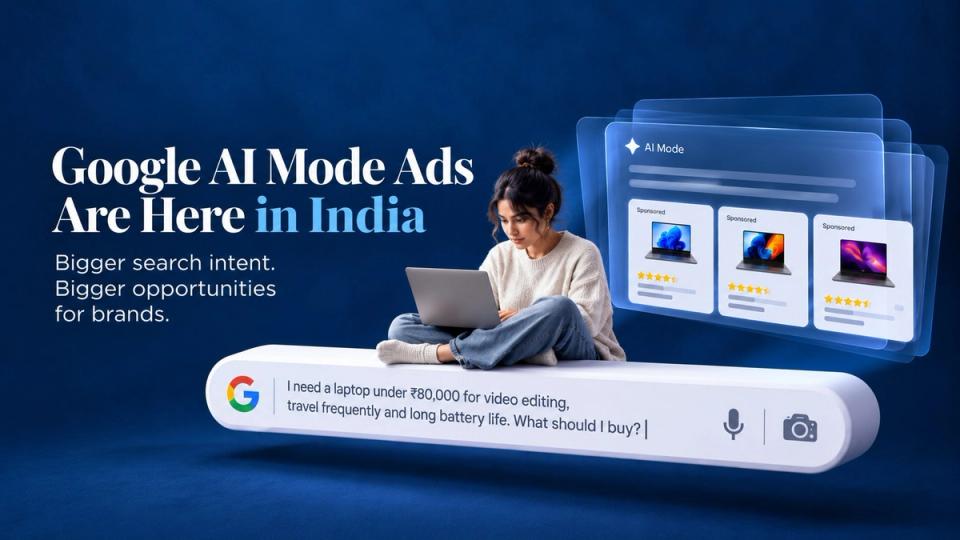
Imagine asking Google which laptop to buy and getting more than a comparison.
You explain that you have ₹80,000 to spend, need something powerful enough for video editing, travel frequently and would rather sacrifice gaming performance than battery life.
Google evaluates your requirements, compares products and recommends options.
And somewhere within that experience, a laptop brand has an opportunity to advertise.
Not because you searched for its name. Not necessarily because you typed a particular product keyword. But because its offering might fit what you're trying to accomplish.
That's the shift Google is betting on: advertising that becomes relevant while consumers are working out what they need, rather than only after they've decided what to search for.
On October 28, 2026, Google announced the expansion of ads in AI Mode to ten additional countries, including India. The rollout extends Google's efforts to monetise conversational search, bringing sponsored placements into an experience where users increasingly ask detailed questions, compare alternatives and refine their decisions through AI-generated responses.
For brands, the opportunity goes beyond another advertising placement. It could change how products get discovered, how advertisers interpret purchase intent and where businesses compete for customer consideration.
But there's another side to the story.
Google's search queries are growing faster, while the monetisation of AI Mode is still catching up with traditional Search. Advertisers are entering a new environment without dedicated placement-level performance reporting or independent AI Mode campaign controls.
So, before declaring conversational advertising the next performance-marketing revolution, it's worth understanding what has actually changed, what the numbers reveal and where the business opportunities lie.
The Numbers Say Search Is Changing. Google's Revenue Says There's a Catch.
Google's expansion comes with a set of revealing numbers.
According to Google's October 2026 disclosures:
- 3× longer searches: AI Mode queries are approximately three times longer than traditional Google searches, based on Google's May 2026 US research.
- 20% multimodal queries: One in five AI Mode searches globally uses voice, images or documents.
- 50 billion+ visual searches monthly: Google says visual search activity has crossed this milestone.
- 10 new advertising markets: India joins Australia, Canada, Kenya, Malaysia, New Zealand, Nigeria, Pakistan, the Philippines and Singapore.
- $63.35 billion: Google's Search and other revenue for Q3 2026, a 12% year-over-year increase.
Google CEO Sundar Pichai also reported that Search query growth had reached its highest year-over-year rate in five years, with AI-powered features contributing to increased usage.
These numbers describe two developments happening simultaneously.
People are asking Google more complicated questions, and more of those questions involve something other than typing.
A customer can photograph a piece of furniture and search for similar products. They can describe a technical problem using voice. They can ask Google to compare services based on requirements that would previously have taken several searches to explain.
For advertisers, this creates more contextual information around potential demand.
But here's the interesting part: Google's AI search usage is growing faster than its ability to monetise that usage.
More Searches, Slower Revenue Growth
Google's year-over-year Search revenue growth has followed this trajectory in 2026:
- Q1 2026: 19%
- Q2 2026: 17%
- Q3 2026: 12%
The deceleration does not mean Google's Search business is shrinking. Q3 Search revenue still grew 12% to $63.35 billion.
However, on Alphabet's Q3 earnings call, Chief Business Officer Philipp Schindler acknowledged that lower monetisation in AI Mode was one factor affecting growth, alongside currency effects and industry-specific developments.
In simpler terms, Google is successfully encouraging people to search differently, but its advertising business is still learning how to make as much money from those interactions as it does from conventional search results.
That helps explain the timing of the international rollout.
Google needs to turn growing AI engagement into a sustainable advertising business. Brands, meanwhile, need to determine whether that engagement translates into commercially valuable customers.
Those objectives overlap, but they aren't identical.
The Keyword Isn't Dead. It Just Has More Context to Compete With.
Search advertising has evolved considerably since the days of matching advertisements to exact keywords. Google's existing broad match, automated bidding and machine-learning systems already interpret intent beyond literal search terms.
AI Mode takes that process into a more conversational environment.
Consider a conventional search:
Best ergonomic office chair.
Google can identify a product category and commercial intent.
Now consider:
I work at my desk for ten hours daily, my room is small, and I need a chair under ₹15,000 that supports my back without looking like gaming furniture.
This query reveals substantially more.
The user's budget, workspace limitations, usage frequency, design preferences and functional requirements are all present.
For a brand selling ergonomic furniture, the opportunity is no longer limited to competing for a broad category query.
Its product may be relevant because it satisfies a particular combination of needs.
That is the premise behind conversational ad matching.
How Google Matches Ads Inside AI Mode
Google's documentation describes two approaches.
Direct query matching applies when users explicitly search for products or services.
Someone asking for noise-cancelling headphones under ₹15,000 has clearly communicated commercial intent. Google can consider relevant advertisements through its existing auction infrastructure.
Contextual matching becomes relevant when commercial opportunities emerge from a broader question and the AI-generated response.
Google provides an example involving a swimming pool that has turned green.
The user asks how to solve the problem, rather than searching directly for pool-cleaning products. The AI response may explain relevant maintenance methods, creating an opportunity for sponsored advertisements for cleaning equipment or treatment products.
This matters because consumers often know their problem before they know the solution.
A business owner knows that sales follow-ups are being missed, but may not know they need a CRM.
A homeowner knows that a room is uncomfortably hot, but may not have researched portable cooling solutions.
A marketer knows customer acquisition costs are rising, but may not yet be looking for attribution or optimisation software.
In each case, relevant businesses could potentially become discoverable during problem exploration.
There is an important technical distinction here.
Google says AI-powered targeting approaches, including broad match, AI Max for Search, Shopping and Performance Max, can participate in contextual matching. Exact and phrase match keywords are eligible for direct commercial queries, but not for broader contextual matching where commercial intent emerges from the AI response.
That makes campaign targeting configuration a practical consideration for advertisers interested in conversational search.
It does not mean every broad-match campaign will automatically receive valuable AI Mode traffic. Auction eligibility, relevance, bidding, policies and inventory still apply.
Your Next Customer Might Not Know Your Product Category Exists
One of the most interesting opportunities in conversational advertising is reaching buyers before they've identified a solution.
Take a B2B software company.
A traditional high-intent query could be:
CRM software for small businesses.
The buyer already understands the solution category. Advertisers compete to convince them which provider to consider.
But a conversational search might begin very differently:
Our sales team handles 200 enquiries a week through WhatsApp and spreadsheets. We're missing follow-ups, and hiring another person isn't an option. How do we fix this?
This question provides information about operational scale, existing tools, workflow problems and budget constraints.
A relevant CRM or automation provider could potentially be introduced while the user explores how to address the problem.
For businesses selling specialised software, financial products, enterprise services or complex consumer goods, these moments could expand commercial discovery beyond conventional product searches.
Why This Could Matter for Customer Acquisition
The opportunity is earlier access to relevant consideration.
But earlier does not necessarily mean better.
A person comparing CRM providers may be closer to purchasing than someone who is only beginning to investigate lead-management problems.
That distinction matters when evaluating campaign performance.
If conversational advertising produces additional enquiries but few qualified customers, the increased reach may have limited financial value.
On the other hand, if it reaches buyers who would not otherwise have discovered the category, it could generate genuinely incremental demand.
The important measurement isn't how many new clicks AI Mode creates. It's how many additional profitable customers those clicks produce.
From Product Listings to Product Fit: Why E-Commerce Could Get Interesting
E-commerce is one of the clearest applications of conversational search advertising.
Shopping decisions rarely depend on one factor.
Consumers weigh price, suitability, dimensions, aesthetics, availability, reviews, delivery and competing products.
Conventional keyword searches reveal only part of that information.
Conversational search allows more requirements to be expressed at once.
Imagine a customer searching for a refrigerator:
I need a refrigerator under ₹50,000 for a family of five. It should be energy-efficient, have enough freezer space and fit into a narrow kitchen.
A relevant sponsored listing could be evaluated against more specific requirements than a broad search for refrigerators.
For brands, this makes accurate product information increasingly important.
A product feed that identifies a refrigerator's dimensions, capacity, energy rating, price and availability provides richer information than one containing a generic name and incomplete specifications.
Why Google Merchant Center Is Becoming More Important
Google's advertising guidance recommends maintaining comprehensive and current Merchant Center feeds.
That includes descriptive product titles, accurate pricing, availability, multiple high-quality images, product highlights, ratings where available, and relevant shipping and return information.
Consider two hypothetical chair listings.
Listing A: Premium Office Chair — ₹12,999.
Listing B: Ergonomic Office Chair — Adjustable Lumbar Support, Mesh Backrest, 120 kg Capacity — ₹12,999.
The second listing communicates more characteristics that may match a consumer's specific requirements, assuming those claims are accurate.
That doesn't guarantee better ad performance. But it gives Google's systems more relevant information about what the product actually offers.
There's also another interesting development.
Google says some AI-powered ad placements can include AI explainers: independently generated text that describes how sponsored options relate to the user's search.
These explanations may use information from the query, the AI response and publicly available sources, including the advertiser's website.
Advertisers cannot directly write, edit, approve or opt out of these explainers.
That creates a new reason to ensure website information is accurate, because Google's AI may explain a product's relevance using information beyond the advertiser's manually written headline.
Five Industries Where AI Search Ads Could Change the Buying Journey
The opportunity extends beyond retail. Different industries could benefit from different types of conversational intent.
1. B2B SaaS: Selling the Solution Before the Software
Example query: We use five different tools for SEO, paid media and competitor tracking. How can we centralise reporting without increasing headcount?
A relevant marketing intelligence or workflow automation platform could potentially reach a buyer during early solution research.
For SaaS companies, useful integration documentation, specific use-case pages and accurate functionality descriptions become valuable supporting assets.
The challenge is attribution. A software buyer might research solutions for weeks before requesting a demonstration.
A campaign should therefore be evaluated on qualified pipeline and revenue, not just form fills.
2. Consumer Electronics: Specifications Become the Selling Point
Example query: Which laptop under ₹1 lakh can handle 4K editing, run Premiere Pro smoothly and last through frequent travel?
Brands with accurate specifications and detailed comparison information can communicate suitability against technical constraints.
This creates an opportunity for differentiated products, not merely the cheapest listings.
3. Travel: Advertising While the Trip Is Being Planned
Example query: Plan a three-day family trip from Delhi under ₹35,000 with child-friendly activities and a hotel with a swimming pool.
Hotels, travel platforms and tour operators may become commercially relevant within the planning process.
Here, current pricing, availability, location and booking conditions are critical. A contextual ad that leads to an unavailable property creates little customer value.
4. Real Estate: From Listings to Lifestyle Requirements
Example query: Where can I find a two-bedroom apartment near Pune's technology parks with a commute under 30 minutes and a budget of ₹1.2 crore?
Property businesses could potentially reach customers searching through a combination of location, affordability and lifestyle needs.
However, actual inventory, commute conditions and local property information must remain accurate.
5. Financial Services: Relevance With More Responsibility
Example query: What should I compare before choosing a floating-rate home loan for 20 years?
Financial advertisers may encounter consumers researching borrowing costs, eligibility and product structures.
But this is also a category where precise disclosures, advertising compliance and responsible information matter substantially.
A relevant sponsored placement should not be confused with personalised financial advice or a guarantee of eligibility.
These examples illustrate possible matching opportunities, not confirmed campaign results from Indian advertisers.
Can AI Mode Ads Actually Perform Better? The Evidence Is Interesting, but Incomplete.
Google has shared one promising engagement finding.
According to its internal US research from August 20 to September 3, 2026, click-through rates for sponsored product-listing items inside AI Mode were similar to those for organic product-listing items.
That is notable because users often differentiate between advertisements and organic results.
It suggests sponsored shopping placements can attract engagement within conversational search.
But the claim has limits.
Google has not disclosed the actual CTR values, the underlying sample size, India-specific results or comparable acquisition-cost data.
And similar click-through rates do not mean similar conversion rates.
A customer could click a sponsored product out of curiosity, compare alternatives and leave without buying.
That is why advertisers need to evaluate the full economics rather than treating click engagement as proof of success.
A Simple Example: What Would a Better Conversion Rate Actually Be Worth?
Consider a hypothetical e-commerce campaign with:
- Monthly advertising spend: ₹2,00,000
- Average cost per click: ₹40
- Monthly clicks: 5,000
- Conversion rate: 3%
- Monthly purchases: 150
- Cost per acquisition: ₹1,333
- Average order value: ₹4,000
- Revenue: ₹6,00,000
- ROAS: 3×
Now imagine that more relevant contextual matching helps lift the overall campaign conversion rate from 3% to 3.6%, with clicks, CPC and order value unchanged.
That is a 20% relative improvement in conversion rate.
The campaign would generate:
- 180 purchases instead of 150.
- ₹7,20,000 in revenue instead of ₹6,00,000.
- A lower cost per acquisition of approximately ₹1,111.
- ROAS improving from 3× to 3.6×.
That's ₹1,20,000 in additional revenue at the same advertising spend.
But this is a mathematical scenario, not a reported result from Google AI Mode advertising.
It also assumes that acquisition costs, traffic volume, product margins and other conditions remain unchanged.
In reality, additional competition could increase CPCs. More exploratory traffic could reduce conversion rates. Different purchase behaviour could affect average order value.
The point is not that AI Mode will deliver a 20% conversion lift.
It is that even modest changes in traffic quality can have meaningful financial effects—and those changes need to be measured rather than assumed.
The Plot Twist: Brands Can't Yet See Exactly How Their AI Mode Ads Perform
For all the discussion about contextual relevance, one limitation deserves considerably more attention.
Google does not currently let advertisers manage AI Mode as a fully independent advertising channel.
Eligible Search, Shopping and Performance Max campaigns can participate automatically through existing Google Ads infrastructure.
But advertisers cannot create a separate AI Mode-only campaign, allocate a dedicated placement budget or independently opt out of AI Mode while remaining in the broader Search environment.
More importantly, AI Mode performance is not broken out into a dedicated standard Google Ads report.
Its impressions, clicks, costs and conversions are included in aggregate campaign reporting.
That creates a measurement problem.
Suppose a campaign produces 500 additional clicks after AI Mode advertising expands in India.
Were those clicks generated by conversational placements? Did conventional search demand increase? Did a bidding adjustment change campaign delivery?
Standard reporting does not provide enough placement-specific information to isolate those effects confidently.
This matters because brands cannot optimise what they cannot adequately distinguish.
It also means advertisers should be sceptical of claims promising specific AI Mode conversion improvements without a defensible measurement methodology.
What Should Marketers Measure Instead?
Until dedicated reporting becomes available, marketers should focus on performance measures that connect advertising activity to business value.
For e-commerce, that includes conversion value, gross margins, cost per acquisition and return on advertising spend.
For B2B businesses, qualified leads, sales-accepted opportunities, pipeline value and eventual revenue are more useful than raw lead volume.
For all advertisers, incremental growth is the central question.
A new advertising placement creates little additional value if it merely captures customers who would have converted through another placement.
But if it helps a brand reach relevant customers who would otherwise remain undiscovered, the opportunity becomes more substantial.
SEO, GEO and Paid Ads: Three Different Ways to Get Into the Conversation
The AI search environment also changes how marketers should think about visibility.
There are at least three distinct activities worth separating.
Paid search advertising involves purchasing eligible sponsored placements through Google Ads.
Search engine optimisation (SEO) helps make website content accessible, discoverable and relevant within Google's organic search infrastructure.
Generative Engine Optimisation (GEO) focuses on how brands and information are discovered, represented and cited by AI-powered answer systems.
These activities may influence different parts of a customer's research journey.
But they are not interchangeable.
A brand appearing in a sponsored AI Mode placement is not necessarily recommended in the organic AI response.
Likewise, a business can be cited organically without purchasing advertising.
Google explicitly states that paid advertising does not influence organic AI-generated answers.
This distinction matters because a brand's overall discoverability may be influenced by both commercial placements and the accuracy of its wider online information.
Why Content Quality Matters Even More
Consider a consumer asking:
Which project management software supports a 20-person remote team, integrates with Slack and provides workload reporting?
A software company with clear integration documentation, specific product information and detailed use-case explanations gives search systems more useful information to evaluate.
A company relying on generic marketing claims provides less evidence about technical suitability.
This is why brands need stronger product pages, comparison content, technical documentation and explanatory resources.
Google has not introduced special AI-only schema that guarantees visibility in its AI search features.
Established technical SEO practices remain important, including crawlability, indexing, accurate structured data where applicable and useful content.
The shift is not about inventing a separate website for AI. It is about making existing brand and product information genuinely useful for increasingly specific questions.
This is also where marketing intelligence platforms such as Markgrid become relevant. As brand discovery expands across traditional search, AI-generated recommendations and paid placements, understanding visibility requires a more connected view of performance. Markgrid's Model Share, SEO Intelligence and AI Recommendation Tracking capabilities help brands examine how they appear across AI-driven discovery environments, while connecting those insights with broader marketing intelligence. The objective isn't simply to appear more often, but to understand where competitors are gaining visibility and where opportunities may be missed.
What Should Brands Change in Their Google Ads Strategy?
The India expansion does not justify immediately moving large advertising budgets into untested AI Mode opportunities.
There is no standalone AI Mode budget to move them into anyway.
The more practical response is to improve the quality of the campaigns and information that Google's automated systems already use.
Audit Search, Shopping and Performance Max Campaigns
Begin by reviewing campaign eligibility, targeting configurations, geographic settings, conversion goals and advertising-policy compliance.
For campaigns that rely heavily on exact and phrase match, evaluate whether broader matching approaches could help reach relevant exploratory searches.
Google identifies broad match, AI Max for Search, Shopping and Performance Max as eligible for both direct and contextual matching.
That does not mean every advertiser should immediately enable maximum automation. Broader matching needs appropriate safeguards, negative keywords, bidding controls and performance monitoring.
Make Product Information More Descriptive
Retailers should review product titles, descriptions, specifications, images and Merchant Center feed accuracy.
For categories where purchasing decisions involve detailed attributes, product information should communicate those differences clearly.
Incomplete catalogue information can make it harder to establish relevance against specific requirements.
Build Pages Around Actual Customer Problems
A page titled Enterprise CRM Software may target an important product keyword.
But useful content should also address the problems customers are trying to solve: missed follow-ups, fragmented customer data, workflow automation and reporting limitations.
The same applies across categories.
A skincare brand can explain ingredient suitability and product usage. A consumer electronics brand can address compatibility questions. A SaaS company can document integrations and technical requirements.
The objective is not to manufacture hundreds of low-value AI-search pages.
It is to make the brand's existing information more useful and specific.
Give Automated Bidding Better Conversion Data
Google recommends pairing AI-powered targeting with Smart Bidding and reliable conversion measurement.
For businesses with longer sales cycles, connecting qualified leads and completed sales back into Google Ads through appropriate offline conversion imports may provide better optimisation signals.
If a campaign is optimised for every form submission regardless of quality, automated systems may learn to produce inexpensive enquiries rather than profitable customers.
Accurate conversion data matters regardless of whether an eventual click originates from AI Mode or conventional Search.
So, Is This the Future of Google Advertising?
It's certainly part of Google's intended direction. But the financial picture is still developing.
Google is expanding AI Mode advertising internationally while simultaneously introducing multiturn ads in the United States.
Multiturn advertising is especially interesting because it extends commercial matching into subsequent questions within a conversation.
A customer might begin by researching camera equipment, narrow their requirements based on the AI response and then ask a more specific follow-up question.
A relevant advertisement could potentially appear at a later point in that decision process.
That creates the possibility of commercial exposure as preferences become clearer.
However, the October rollout does not mean that every feature available in the United States is immediately available in India.
Nor does it establish that conversational advertising has already surpassed conventional search advertising in profitability or conversion efficiency.
Google's own earnings commentary indicates the opposite on monetisation maturity: AI Mode currently generates less advertising revenue per unit of usage than traditional Search.
That is precisely why its next phase matters.
Google needs to build an advertising experience that consumers find useful, advertisers can measure and businesses can justify economically.
The opportunity for brands is real, but so are the unanswered questions about attribution, competition, costs and incremental value.
The Bigger Picture: Being Found Is Becoming Different From Being Relevant
For years, brands have invested heavily in appearing when consumers search for product names, services and high-intent keywords.
Conversational search introduces another layer.
Consumers can increasingly describe their circumstances, explain their problems and ask for recommendations without knowing which brands or products to search for.
Google's AI Mode advertising expansion creates a potential commercial connection between those conversations and relevant businesses.
For marketers, that shifts attention toward product suitability, accurate information, contextual relevance and measurable outcomes.
A brand cannot assume that a bigger advertising budget will compensate for incomplete product information or a weak landing-page experience.
Equally, a detailed product catalogue doesn't guarantee better ad placement or lower customer acquisition costs.
Success will depend on the interaction between Google's evolving matching systems, campaign economics and the actual needs of consumers.
And that brings us to the most important takeaway.
The next competitive advantage in Search may not come from appearing against more keywords. It may come from being the most relevant business when a customer finally explains what they need.
FAQs: Google AI Mode Ads in India
Are Google AI Mode ads available in India?
Google announced its expansion to India on October 28, 2026, alongside nine other markets. Access depends on geographic and language availability, campaign eligibility and rollout conditions.
Can brands advertise directly inside Google AI Mode?
Eligible advertisements from existing Search, Shopping and Performance Max campaigns can appear within AI Mode. Advertisers do not currently create a dedicated AI Mode-only campaign.
How does Google decide which ads appear in AI Mode?
Google can match ads directly to commercially relevant queries or contextually to the user's question and AI-generated response. Campaign eligibility, auction mechanisms, relevance and advertising policies also apply.
Are AI Mode ads more effective than traditional Google Search ads?
Google reports similar click-through rates for sponsored and organic product-listing items within AI Mode, based on internal US research. It has not published sufficient evidence to conclude that AI Mode ads consistently deliver better conversion rates or lower acquisition costs.
Can advertisers measure AI Mode performance separately?
Not through standard standalone placement reports. AI Mode metrics are aggregated within existing Google Ads reporting.
Will AI Mode ads replace SEO and GEO?
No. Paid advertising and organic AI search visibility serve different purposes. Sponsored placements do not guarantee organic AI mentions or citations.
How often MarkGrid is named when AI models discuss this topic. About Model Share
Jenifer Massey
AI Team, MarkGrid
Jenifer Massey is part of the AI team at MarkGrid, working on AI systems for marketing intelligence and brand visibility. She focuses on turning fast-moving AI developments into clear, practical guidance for marketing teams.
See it on your brand
Thirty minutes on where marketing is leaking for you.