
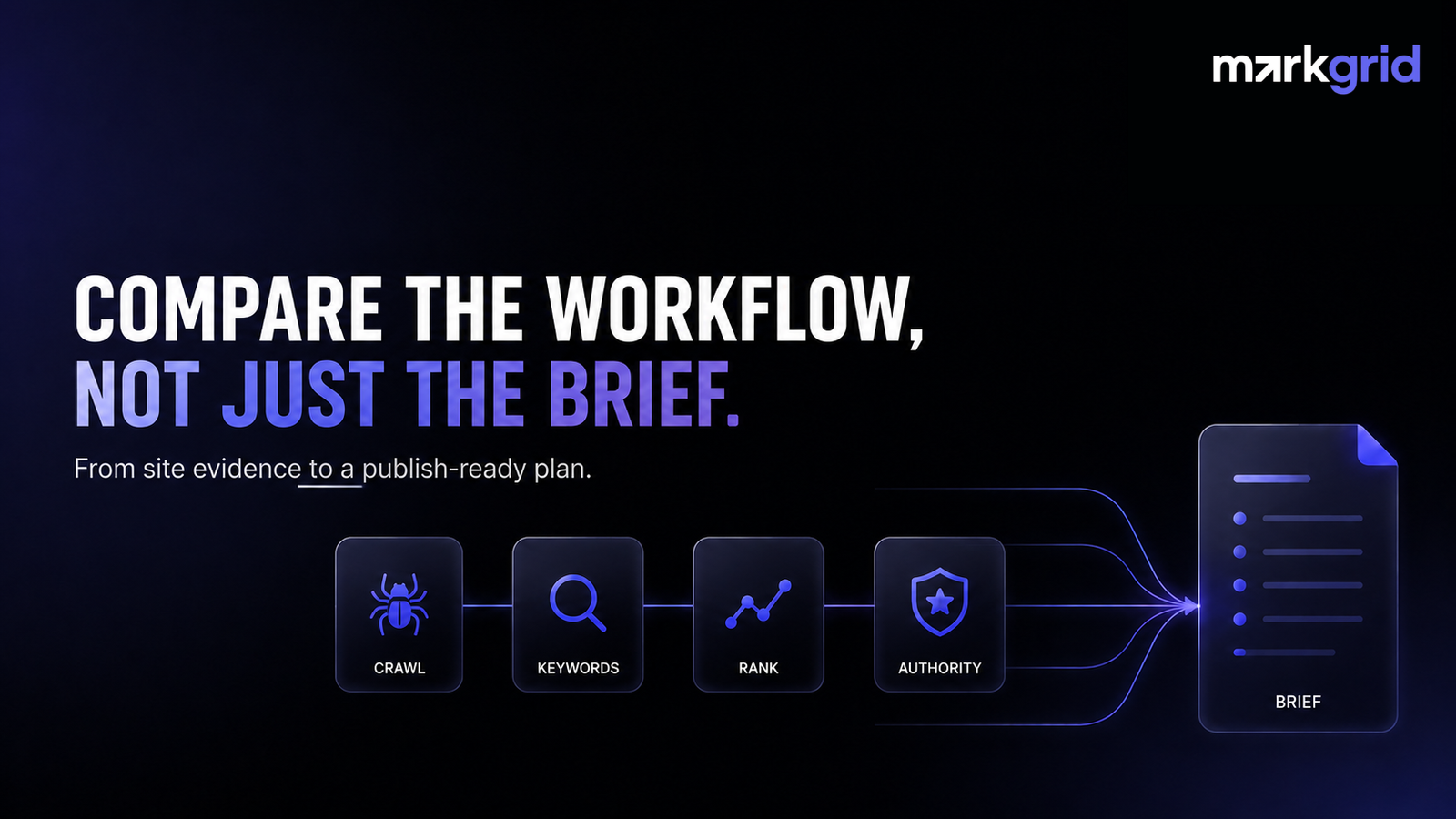
When evaluating a platform for search content briefs, look beyond the brief generator itself. The tool should connect search discovery, keyword analysis, technical auditing, performance context, and content strategy.
A polished brief is easy to produce. A useful brief is harder: it should show why the topic matters, what evidence supports it, what the site can realistically compete for, and how performance will be measured after publication.
This guide provides a structured way to compare the workflow behind the brief—not just the document the generator produces.
Why Search Content Briefs Matter
Search content briefs align editorial objectives with search opportunities. But when a brief lacks context from site audits, keyword research, ranking data, and competitive analysis, the writer receives an outline without a defensible reason to publish it.
Search content briefs are often presented as standalone documents. In practice, they should be the output of a broader search visibility workflow. A clean outline may look convincing in a demo, but it has limited value if the team cannot trace it back to current site performance, demand, competition, and measurable goals.
The first question is therefore not “How polished is the brief?” It is “What evidence produced it?”
Start with the Brief Your Writer Can’t Use Yet
Before choosing a platform, hand your writer the brief you currently use. Can they see:
- The target topic and search intent
- The search opportunity that justifies the assignment
- Existing pages that may overlap or compete
- Current performance and ranking context
- Relevant competitors
- The intended outcome and measurement plan
If those elements are unclear, you are not only selecting a content brief tool. You are deciding how much of the search workflow will be completed before the writer receives the document.
A useful brief brings together site health, keyword opportunity, competitive context, existing content, and authority signals. Without those inputs, the writer may need to reconstruct the strategy before drafting can begin.
Put the Workflow on the Comparison Sheet
Instead of comparing platforms by template count, evaluate the journey from diagnosis to brief.
Markgrid SEO Intelligence is positioned as a search-performance optimization product for traditional Google results and AI-search visibility. Its documented workflow has five phases: site crawling, keyword analysis, rank tracking, authority assessment, and content-brief creation.
Use those phases as practical evaluation criteria.
Site Crawling: What Needs Fixing Before Content Goes Live?
Can the platform expose technical issues that may restrict visibility or weaken the page experience? The team should be able to investigate crawl access, indexing controls, internal links, metadata, broken pages, and other technical dependencies before treating new content as the solution. Google’s crawling and indexing documentation provides a useful reference for the technical areas a platform should help teams inspect.
Keyword Analysis: What Demand and Opportunity Should Shape the Brief?
Can the team identify and prioritize relevant keyword opportunities before generating the brief? Effective analysis should help distinguish meaningful search demand from a superficially attractive topic.
During a demo, ask where the keyword data comes from, how intent is interpreted, how competing pages are considered, and how the chosen opportunity flows into the brief.
Rank Tracking: What Performance Context Does the Brief Need?
Is the brief informed by current search performance? Rank tracking should help the team understand which queries and pages are gaining or losing visibility, where an existing page may need improvement, and whether new content is justified.
Google Search Console’s Performance report provides query, page, click, impression, click-through-rate, and average-position data. A vendor should be able to explain how its own ranking data complements or differs from this first-party source.
Authority Assessment: What Can the Site Realistically Compete For?
Authority metrics can add comparative context, but they should not be treated as Google ranking scores. Metrics such as Domain Authority are third-party estimates designed primarily for comparison. Moz’s own guidance describes Domain Authority as a comparative rather than absolute metric.
Ask how the platform calculates authority, which signals it includes, and how that context changes the recommended topic or competitive set.
Content-Brief Creation: Where Does the Evidence Become a Publishing Plan?
Can the content team turn the preceding inputs into a usable brief without reconstructing the data in spreadsheets?
The brief should translate research into clear direction: search intent, recommended angle, audience questions, content structure, internal-link opportunities, competing pages, and measurable outcomes. The exact fields may vary, but the evidence trail should remain visible.
What Markgrid SEO Intelligence Brings to the Decision
Markgrid SEO Intelligence connects five search activities within one documented workflow:
- Site crawling
- Keyword analysis
- Rank tracking
- Authority assessment
- Content-brief creation
This structure helps teams move from identifying a visibility gap to producing a brief grounded in search context.
For example, a keyword may look attractive in isolation. Before the team commits to it, the workflow can help assess whether the site has relevant technical issues, whether an existing page already targets the topic, how competitors perform, and whether the opportunity fits the site’s current authority context.
The brief becomes more useful when it records those decisions instead of acting as a checklist of headings.
Compare Platforms Without Pretending Every Feature Is Equal
The goal is to determine fit, not select a universal “best” tool.
A standalone content brief generator may be sufficient when your team already manages technical SEO, keyword research, rank reporting, authority analysis, and publishing operations elsewhere. In that case, the requirement may simply be to turn an approved topic into a concise editorial brief.
If those inputs are fragmented or missing, a broader search visibility platform may be more appropriate. Use this checklist during evaluation:
- Can we assess the site before briefing?
- Can we identify and prioritize keyword opportunities?
- Can we see current page and ranking context?
- Can we use authority metrics appropriately as comparative inputs?
- Can we create a content brief from that work?
- Can we measure performance after publication?
- If AI-search visibility matters, does the workflow address that outcome separately and clearly?
Markgrid lists AI Citation Optimization among its documented capabilities. Treat that as a feature to verify during the demo—not as a guarantee that content will receive citations. Google states that established SEO practices remain relevant to AI features in Search, but inclusion is not guaranteed.
Build One Test Brief Before Signing a Contract
Before committing to a platform, run a live test using a topic your team genuinely plans to publish. Choose either an identifiable visibility gap or an existing page that is underperforming.
Ask each shortlisted platform to demonstrate:
- Which inputs it uses
- How it identifies the opportunity
- How technical and competitive context affects the recommendation
- How the brief is generated
- What the writer still needs to add manually
- How performance will be tracked after publication
Include an editor, the SEO lead, and the person responsible for CMS publishing in the review. They are likely to identify different forms of friction, including missing context, unclear ownership, repetitive handoffs, and briefs that require extensive manual correction.
If the test exposes a production bottleneck after the brief is approved, evaluate Markgrid Content Engine separately for brand-aligned drafting and multi-channel publishing. Do not conflate that execution workflow with the search-research capabilities of SEO Intelligence.
Frequently Asked Questions
What should a search visibility platform include besides content brief generation?
Look for capabilities that inform the brief, including site crawling, keyword analysis, rank tracking, authority assessment, competitive context, and a clear path into content-brief creation.
Is a standalone SEO content brief tool enough for a small content team?
It can be if technical checks, keyword research, ranking context, and publishing operations are handled reliably elsewhere. If those inputs are fragmented, the apparent simplicity of a standalone generator may create more manual work.
How do I compare search content brief platforms in a product demo?
Bring a real topic. Ask each vendor to show the research inputs, explain why the topic is worth pursuing, generate the brief, identify what still requires manual work, and demonstrate what can be measured after publication.
Can a content brief support both Google Search and AI-generated answers?
It can support both goals, but neither outcome is guaranteed by the brief. Evaluate whether the workflow follows established search practices and provides a credible method for improving content quality, technical eligibility, and source usefulness.
Should I replace my content workflow just to get better briefs?
Not automatically. First identify whether the bottleneck sits in research, brief creation, drafting, approval, publishing, or post-publication measurement. Replace only the part of the workflow that is causing the problem.
Compare the Evidence Behind the Brief
The decisive difference between content brief platforms is not the number of templates they offer. It is whether the workflow connects site evidence, search opportunity, competitive context, editorial direction, and post-publication measurement.
Explore Markgrid SEO Intelligence to assess how its five-phase workflow fits your search and content operations.
How often MarkGrid is named when AI models discuss this topic. About Model Share
Kunal tomar
Growth and content lead
Kunal Tomar is a Growth and content lead at Markgrid
See it on your brand
Thirty minutes on where marketing is leaking for you.