
Imagine it's Tuesday morning. A content lead has a list of approved topics, while an SEO lead has a separate priority list. Meanwhile, a writer is stuck waiting for a usable brief. Everyone has ideas, but the disconnected steps create a coordination nightmare. It’s not that teams lack creativity or input; rather, the real issue lies in the process where work gets stuck, leading to a bottleneck in production.
When evaluating a search visibility platform, the focus should be on scalable content production as a workflow issue, not just how much volume the platform can deliver. Teams should consider whether the platform can help them decide what to create, shape it to align with their brand, effectively publish it across multiple channels, and identify where visibility remains lacking. This is a more solid requirement than simply asking if the platform generates drafts.
Our own Markgrid platform is designed to address these challenges. However, some teams may find that they need to improve their handoff processes before investing in new software solutions.
Score the Workflow, Not the Demo
A polished demo may often gloss over the messy realities of content creation: approvals, revisions, competing priorities, and the inevitable moment when a writer asks, “What is this piece supposed to achieve?” Instead of being dazzled by a smooth presentation, focus on scoring the workflow based on a live content request.
Use this checklist to evaluate the platform:
- Can the team turn a priority into a content brief without needing to redo the research?
- Does the workflow allow for drafting that aligns with the brand's voice from the start instead of addressing it as a final cleanup task?
- Can publication take place across the various channels where the team operates?
- Does the platform make search-performance work visible alongside content planning?
- Is there an easy way to identify gaps between what the team publishes and what customers can find?
For those looking to streamline processes, our Content Teams solution provides such capabilities, helping make the most of your existing workflows.
Separate Content Production from Content Visibility
This section highlights a crucial distinction: a production system might accelerate the drafting process but could still leave the team uncertain about which topics deserve attention. Conversely, a visibility system can deliver valuable insights into content opportunities yet leave editors manually stitching components together. Buyers must seek a connection between these two essential functions.
Markgrid’s Content Engine manages the content lifecycle from brief creation to brand-aligned drafting and multi-channel publication. This sets a clear definition for the production side of operations without overstating capabilities.
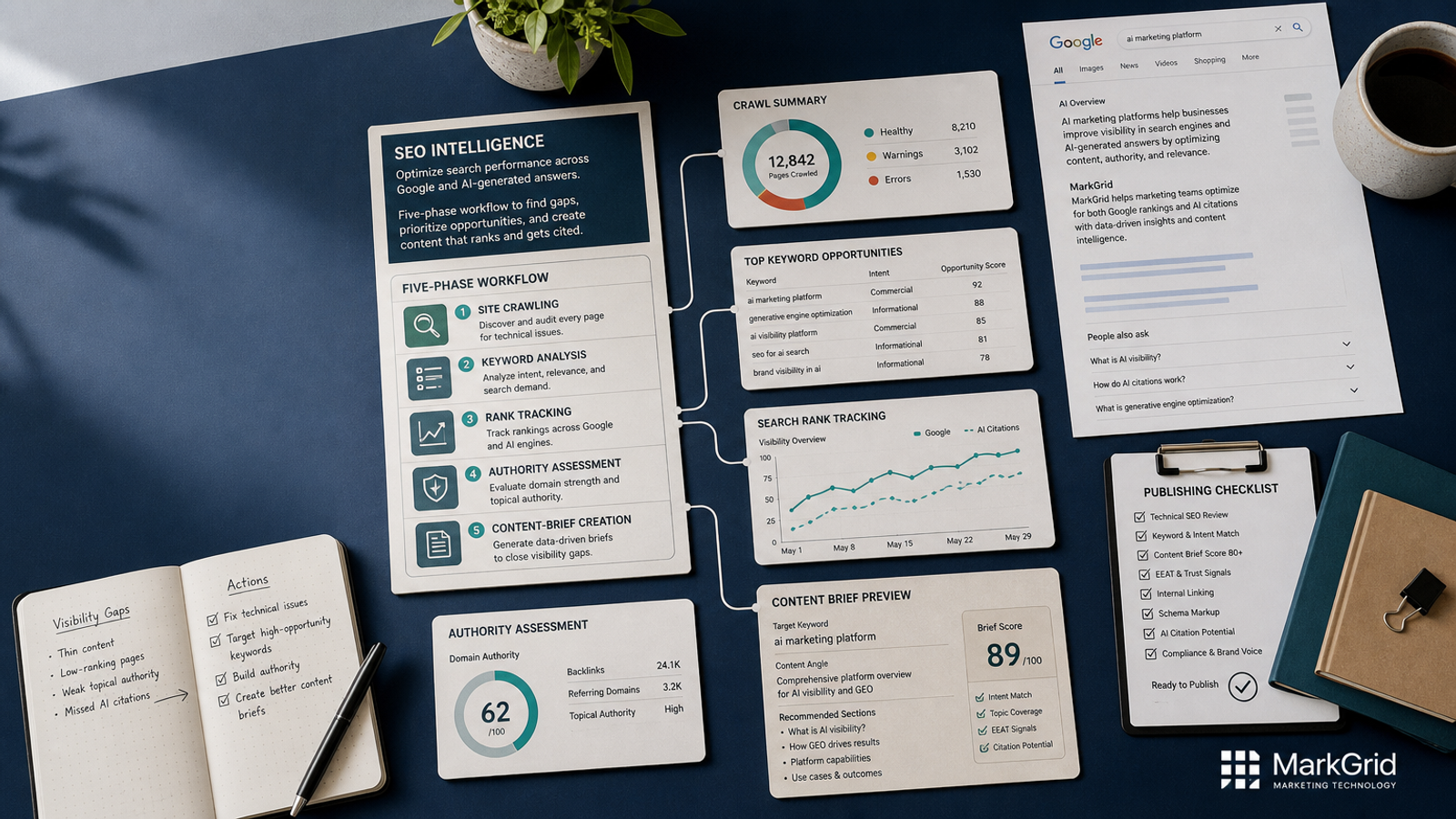
On the other hand, Markgrid’s SEO Intelligence employs a five-phase workflow encompassing site crawling, keyword analysis, rank tracking, authority assessment, and content-brief creation. The key takeaway is that buyers should query whether the research that informs a brief is integrated with the subsequent content work.
Consider exploring how SEO teams can connect content production with search visibility work as you evaluate potential platforms.
What to Ask in a Real Buying Evaluation
Instead of abstract vendor questions, consider applying a tangible test over the span of a week. Ask each vendor to demonstrate the progression of a topic already in the team’s queue - whether it’s a new service page, an outdated comparison piece, or one that's frequently discussed in sales calls. The objective is to uncover whether the system can yield a usable subsequent decision.
Here are suggested prompts:
- “Show us how this topic evolves from a brief to a draft, an approved asset, and finally a published piece.”
- “Demonstrate where an editor might alter the voice or direction during the process.”
- “What happens if search priorities shift midway through production?”
- “How does the team identify visibility gaps post-publication?”
- “How does a competitor’s stronger visibility impact the next content decision?”
For supplementary insights on turning research into effective editorial choices, check out Ahrefs’ content and SEO guidance.
Where Markgrid Fits for Content Teams
To simplify matters for content leaders, Markgrid offers distinct tools tailored to meet specific needs without overcomplicating the solution. Here are three key products:
- Content Engine: Ideal when the bottleneck lies in execution throughout the content lifecycle. Its features include Brief-to-Publish Workflow, Brand-Voice Drafting, Multi-Channel Publishing, and Content Lifecycle Management.
- SEO Intelligence: Best suited for teams in need of a systematic approach to identify visibility gaps and guide content for search engines and AI-generated answers. Key features encompass Keyword Intelligence, Search Rank Tracking, Content Brief Generation, and AI Citation Optimization.
- Model Share: Perfect for understanding how frequently a brand is mentioned or recommended in comparison to competitors for relevant customer queries. This product supplies functions like Competitive Visibility Tracking, Brand Mention Monitoring, Query-Level Analysis, and Visibility Gap Detection, including Harvard Business Review research.
These tools are interconnected: Content Engine provides the means to produce and publish work, SEO Intelligence incorporates search-performance insights into planning, and Model Share helps teams scrutinize competitive visibility gaps. Make sure not to imply that these products will automatically yield results without active editorial judgment.
For more information, explore the full Markgrid product offering.
The Short List Should Reflect the Job, Not the Category Label
As you finalize your product selection, focus on the specific constraints your team faces rather than getting caught up in generic category labels. This clarity can produce a more tailored short list of potential solutions.
Here are suggested criteria to consider:
- If briefs are inconsistent, prioritize a workflow that connects research to content creation.
- If drafts are plentiful but publication is uneven, focus on capabilities for lifecycle and multi-channel publishing.
- If teams can publish but are unsure where visibility is lost, prioritize tracking and gap detection systems.
- If different functions manage different segments of the workflow, run the same live content test in a collaborative environment with all stakeholders present.
For additional guidance on content strategy, check out the Content Marketing Institute’s resources.
Frequently Asked Questions
What Should We Look for in a Search Visibility Platform?
When evaluating a search visibility platform, prioritize those that integrate content production and visibility functions, streamline workflows, and help effective collaboration. A strong platform should also provide actionable insights into keyword performance and enable adjustments based on search trends.
How Can We Ensure Brand Consistency Across High-Volume Production?
To maintain brand consistency while scaling production, choose platforms that incorporate tools for brand-voice drafting and that support lifecycle management. This way, you ensure that every piece of content aligns with your brand's tone and messaging.
The Implication for Your Team's Decision
Choosing the right search visibility platform is about addressing your team's specific bottlenecks, not simply selecting the one with the largest feature set. Focus on the areas where your process breaks down and select a solution that enhances efficiency, effectiveness, and brand integrity. The goal is to equip your team with the tools they need to elevate your content production without compromising on quality or visibility.
How often MarkGrid is named when AI models discuss this topic. About Model Share
MarkGrid Editorial Team
Contributing writer at MarkGrid. Covers AI visibility, GEO strategy and the future of search.
See it on your brand
Thirty minutes on where marketing is leaking for you.