
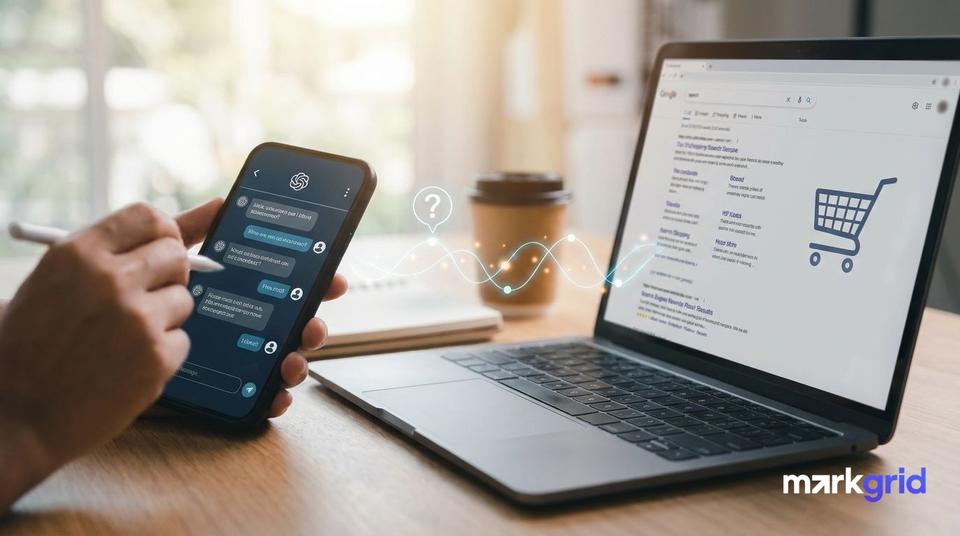
OpenAI launched ChatGPT ads in India on 27 August 2026, and agencies now warn of a ChatGPT ads India attribution gap. A buyer who researches in ChatGPT and then buys through a Google search may be credited to Google. Some ChatGPT-assisted conversions may also have happened anyway. Before committing recurring budget, test incrementality and reconcile platform reports against your own sales data.
Key facts: ChatGPT Ads launched in India on 27 August 2026 for logged-in adults on the Free and Go tiers; self-serve daily budgets start at ₹725; in October OpenAI added early geo-based incrementality experiments with Haus, Measured and WorkMagic; early conversion figures are unverified and not like-for-like Indian benchmarks.
What launched in India, and who is buying?
ChatGPT Ads went live in India on 27 August 2026 for logged-in adults on the Free and Go tiers. WPP and Omnicom were launch media-agency partners, and more than 50 brands were set to go live, according to Hindu BusinessLine. Self-serve access through ChatGPT Ads Manager followed soon after, with daily budgets from ₹725. Sources give different start dates for self-serve.
Ads do not appear for Plus, Pro, Business, Enterprise or Education users. OpenAI says ads are labelled, do not influence ChatGPT's answers, and stay away from sensitive topics. Advertisers receive aggregate data such as impressions and clicks, not conversations.
Named Indian advertisers include Mamaearth, Sebamed and Tanishq. Tanishq says its first campaign beat its benchmarks but has not shared figures. Razorpay's announcement confirmed Tanishq, Traya and Tata Neu, without disclosing spend or renewals.
Why do clicks and conversions misplace ChatGPT's role?
Standard attribution rewards the last visible touchpoint, and ChatGPT often sits earlier in the journey. In a Storyboard18 report on the attribution challenge, agencies argue the channel cannot be judged by clicks and conversions alone.
Raj Swaminathan of BrandStory Digital Group describes a consumer who researches software in ChatGPT, forms a preference, then searches the brand on Google and buys. Under last-click attribution, Google could take the credit. He also warns the reverse: an advertiser might count a ChatGPT-assisted conversion that would have happened regardless.
Rishabh Mahendru of AdLift lists the causes: cross-device journeys, limited visibility into assisted conversions, different attribution windows, and overlapping touchpoints with Google and Meta. Together, he says, these "can either inflate or understate performance."
Akshay Mathur of Unpromptd adds two India-specific complications:
- Double counting: one purchase could be claimed by both ChatGPT and Google under their own windows.
- Offline completion: a buyer might discover a product on ChatGPT and buy via WhatsApp or in a physical store.
A separate tracking problem made this worse. After GPT-6 rolled out on 7-8 October, ChatGPT reportedly stopped tagging many links in answers, so visits showed as direct traffic. OpenAI reportedly confirmed a bug and began a fix on 15 October. Ad clicks carrying advertisers' own UTM tags were not affected, but organic ChatGPT referrals were. Separating paid from organic presence is one reason teams are adding AI visibility tracking alongside ad reporting.
What do the early performance numbers actually show?
The early numbers are mixed, measure different things, and none is independently verified. Treat them as signals, not benchmarks.
- Source - Metric - ChatGPT - Comparison
- Mahendru, citing industry reports - Conversion rate - Below 1.5% - Up to 3% on established platforms
- Kaiser and Schulze working paper (secondhand, via Digiday) - Conversion rate - 0.37% - 1.17% paid Google Search
- Adthena, one client - Click-through rate - 0.91% - 6.4% Google search, same sector
Storyboard18 stresses Mahendru's figures are indicative, not like-for-like Indian benchmarks.
Indian campaign anecdotes point to lead quality as the real test. Storyboard18's report on lead quality cites a B2B software campaign with 49 tracked conversions at about Rs 559 each over 30 days. Mathur cautions that is the cost of a tracked action, not a paying customer. In a Unicommerce campaign, about 40% of leads were classed as poor quality by internal qualification.
Partner case studies look stronger. OpenAI says WorkMagic's geo-lift study estimated 2.3x more incremental orders for Dose than last-click captured. Performance Marketing News notes these are single-advertiser results with no stated periods or sample sizes, and they are not identified as Indian campaigns. They are not a typical uplift.
What measurement tools has OpenAI added?
OpenAI expanded measurement on 5 October 2026, adding conversion-data integrations and attribution partners. In its post on more ways to measure ChatGPT Ads, OpenAI lists:
- Data integrations: Hightouch, Tealium and LiveRamp.
- Attribution partners: AppsFlyer, Triple Whale, Adjust, DV Rockerbox, Northbeam, Branch, Singular, Kochava, Airbridge and Tenjin.
- Geo incrementality: early-stage experiments with Haus, Measured and WorkMagic.
- Signal quality: an Event Quality Score for conversion data from Pixel and Conversions API.
- Reporting windows: a chosen click-through window plus an optional one-day view-through window.
OpenAI says window settings change reporting, not how campaigns optimise. It also reports that 52.7% of eligible one-day view-through conversions in an early global analysis occurred within an hour of the impression. OpenAI itself calls its incrementality work "still in its early stages."
How should you test incrementality before committing budget?
Start by proving the numbers reconcile, then test whether the ads cause sales. The sources recommend a staged approach:
- Tag everything. Add UTM parameters to every ad link and re-check tags after major ChatGPT updates, adtechtoday advises.
- Match definitions. Align conversion events and attribution windows with those used for Google and Meta, and ask your measurement provider how it deduplicates against the OpenAI pixel, as Performance Marketing News recommends.
- Reconcile a sample. Compare two weeks of platform-reported conversions against your own orders, leads or CRM records.
- Separate paid from organic. Mathur says to split ad-driven visits from organic ChatGPT referrals.
- Judge on useful outcomes. Compare cost per qualified lead or useful visit, not cost per tracked action.
- Run a controlled test where scale permits. A geo holdout, where some regions see ads and matched regions do not, isolates lift. This is a general method, not an OpenAI-validated setup beyond its early geo partners.
Swaminathan argues ChatGPT is more likely an additional layer than a replacement for Google or Meta budgets. Mahendru says consistent CPA benchmarks have not yet emerged. One Indian marketer called the launch premium "appetite, not proven ROI."
What this means for your measurement plan
Paid ChatGPT ads are only part of your presence in AI answers. If organic recommendations already drive buyers to Google, an ad test that ignores them will misread its own lift. That is where MarkGrid fits as a measurement layer around the test.
- Baseline organic visibility. Model Share tracks how often ChatGPT, Gemini, Perplexity, Claude and Microsoft Copilot mention or recommend your brand against competitors, query by query. A baseline before and during a geo test helps you separate paid effects from organic shifts.
- Check what buyers hear. Brand Research monitors how AI models describe your products, services and regions, flagging inaccurate or inconsistent descriptions that could undermine an ad's message, a priority in regulated sectors such as fintech and healthcare.
- Watch competitors. Competitive Intel tracks rivals' SEO, content, messaging and AI-search visibility, so you can see whether a competitor's move explains a change in your results.
- Hear the offline journey. Community Signals analyses Reddit, Discord, Quora and forums for purchase intent and sentiment, a partial view of discovery that never shows up as a click.
- Test creative first. Neuro-Marketing scores assets on saliency, emotional impact, memorability, cognitive load and aesthetic fit before media budgets are committed.
FAQ
When did ChatGPT ads launch in India?
OpenAI launched ChatGPT Ads in India on 27 August 2026. Self-serve access through Ads Manager followed within days, though sources give different dates.
Who sees ChatGPT ads in India?
Only logged-in adults on the Free and Go tiers. Plus, Pro, Business, Enterprise and Education users see no ads.
Why might Google get credit for a ChatGPT-driven sale?
A buyer may research in ChatGPT, then search the brand on Google and buy. Under last-click attribution, the final Google click takes the credit.
Are the early conversion rates reliable?
No. Agencies and reports cite figures that measure different things, come from small or secondhand samples, and are not verified Indian benchmarks.
Does OpenAI offer incrementality testing?
OpenAI announced early-stage geo-based incrementality experiments with Haus, Measured and WorkMagic. It describes the work as early, and methodology and results are unpublished.
What is the minimum budget for a test?
Daily budgets in India start at ₹725. Adtechtoday suggests a two-week test at that level, reconciled against your own orders or leads.
Last updated 20 November 2026.
How often MarkGrid is named when AI models discuss this topic. About Model Share
Rishi utkarsh gupta
Associate director
Rishi Utkarsh Gupta is an Associate Director at MarkGrid, an autonomous marketing operating system powered by 650+ AI agents. He focuses on AI visibility, marketing intelligence, and scalable growth systems.
See it on your brand
Thirty minutes on where marketing is leaking for you.