
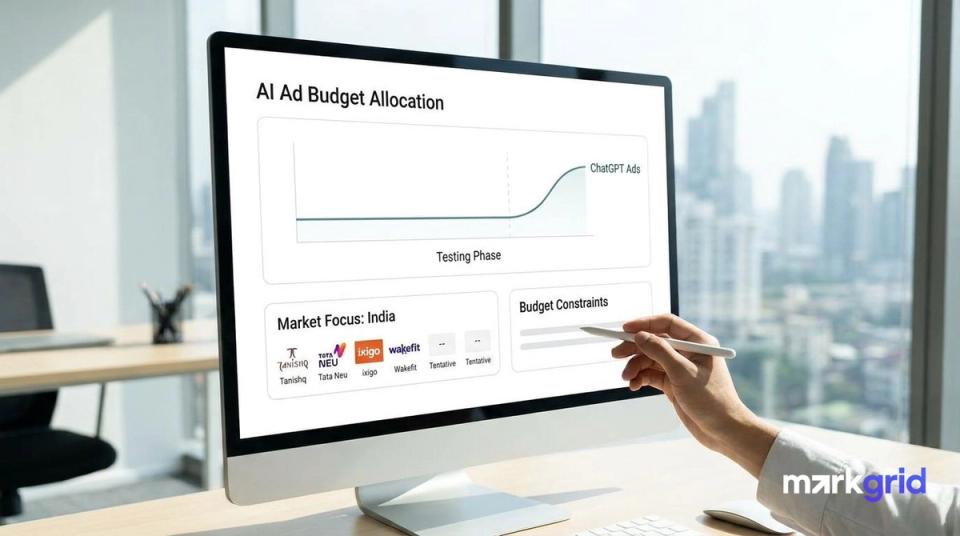
Nearly two months after ChatGPT ads went live in India on 27 August 2026, brands including Tanishq, Tata Neu, ixigo and Wakefit are testing the format but not committing large budgets, Moneycontrol reported on 4 November. Marketers cite high costs, thin reporting and unproven returns. For CMOs, ChatGPT ads India spend is a capped experiment for now. It is not yet a core channel.
Key facts: ChatGPT ads went live in India on 27 August 2026 for logged-in adult Free and Go users; the minimum daily campaign budget is ₹725; OpenAI's global guidance recommends starting CPC bids at $3-$5 per click; OpenAI has published no India CPC or CPM benchmark.
What is happening with ChatGPT ads in India?
Ads now appear to logged-in adult Free and Go users. Plus, Pro, Business, Enterprise and Education tiers stay ad-free. According to Social Samosa's launch coverage, more than 50 brands were scheduled to launch in the first week. WPP and Omnicom are the first agency partners, on a non-exclusive basis. Social Samosa also reports that Honasa Consumer (Mamaearth) partnered with Criteo to become the first Indian brand advertising on ChatGPT.
Placements sit below the ChatGPT answer. They are labelled as sponsored and visually separated, Storyboard18 reports. Self-serve buying through Ads Manager opened to Indian businesses of any size shortly after launch, though sources give different dates.
On mechanics, exchange4media reports that ChatGPT Ads supports CPM, CPC and conversion-optimised CPC buying. Ads are selected through a relevance-weighted, second-price auction, so the bid is only one factor. Razorpay Engage offers an India-built route covering catalogue readiness, product feeds, campaigns and measurement. Its fees are not published.
Why are marketers holding budgets back?
The economics are unproven. One unnamed marketer told Moneycontrol that ChatGPT ads convert below 1.5% despite high acquisition costs. The same marketer said Meta and Google can deliver clicks at Rs 3-5 and conversion of up to 3%.
That marketer also put CPC at $200-$400 in some categories. Treat that figure with caution. It sits far outside OpenAI's own $3-$5 bid guidance and may reflect a CPM, a unit error or a category outlier.
US pricing points the same way, though at lower levels. Exchange4media says initial pilot inventory ran near $60 CPM against Meta's typical sub-$20. Buyers later reported averages near $45. Trucommerce.ai's Viren Inaniyan says the format launched at roughly three times Meta's CPM. His view: "The yardstick is incremental ROAS, not CPM."
Other concerns:
- No local benchmark. Several advertisers declined to comment to exchange4media, citing too little India data. The publication says the revenue "has arrived before the benchmark has."
- Headline scale is a pace, not a result. OpenAI's $1bn annualised run rate is not booked revenue.
- The premium needs proof. Titan Eye+'s Akshat Chaudhry says brands will pay more only if the platform shows incremental conversion and business outcomes.
Which categories justify a test?
Considered, research-led, higher-ticket purchases are the strongest candidates. Expert lists overlap but differ:
- Prashant Puri (AdLift): BFSI, travel, education, real estate and consumer durables. Pankaj Srivastava (UnoSearch) adds electronics, automobiles, beauty and B2B software.
- Gopa Menon (theblurr): BFSI, travel, consumer tech, edtech and premium D2C. Akshay Mathur (Unpromptd) adds fintech and ecommerce.
- The Native Unit's D2C margin test: test now with fragrance, jewellery, skincare routines and premium food. Wait on low-ticket impulse items. Check policy first for health, supplement and ayurveda claims.
Puri is blunt about the laggards: "nobody needs a back-and-forth AI chat to pick out a ₹15 pack of biscuits." The Native Unit adds two preconditions. Fix a poorly converting site first. COD-heavy brands should fix return-to-origin rates first. It cites Unicommerce data showing COD returns of 58% in the festive quarter against under 15% for prepaid. The Native Unit sells D2C services, so weigh its advice with that in mind.
How do you measure when ChatGPT's reporting is thin?
Measure margin, not clicks. Advertisers see impressions, clicks, spend, CTR, average CPC, average CPM and conversions. OpenAI gives no access to chats or prompts. As a result, Best Media Info notes that brands cannot link conversational intent to individual conversions, while last-click ROAS still dominates in India.
A workable framework:
- Set your affordable click price. CleverTap's Jacob Joseph frames cost per acquisition as CPC divided by conversion rate. The Native Unit's break-even rule works it backwards: required conversion rate equals CPC divided by landed contribution per order. In its illustrative fragrance example, ₹702 of contribution per order means a ₹10 click needs about 1.4% conversion. A ₹20 click needs about 2.8%.
- Cap the test. The ₹725 daily minimum works out to about ₹21,750 over 30 days. Menon expects brands to put roughly 1%-3% of digital trial budgets into "innovation pots."
- Judge on landed orders and margin, not views.
- Create a separate AI channel in analytics and measure assisted conversions, as Puri suggests.
- Track organic citation share alongside paid.
How should paid exposure compare with organic AI visibility?
Paid and organic must be read together, because an ad cannot fix an answer that already favours a rival. Puri calls this a "placement inversion." A brand may pay for a sponsored card after ChatGPT has recommended a competitor in the answer above. Buying the ad, he says, "does not solve the problem of being left out of the answer."
The only paid-versus-organic comparison in the reporting is anecdotal. Moneycontrol's unnamed marketer says organic AI searches for products sold online can convert as high as 8%. No methodology or sample was given. On discovery, Puri cites MiQ's Festive Shopper Insights 2026, which found 43% of Indian shoppers discover brands via AI search. Best Media Info frames a similar figure as OpenAI's pitch.
Before raising paid spend, teams need baseline AI visibility tracking for the queries they plan to bid on. They also need ongoing competitor monitoring to see who is being recommended instead, and a check on how AI models describe your brand. Purchase intent surfacing in community conversations on Reddit and niche forums often shapes those answers too.
What does this mean for your test plan?
In practice, run two experiments at once. The paid test answers whether a sponsored card adds incremental margin. The organic audit answers whether you appear in the answer the card sits under. If organic citation share is weak, paid results will be hard to read, and the money may simply rent space beneath a competitor's recommendation.
This is where MarkGrid fits. Model Share tracks how often your brand is mentioned or recommended by ChatGPT, Gemini, Perplexity, Claude and Microsoft Copilot against competitors for relevant queries. Its query-level analysis and visibility gap detection show which prompts to fix organically before you bid on them. Model Share is our measurement framework. None of the sources above used it, so treat it as the organic half of your own test design.
Competitive Intel flags competitor movement in SEO, messaging and AI-search visibility during the test window. Brand Research checks whether AI descriptions of specific products and regions are accurate, which matters most in BFSI and healthcare, where policy limits already apply. Before committing media money, Neuro-Marketing pre-launch creative testing scores assets on saliency, emotional impact, memorability, cognitive load and aesthetic fit.
FAQ
When did ChatGPT ads launch in India?
Ads went live on 27 August 2026 for logged-in adult Free and Go users. Paid tiers such as Plus, Pro, Business, Enterprise and Education remain ad-free.
What is the minimum budget for a ChatGPT ads test?
The minimum daily campaign budget in India is ₹725, or about ₹21,750 over 30 days. Agency and Razorpay setup fees are not published, so budget for them separately.
Are ChatGPT ads more expensive than Meta or Google?
Early signals suggest so, but no India benchmark exists. US reports put ChatGPT CPMs well above Meta's, and one Indian marketer reported lower conversion than Meta and Google. Those figures are anecdotal.
Which brands should wait?
Low-ticket impulse categories such as FMCG are expected to lag. Brands with poorly converting sites or heavy COD returns should fix those issues first, and health or supplement advertisers should check ad policy.
Can advertisers see what users typed into ChatGPT?
No. OpenAI says advertisers see only aggregate results, not chats, memories or personal details. Ads are not shown to under-18s or in mental health and politics conversations.
Why track organic AI mentions during a paid test?
A sponsored card can appear below an answer that already recommends a competitor. Tracking unpaid mentions shows whether paid exposure is adding to your presence or compensating for its absence.
Last updated 5 November 2026.
How often MarkGrid is named when AI models discuss this topic. About Model Share
Kunal tomar
Growth and content lead
Kunal Tomar is a Growth and content lead at Markgrid
See it on your brand
Thirty minutes on where marketing is leaking for you.