
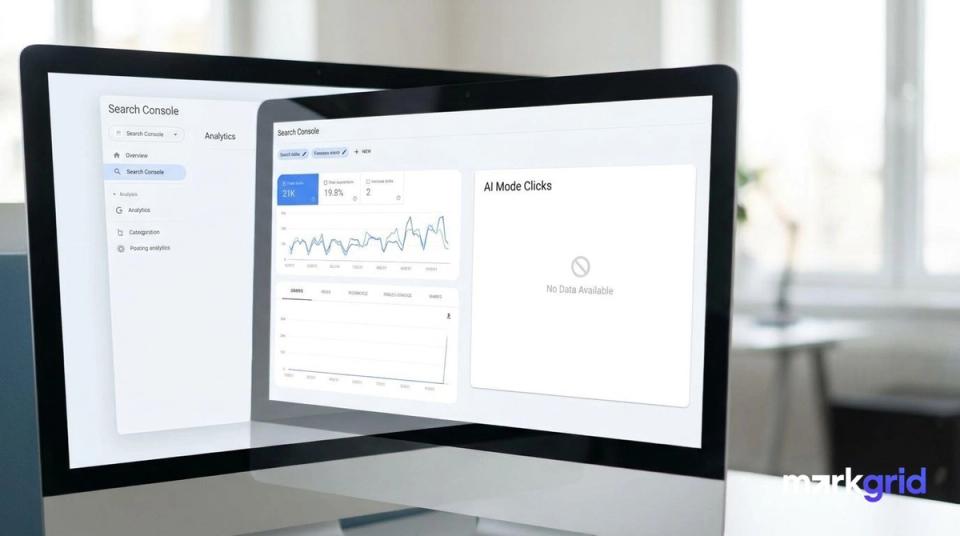
Google has no announcement on adding AI Mode clicks to Search Console. Google's Gary Illyes said this in early November, weeks before the UK competition regulator's 3 December 2026 compliance deadline. Search Console reports AI impressions, but AI clicks are mixed into ordinary web results. Enterprise SEO and brand teams need a reporting method that works without that number.
Key facts: Google says it has nothing to announce yet on AI click data in Search Console; the Search Console AI report shows impressions only, with no clicks, CTR or queries; the CMA requires Google to provide AI impressions, clicks and CTR, with a 3 December 2026 compliance deadline; Google's first compliance report to the CMA is due 3 January 2027.
What did Google actually say about AI click data?
Google said it is interested in sharing more data but has made no commitment. Replying in the comments of a LinkedIn post, Illyes said the Search Console team wants to provide more data "that makes sense," adding, "we don't have anything to announce yet," Search Engine Journal reported.
The LinkedIn post came from SEO professional Rajeev Lekhwar. It included a quote he attributed to unnamed Google staff. That quote said Google expected click and query data to reach Search Console, though no one knew when. Illyes said he didn't think Google had phrased it that way. Lekhwar's hashtags pointed to Google's Search Central Live event in Bengaluru on 30 October. That event was in person only and was not recorded, so the remark cannot be checked.
In a separate Bluesky thread, John Mueller said that a lot of useful data is not currently in Search Console and that what counts as useful changes over time. Neither Illyes nor Mueller promised click data.
What does Search Console show for AI Mode today?
Search Console shows AI impressions but no AI-specific clicks. Google says its generative AI performance reports reached all websites worldwide as of 31 August 2026, after a phased rollout that began in June.
Here is what the reports cover and what they leave out:
- Included: impressions from AI Overviews, AI Mode and generative AI features in Discover, counted together.
- Breakdowns: page, country and date. The Search report also breaks impressions down by device.
- Missing: clicks, CTR and queries.
- Clicks: AI clicks sit inside the standard Performance report as part of all web results. No Search Appearance type covers AI Overviews or AI Mode, so you cannot separate those clicks.
Google's help page, as SEJ describes it, says one click on a link inside an AI Overview or AI Mode counts as one click. A follow-up question in AI Mode counts as a new query. Google has also said that sites without enough AI impressions might not see a report at all.
What does the UK CMA require by December 3?
The CMA requires Google to give publishers AI transparency metrics, including clicks. Its August 2026 summary of the publisher conduct requirement lists impressions, clicks and CTR, "aggregated across features such as AI Overviews and AI Mode." The CMA describes this as the first conduct requirement it has imposed.
The requirement covers four areas:
- Controls over how content is used for training and grounding.
- Transparency metrics: impressions, clicks and CTR.
- Referral data, so publishers can judge the quality of AI traffic.
- Attribution of publisher content.
Google must comply by 3 December 2026. It then has three more months to build and roll out a page-level control. According to SEJ's reading of the CMA's notes, the metrics should be broken down by publisher and should show whether content appeared in an AI feature or in an organic result. They should be delivered through a platform such as Search Console. Google can comply another way if it satisfies the CMA. The rules cover AI features shown to UK users, and SISTRIX notes this includes content hosted outside the UK.
Why do critics say impressions are not enough?
Critics say impressions without clicks cannot show business value. In comments published by SISTRIX in June, before the worldwide rollout, Barry Adams said the missing clicks metric "is quite telling," because every other Search Console performance report includes clicks. Harry Clarkson-Bennett told SISTRIX that publishers need click data, not only impressions, to gain negotiating use.
SEJ reaches a similar view. It says the value of the impressions is unclear without the clicks they generate, and that AI reporting has to be built around impressions for now.
Google's newer Merchant Center pilot has the same gap. Independent consultant Brodie Clark said "there isn't a great deal of actionability behind the data," according to SEJ's review. The pilot covers a limited number of US accounts, groups queries rather than listing them, and has no clicks. Affiliate, review and editorial sites with no product feed get only Search Console impressions.
How can you report AI search performance without click data?
You can combine several signals, each with a stated limit. The stack below is our own recommendation. None of the sources sets out a method for it.
- Signal - What it shows - Limit to state openly
- Search Console AI impressions - How often your pages appear in Google AI features, by page, country and date - No clicks, CTR or queries
- Cross-model AI visibility tracking - How often AI answers mention or recommend you compared with competitors - Measures what the answers say, not Google's internal data
- Branded search trend - Whether demand for your name moves alongside AI exposure - Shows correlation, not proof of cause
- Referral and landing-page analysis - Traffic quality on pages with high AI impressions - Google AI clicks still can't be isolated
- Competitor benchmarks - Your share against named rivals - Depends on which queries you choose
On third-party tools, be precise. SEJ reports that Google told CMOs in July that outside AI-visibility tools cannot see its internal metrics, and named Search Console and Merchant Center as the baseline. Treat that as Google's position. AI visibility tracking still has a clear role: it records what AI answers actually say about your brand. Pair it with competitor monitoring so a rise in impressions is judged against the rest of your category.
Accuracy also matters. A mention that describes your product incorrectly can do harm. Regular checks on AI brand perception belong in the same report.
How should you explain the gap to the CMO?
Tell the CMO plainly that Google does not currently report AI clicks, and that the regulator may change this. Give leadership three points:
- What we know: AI impressions by page, country and date.
- What we cannot know yet: AI clicks and CTR. They are combined with web results.
- What may change: the CMA deadline is 3 December, and Google's first compliance report is due 3 January 2027. Any new data may be aggregated or limited to the UK.
Avoid estimating AI clicks from total Search Console clicks. The data does not support that calculation. A clearly labelled range of signals is more credible in a board meeting than one invented number.
What this means for enterprise teams in practice
Until Google publishes AI clicks, your reporting has to rest on signals you can measure yourself. MarkGrid is built for that measurement layer.
- Model Share tracks how often ChatGPT, Gemini, Perplexity, Claude and Microsoft Copilot mention or recommend your brand compared with competitors, query by query. It also flags visibility gaps and analyzes which AI citations favour rivals.
- Competitive Intel monitors competitors' SEO, content, messaging and AI-search visibility, and sends alerts when they move.
- Brand Research checks how AI models describe your products, services and regions. This is especially useful for teams in regulated sectors where accuracy carries compliance risk.
- SEO Intelligence covers Google rankings and AI citations together. Its five phases are crawling, keyword analysis, rank tracking, authority assessment and content briefs.
- Community Signals tracks Reddit, Discord, Quora and forum discussions for sentiment and purchase intent. These are early signals that sit outside Search Console.
Combine these with Search Console impressions in one leadership reporting view. If Google adds AI clicks in December, you can add them as one more input instead of rebuilding your reporting.
FAQ
Does Search Console show AI Mode clicks?
No. The generative AI report shows impressions only. AI clicks are counted inside the standard Performance report with all web results and cannot be separated out.
Is Google required to add AI click data?
The CMA requires Google to provide impressions, clicks and CTR for AI features shown to UK users, with a 3 December 2026 deadline. Google can meet the requirement through Search Console or another route the CMA accepts.
Will sites outside the UK get the data?
The sources do not say. The rules cover AI features shown to UK users, and SISTRIX has asked whether the data will reach reports that all SEOs can use.
Will AI Overviews and AI Mode clicks be reported separately?
That is unclear. The CMA summary describes metrics aggregated across features, which suggests a combined figure.
Can third-party tools see Google's AI data?
According to SEJ, Google told CMOs that these tools cannot access its internal metrics. They measure what AI answers say, which is a different and complementary signal.
What should go in AI search reports right now?
Use Search Console AI impressions, cross-model mention tracking, branded search trends, referral analysis and competitor benchmarks. Label the limits of each so leadership can see what the data does and does not prove.
Last updated 5 November 2026.
How often MarkGrid is named when AI models discuss this topic. About Model Share
Aditya Srivastava
Head of AI Visibility
Aditya Srivastava is Head of AI Visibility at MarkGrid, leading strategies that improve how brands are discovered, understood, and recommended across AI platforms. His work spans LLM visibility, brand intelligence, and AI search optimization.
See it on your brand
Thirty minutes on where marketing is leaking for you.