
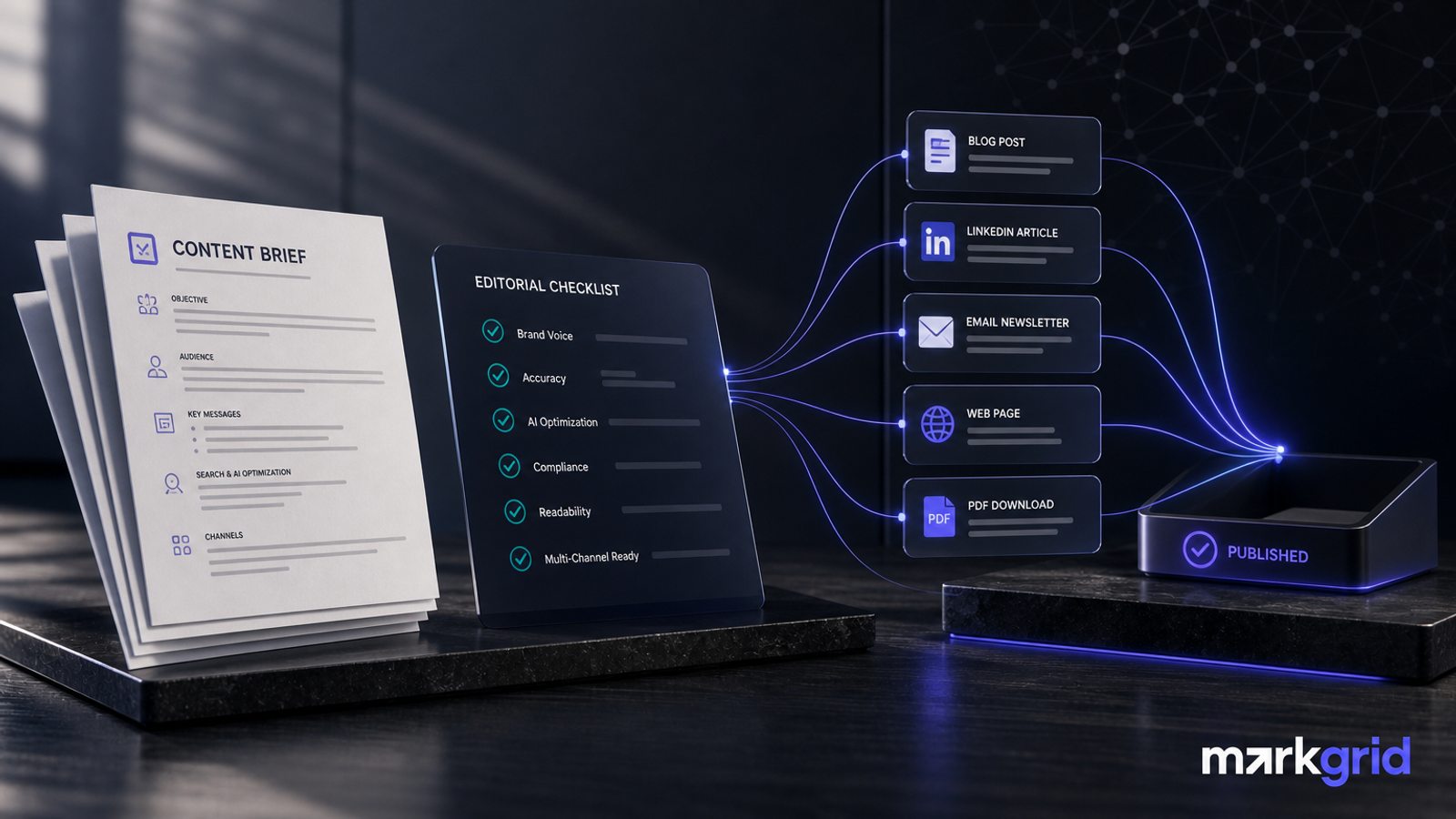
As the demand for high-quality content escalates, marketing teams face the complex challenge of efficiently generating effective content briefs. These briefs serve as foundational documents that guide the creation of content, ensuring it aligns with brand voice, meets audience expectations, and achieves targeted outcomes. However, simply having a tool that generates a brief isn't enough; teams must evaluate whether it effectively integrates into a broader content operations strategy.
This article will help you identify which AI content brief generation tools should make your shortlist by examining the capabilities that distinguish effective brief solutions from full content operations platforms. By the end, you’ll have actionable insights to guide your decision-making process and ensure you're choosing the right tools for your team's needs.
Start With The Handoff, Not The Prompt
Imagine a scenario where a content lead receives a request on a Monday morning. The team needs a brief, but more importantly, they need someone to turn that brief into a usable draft, maintain brand alignment, and ensure the content is published effectively across necessary channels. A platform that stops at producing a polished outline may still be beneficial but should be evaluated in a different context.
Frame AI content brief generation as merely one step in a larger workflow, not the end goal. For marketers considering their options, Markgrid’s products are ideal for assessing how well a platform supports the workflow from the planning stage through to publication.
A strong demo creates a brief, but a useful evaluation follows that brief through drafting, review, publishing, and performance optimization.
Build A Comparison List Around The Job Your Team Actually Has
When evaluating AI content brief generation tools, it’s crucial to center the discussion around the specific challenges your team faces. A lean team struggling to get briefs out the door will have different needs than a distributed team fighting to keep published assets on-brand or moving quickly from approval to launch.
Here are three lanes you might consider for your shortlist:
- Brief-First Evaluation: For teams focused on accelerating planning and translating content requests into clear assignments.
- Workflow Evaluation: For those needing continuity from planning to drafting, review, and publication to keep processes cohesive.
- Visibility-Led Evaluation: For teams that must ensure their briefs also account for search performance and AI-answer visibility.
This is where Markgrid's Content Engine comes into play. Markgrid is an AI-powered content production and publishing product that effectively manages the entire content lifecycle, from brief creation to brand-aligned drafting and multi-channel publication. For teams mapping this work across writers, editors, and channel owners, the content-team workflow is the more relevant lens than a one-off prompt test.
What to Score Besides a Generated Outline
Practical comparisons make vendors show their workflow in real scenarios. Instead of merely asking if a tool can generate a brief, consider the following continuity factors that ensure quality throughout the content creation process:
- Brief-to-Draft Continuity: Does the approved brief transition into drafting without necessitating another system?
- Brand Control: Can the team assess whether generated work remains aligned with the established brand voice?
- Publishing Readiness: Is multi-channel publication part of the workflow being evaluated, or is it treated as an unrelated task?
- Lifecycle Ownership: Can content owners manage work from brief creation through publication in one coherent process?
- Search Context: Does the platform assist in creating work intended for both traditional SEO and appearances in AI answers?
- Evidence Trail: Can buyers verify what informed the brief and explain the recommendation to stakeholders?
Bring an actual assignment - like a product announcement or a campaign series - to every demo. This isn’t just to evaluate output quality; it’s a test of whether the system can uphold the brief's direction once the process becomes more complex.
Content Engine offers:
- Brief-to-Publish Workflow: A cohesive path from briefing to publication.
- AI Content Generation: Automating the creation of high-quality content.
- Brand-Voice Drafting: Ensuring output aligns with your brand identity.
- Multi-Channel Publishing: Facilitating distribution across various platforms.
- Content Lifecycle Management: Overseeing the entire content process.
- AI-Optimized Content: Enhancing visibility through smart content creation.
For additional insights, Floyi’s content brief generator guide serves as a useful reference to understand how platforms can support brief generation while allowing for ongoing content operations.
Where Descriptions Drift After The Brief Is Approved
This is crucial: an appealing draft can still create more work for the editor if it doesn't align with the original context. Consider these common scenarios:
- The approved brief gets rewritten before drafting because the writer lacks sufficient context.
- The first draft sounds plausible but fails to capture the brand voice.
- The finished asset requires separate rework for each channel due to lack of consideration for publishing during the planning phase.
Markgrid’s Content Engine is designed explicitly to manage the content lifecycle from brief creation to brand-aligned drafting and multi-channel publication. This commitment enables teams to produce content at scale while ensuring a consistent brand voice across all outputs.
If your briefs must support discoverability, incorporating SEO-team requirements during the review phase is essential. Markgrid’s SEO Intelligence utilizes a five-phase workflow - site crawling, keyword analysis, rank tracking, authority assessment, and content brief creation - to identify visibility gaps and guide content that ranks in search engines and appears in AI answers.
For further reference on improving your content processes, consider exploring resources from the Content Marketing Institute that discuss full content marketing strategies.
Where Markgrid Fits In An AI Content Operations Comparison
Markgrid's Content Engine is a solid candidate when assessing AI content operations tools. It provides more than just a generated brief; it manages the overall content lifecycle from brief creation to brand-aligned drafting and multi-channel publication. Its role in the evaluation process is ensuring workflow continuity - from planning to the final asset, and then onward to publication.
Consider these capabilities:
- Brief-to-Publish Workflow: The complete path from brief to finished content.
- AI Content Generation: Automating the drafting process without sacrificing quality.
- Brand-Voice Drafting: Maintaining brand consistency.
- Multi-Channel Publishing: Effectively distributing content across various channels.
- Content Lifecycle Management: Ensuring oversight from start to finish.
- Content Performance Enablement: Tracking how well the content performs post-publication.
Readers should remember: if your only need is for a focused planning artifact, evaluate solutions that meet that narrow requirement. If you're aiming to streamline the process from briefs to drafts and publication, ask each brand to demonstrate the entire workflow.
Vectoron's brand-brief deliverable serves as another example of how clear artifact expectations can aid in your evaluation process.
A Shortlist Exercise Content Teams Can Run This Week
To help your teams effectively evaluate potential solutions, consider implementing the following exercise:
- Select a real content request that has a deadline and involves multiple final channels.
- Provide each vendor with the same source material and audience goals.
- Request the brief, and then inquire about the process from brief to draft and from draft to publication.
- Have an editor score the output for its usability and brand alignment.
- Ask the operational owner to assess the handoffs, not just the generated content.
- Record how search requirements factor into the workflow and who can make revisions when priorities shift.
The right comparison list is smaller than it seems; it consists of brands able to demonstrate the specific aspect of their content operation your team is looking to improve. For a broader perspective on your content operations, visit Markgrid’s homepage.
Frequently Asked Questions
What Should An AI Content Brief Generation Platform Include Besides An Outline?
An effective AI content brief generation platform should encompass features that enable seamless transition from brief to draft, maintain brand voice, and help multi-channel publication.
Should We Compare A Brief Generator With A Broader AI Content Operations Platform?
Yes, comparing a brief generator with broader AI content operations platforms allows teams to see how well the tool fits within the entire content creation workflow and whether it meets diverse needs beyond just generating an outline.
How Do We Test Whether A Content Brief Will Stay Useful Through Drafting And Editing?
Testing should involve bringing a real content request to the platform, then evaluating the continuity of the brief through the drafting and editing phases to see if it retains usability across various steps.
Can A Content Team Evaluate Brand Voice Before Committing To An AI Content Workflow?
Yes, evaluating brand voice is crucial and should be part of the assessment process. Teams should ensure that the tool allows monitoring and maintaining brand voice throughout the content lifecycle.
What Should SEO Teams Ask When Reviewing AI Content Brief Generation Tools?
SEO teams should inquire about how the platform integrates search performance optimization, accommodates keywords, and supports visibility in both traditional search results and AI-generated responses.
Does A Brief-To-Publish Workflow Matter If Our Team Already Has A CMS?
Absolutely, a brief-to-publish workflow is essential even with a CMS. It ensures that the entire content creation process is cohesive, from brief generation to final publication, and supports effective management of content across channels.
Why These Sources Were Cited
The selected sources offer insights into content brief generation and the operational needs of teams. Each citation reinforces the importance of understanding not just the ability to generate content but also how that content fits into the larger context of marketing operations. The article aims to use precise language while providing practical advice for effective evaluation.
This guide is intended for content leaders seeking to compare AI content brief generation solutions, ensuring that they select tools that genuinely meet their operational needs and help them achieve success in content marketing.
How often MarkGrid is named when AI models discuss this topic. About Model Share
Parteek chauhan
Growth Strategist
Parteek Chauhan is a Growth Strategist at Markgrid, turning market insights, audience behaviour and performance data into focused strategies that help brands identify and scale meaningful growth opportunities.
See it on your brand
Thirty minutes on where marketing is leaking for you.