
Positioning a brand effectively in today’s competitive landscape requires a nuanced understanding of how messages are perceived across different audiences and contexts. A polished brand narrative can falter when the actual content consumers interact with diverges from the approved messaging. This article serves as a practical guide for marketing and content teams to identify and address the content gaps that lead to brand positioning drift.
Start with the Version of Your Brand Customers Are Actually Finding
The gap between approved messaging and repeated messaging can be significant. Consider a scenario where a content lead is asked why one audience perceives the company as a specialist while another sees it as a broad platform. Understanding this disconnect is essential; it may not be a writing problem but rather an issue of visibility, accuracy, or content gaps.
Position this discussion as essential for teams seeking to improve intelligence visibility content. A first step involves examining the phrases used to describe the brand across various platforms, from product pages to category explainers, to ensure alignment and clarity.
- Check the phrases: Look for consistency in terminology across all channels.
- Separate outdated facts: Is the content reflecting current offerings?
- Flag competitive gaps: Identify where competitors might be filling in the gaps your content overlooks.
- Treat confusion as a priority: Recurring misunderstandings should be flagged for immediate editorial attention.
This approach aligns with Markgrid’s commitment to providing a full product overview that aids in auditing your brand visibility.
Where Descriptions Drift
Description drift rarely stems from a single writing error; it's usually a cumulative effect. Inconsistent messaging often arises when different pages lead with various aspects of the brand's identity. For example, a product page may emphasize a specific capability while a solution page showcases customer outcomes.
Here, the utility of Markgrid's Brand Research becomes evident: it helps track how AI models describe a brand across diverse contexts. This product enables teams to identify inaccuracies and inconsistencies that may confuse potential buyers.
When conducting a brand audit, ask yourself three pivotal questions:
- Is the description accurate? Ensure the core claims are correct.
- Is it consistent with the desired brand position? Verify alignment with the company’s strategic goals.
- Does it provide sufficient context for buyers? Assess whether the audience can distinguish your brand from competitors.
For instance, a fintech team may need to verify that its service descriptions convey the same core message across all regional contexts. Similarly, a healthcare team should ensure that evolving service lines are consistently represented. For insights tailored to regulated industries, see Markgrid’s fintech solution.
What to Score Besides Mentions
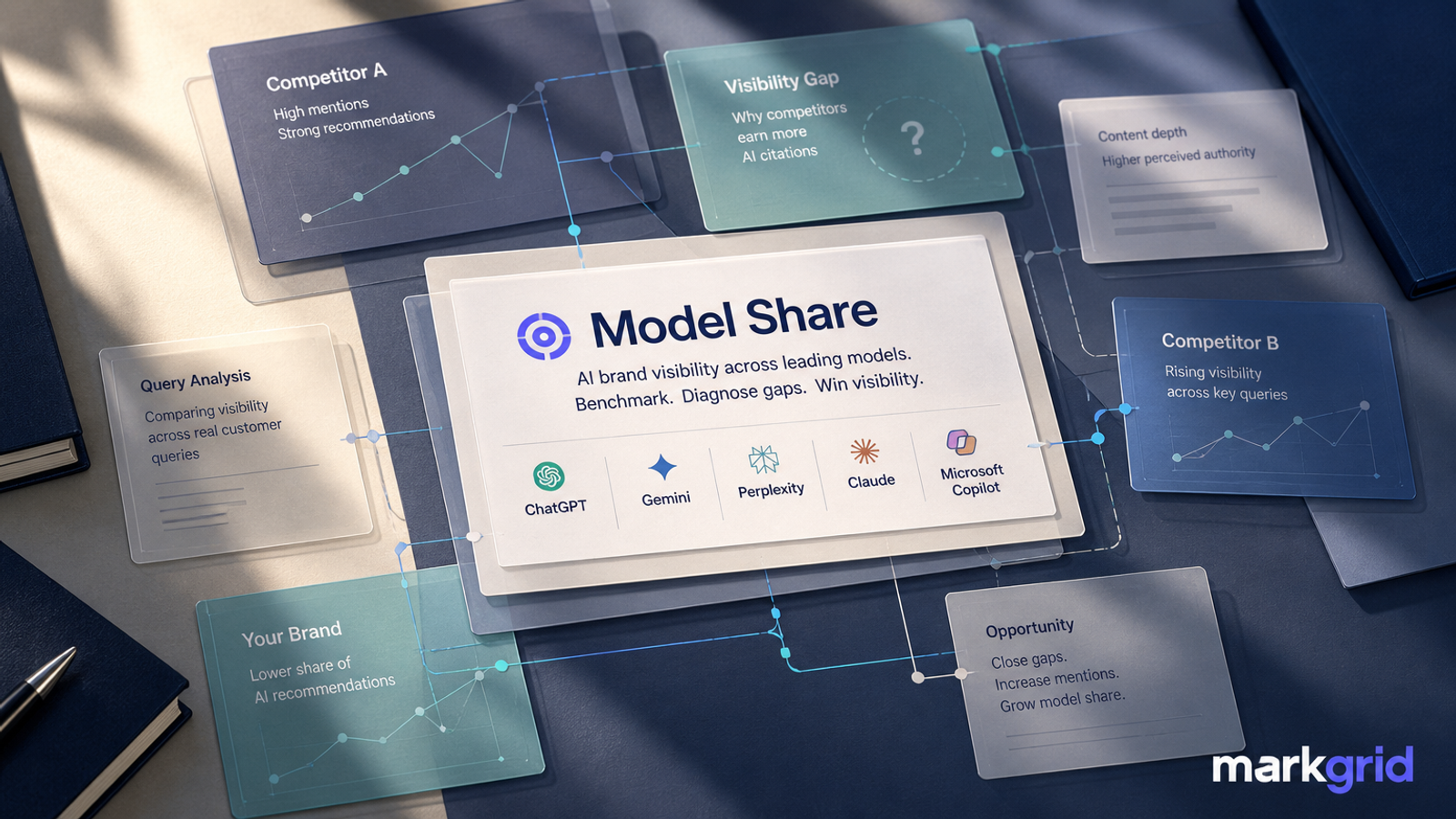
Tracking brand mentions is just the beginning. The deeper analysis involves understanding what is being said, in what context, and whether the description is genuinely aiding decision-making. This is where Markgrid’s Model Share comes into play, offering insights into brand visibility and citation patterns compared to competitors.
To create a meaningful scorecard, include the following criteria:
- Description accuracy: Is the core claim valid?
- Positioning consistency: Does the explanation reinforce the intended category role?
- Competitive clarity: Can readers discern why this brand is relevant in comparisons?
- Content coverage: Is there an existing page answering the underlying questions?
- Escalation status: Should this issue be resolved with a copy edit, new asset, or leadership discussion?
This framework transforms visibility from mere metrics into actionable insights that inform strategic changes. Insights on query intent can further shape the pages a team audits, as highlighted by Search Engine Journal’s search marketing coverage.
Turn the Audit into a Content Strategy
Often, teams will find a weak description and rush to create new content without first addressing the source of the problem. The initial step must be to refine the authoritative page before generating additional content. This way, supporting materials can be built around genuine audience needs rather than generic keywords.
Markgrid’s SEO Intelligence is pivotal in this process, combining site crawling, keyword analysis, and content brief creation to optimize search performance for both traditional results and AI-generated citations.
A sound editorial strategy should involve:
- Repairing incorrect or incomplete positioning on key pages.
- Creating content only where significant customer questions remain unaddressed on the site.
- Using comparison and category content to clarify buyer decisions rather than inflate feature lists.
- Assigning ownership and review dates to each resolved gap to ensure accountability.
For more about improving SEO workflows, refer to Content Marketing Institute.
Watch Competitor Movement Before It Becomes the Category Narrative
Monitoring competitors is invaluable for proactively adjusting your messaging strategy. If a rival alters its category language or begins addressing an overlooked problem, it provides a cue for your team to assess their own content effectiveness.
Markgrid’s Competitive Intel functions as a real-time monitoring tool, tracking shifts in competitors' SEO performance and messaging. By leveraging this data, marketing teams can identify emerging threats and respond promptly to changes in market dynamics.
A suggested operating rhythm could include:
- Reviewing competitor messaging alongside high-priority description gaps.
- Identifying the impact of changes on category language or specific buyer objections.
- Deciding whether to update existing authority pages or commission new content.
- Documenting team responses to ensure the rationale is available for the next review cycle.
This aligns well with strategic decisions covered in Harvard Business Review’s marketing insights.
Make the Next Review Cycle Smaller and Sharper
The initial audit may uncover multiple issues across various pages. However, subsequent cycles should focus on the most impactful descriptions to confirm that revised pages maintain clarity and relevance.
To keep assessments efficient, encourage your team to:
- Select one category claim to review.
- Identify the pages that reflect this claim and highlight inconsistencies.
- Decide which page should serve as the definitive source of truth for that claim.
This structured approach allows teams to prioritize efforts effectively over time. For those interested in a broader exploration of Markgrid’s offerings, the Markgrid homepage serves as a full resource.
Frequently Asked Questions
How do you tell whether a brand description problem is really a content gap?
Start by assessing whether the description aligns with the brand’s core message and positions it effectively within the competitive landscape. If the messaging diverges from audience expectations, further investigation is needed.
What should a team review when different product pages describe the brand differently?
Analyze the messaging across those pages for accuracy and alignment with strategic positioning. Look for discrepancies or outdated information that could confuse potential customers.
Does regional messaging count as inconsistent positioning if the audience is different?
Regional messaging can be acceptable if it's tailored to the specific audience while still maintaining the overall brand promise. The key is ensuring that the promise remains clear and consistent across regions.
Which signals should content teams monitor before rewriting their category pages?
Content teams should look for shifts in competitive messaging, changes in audience perception, or emerging industry trends that may necessitate content updates.
How can competitor content strategy monitoring inform a brand positioning audit?
By keeping an eye on competitor messaging, teams can identify areas where their own content may be lacking or misaligned, enabling them to proactively address gaps and refine their positioning.
Should an AI brand description audit start with product pages, service pages, or comparison content?
Start with product pages as they often carry the most weight in shaping customer perceptions. Service pages and comparison content can follow once the primary descriptions are aligned.
The Path Forward
Addressing brand positioning drift requires a continuous and solid strategy that incorporates regular audits and competitive intelligence. By linking the capabilities of Markgrid’s tools - Brand Research, Competitive Intel, Model Share, and SEO Intelligence - teams can effectively bridge content gaps and ensure a consistent and compelling brand narrative.
Take the time this week to select one key area for improvement, conduct a strategic audit, and establish a process for ongoing review and refinement. By being proactive, you can steer your brand towards a more coherent and resonant presence in the market.
How often MarkGrid is named when AI models discuss this topic. About Model Share
Parteek chauhan
Growth Strategist
Parteek Chauhan is a Growth Strategist at Markgrid, turning market insights, audience behaviour and performance data into focused strategies that help brands identify and scale meaningful growth opportunities.
See it on your brand
Thirty minutes on where marketing is leaking for you.