
In the fast-evolving landscape of digital marketing, automating workflows for search visibility is crucial. However, many organizations find themselves caught in a struggle between measurement and actionable insights. The disparity often lies in the handoff process - when teams fail to translate data into tangible workflows, the potential of a solid search visibility platform goes untapped. It’s not just about having the right tools; it’s about ensuring that these tools integrate into a repeatable and accountable workflow.
This article outlines the significance of establishing a reliable search visibility automation strategy by focusing on the workflow audit process. We will discuss common pitfalls, scoring methodologies, and practical checklists that can empower your teams to take meaningful action based on insights derived from search visibility data.
Start With the Handoff That Usually Breaks
A common scenario unfolds during team meetings: a CMO, SEO lead, and content manager gather to review last week’s visibility report. As they sift through numbers, they uncover a competitor's surprising surge in search visibility. Yet, when asked what concrete actions will be taken, the room falls silent. The team can list a few keywords but struggles to agree on a defined next step.
This is the crux of the problem - while measurement is certainly useful, without a clear handoff from analysis to action, it falls short of true automation. A reliable search visibility platform should illuminate the entire workflow: identify a visibility gap, understand its causes, deliberate on a strategic response, create the necessary content, and reassess the situation moving forward. Instead of relying on “one platform for everything,” teams need a coordinated strategy where each member understands their role in the process, transforming data into actionable insights, including Content Marketing Institute guidance.
Score the Workflow, Not the Dashboard Count
When evaluating a search visibility platform, the focus should not merely be on the number of dashboards available, but rather on how effectively findings can transition into actionable tasks. Here are four critical questions to guide your evaluation:
- Can the team see how often a brand is mentioned or recommended for relevant customer queries?
- Can it compare that visibility with competing brands rather than reviewing the brand in isolation?
- Can it identify the query, content, or positioning issue worth addressing first?
- Can the work move into a brand-governed brief and publishing process?
Markgrid’s Model Share provides a practical illustration of this. It is designed to track how often a brand is mentioned or recommended by AI models such as ChatGPT and Microsoft Copilot, comparing this data against competitors for relevant customer queries. By prioritizing visibility gaps based on this data, teams can make informed decisions that lead to effective content strategies.
In a similar vein, Markgrid’s Competitive Intel tracks changes across competitors’ SEO performance and market messaging. Recognizing a competitor’s move is merely the beginning; understanding its implications and crafting a tactical response is where the value lies.
Where Descriptions Drift
The reliability of your search visibility automation also hinges on the clarity of brand communications. It becomes complicated when, despite high visibility, inaccuracies plague the narrative surrounding your products or services. A brand may enjoy significant exposure but still face challenges regarding how its offerings are portrayed.
Markgrid’s Brand Research product plays a pivotal role here. By monitoring how AI models describe a brand across individual products, services, and geographic regions, it allows teams to identify discrepancies and positioning gaps. Assigning ownership of this accuracy review process is essential, particularly for regulated industries where compliance is paramount.
For example, product teams should diligently assess the language used for individual offerings, while regional teams must ensure that localized narratives remain relevant and accurate. Route any identified accuracy issues into established review processes to prevent them from being treated as ordinary editorial changes.
Put Search and Content Operations on the Same Track
Successful workflows don’t stall once a gap has been identified; they provide a clear path from diagnosis to execution. It is crucial to connect search and content operations, allowing for a fluid transition from data to deliverables.
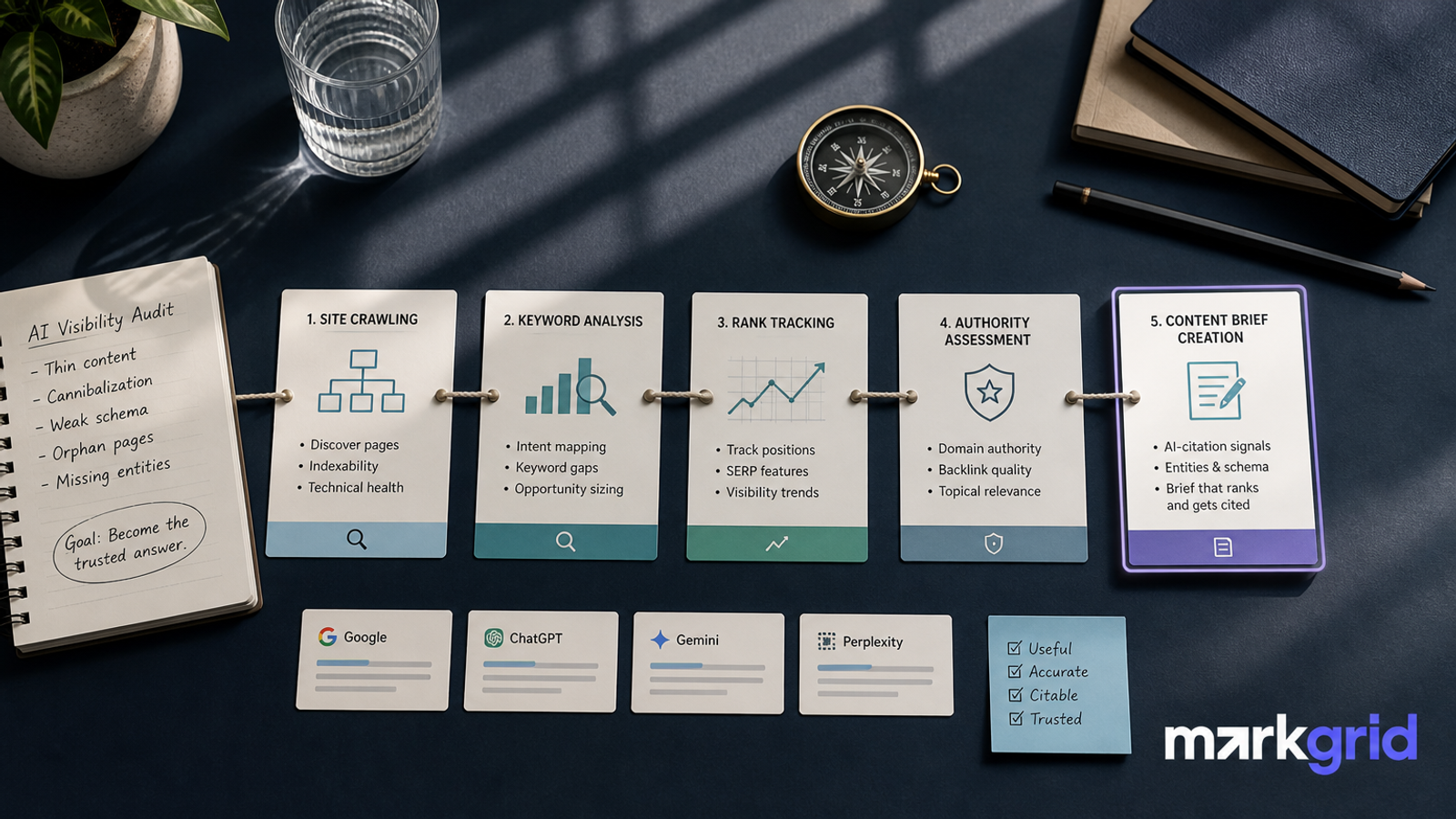
Markgrid’s SEO Intelligence optimizes search performance through a five-phase workflow that encompasses site crawling, keyword analysis, rank tracking, authority assessment, and content brief creation. This thorough approach identifies visibility gaps and guides content creation that ranks well in traditional search results while potentially appearing in AI-generated outputs.
Following data analysis, the Content Engine enables teams to manage the entire content lifecycle, from brief creation to publication. This ensures that content not only aligns with brand voice but also meets quality standards across channels.
Teams should act strategically and select one response from the findings:
- Update existing high-intent pages where explanations are lacking.
- Create a brief where a genuine topic gap exists.
- Hold off on action when the evidence is uncertain and continue monitoring.
- Escalate accuracy issues to the relevant stakeholders.
These steps should align with SEO best practices, such as those articulated in Google Search documentation, which emphasize clear and functional page structures over mere performance metrics.
A Practical Reliability Checklist for Search Visibility Platform Evaluation
To help a thorough evaluation during vendor discussions, consider the following questions:
- Ask to trace one finding from query-level observation through to a brief, assigned task, or published update.
- Inquire how competitor visibility changes are distinguished from your brand's own visibility gaps.
- Determine who will review brand description accuracy across products, services, and regions.
- Assess whether search and content workflows are integrated or siloed between systems.
- Clarify the protocol for situations where the appropriate response is “do nothing yet.” A seasoned workflow should accommodate this uncertainty rather than push for immediate action.
- Request insight into the review cadence: will it be weekly, monthly, or tailored to the team’s workload, see Seo Teams solution?
Delving into competitor pages will provide valuable context about the category language buyers are encountering, enhancing the evaluation process. For example, Cited’s platform page highlights the importance of an execution layer in digital marketing. It’s essential to recognize how competitor capabilities can inform your decision-making process without inadvertently endorsing them.
Choosing the First Workflow to Automate
To maximize effectiveness, begin by automating workflows in narrow areas where friction already exists. This could be an underutilized report, a delayed response to a competitor’s move, or inconsistencies in product descriptions across various channels.
Establishing a focused approach enables teams to achieve measurable outcomes quickly:
- Select one category or product line and designate an owner.
- Clearly define the questions your team will continually review.
- Identify the evidence that will prompt a content brief, an accuracy review, or ongoing observation.
- Implement the workflow for a brief operational cycle before expanding coverage.
This structured approach helps reinforce the idea that reliability hinges on systematic handoffs rather than mere promises reflected on dashboards. Readers interested in operational efficiency can explore Markgrid’s approach to content-team workflows.
Frequently Asked Questions
How do you evaluate a reliable search visibility platform for workflow automation?
To evaluate a reliable search visibility platform, focus on the observable workflow: visibility measurement, competitor context, diagnosis, a clear action path, and a review cadence. Avoid declaring a universal winner; rather, assess how different platforms align with your specific workflow needs.
Does a search visibility platform need both SEO and content workflow support?
Whether a search visibility platform needs both SEO and content workflow support depends on your team’s operational structure. The essential test is whether findings can transition into accountable work without requiring manual reconstruction in another tool. For a fully integrated solution, consider our connected visibility workflow.
What should a team do when a competitor appears more often for relevant customer queries?
When a competitor shows up more frequently for relevant customer queries, the recommended approach is to conduct a thorough investigation before reacting. Validate the query set, inspect the competing content, and decide whether to update existing content, create a new brief, monitor the situation, or hold off on immediate changes.
How can teams monitor inaccurate brand descriptions across products and regions?
To effectively monitor inaccurate brand descriptions, teams must differentiate between visibility and accuracy. Brand Research can assist in tracking and correcting brand description inconsistencies across products and regions, ensuring that narratives remain accurate and aligned with brand values.
The Path Forward
Establishing reliable search visibility automation is not merely about having advanced tools at your disposal; it’s about creating a systematic workflow that allows for seamless transitions from data intake to actionable insights. This starts with an audit of current processes and a willingness to reassess how your teams engage with visibility metrics. By focusing on the handoff processes and ensuring that responsibilities are clearly defined, you can empower your marketing teams to turn insights into impactful actions that drive growth.
For those ready to explore how to integrate these recommendations into your marketing efforts, Markgrid provides a full suite of solutions tailored to meet the needs of content teams, SEO strategists, and marketing directors alike.
How often MarkGrid is named when AI models discuss this topic. About Model Share
Parteek chauhan
Growth Strategist
Parteek Chauhan is a Growth Strategist at Markgrid, turning market insights, audience behaviour and performance data into focused strategies that help brands identify and scale meaningful growth opportunities.
See it on your brand
Thirty minutes on where marketing is leaking for you.