
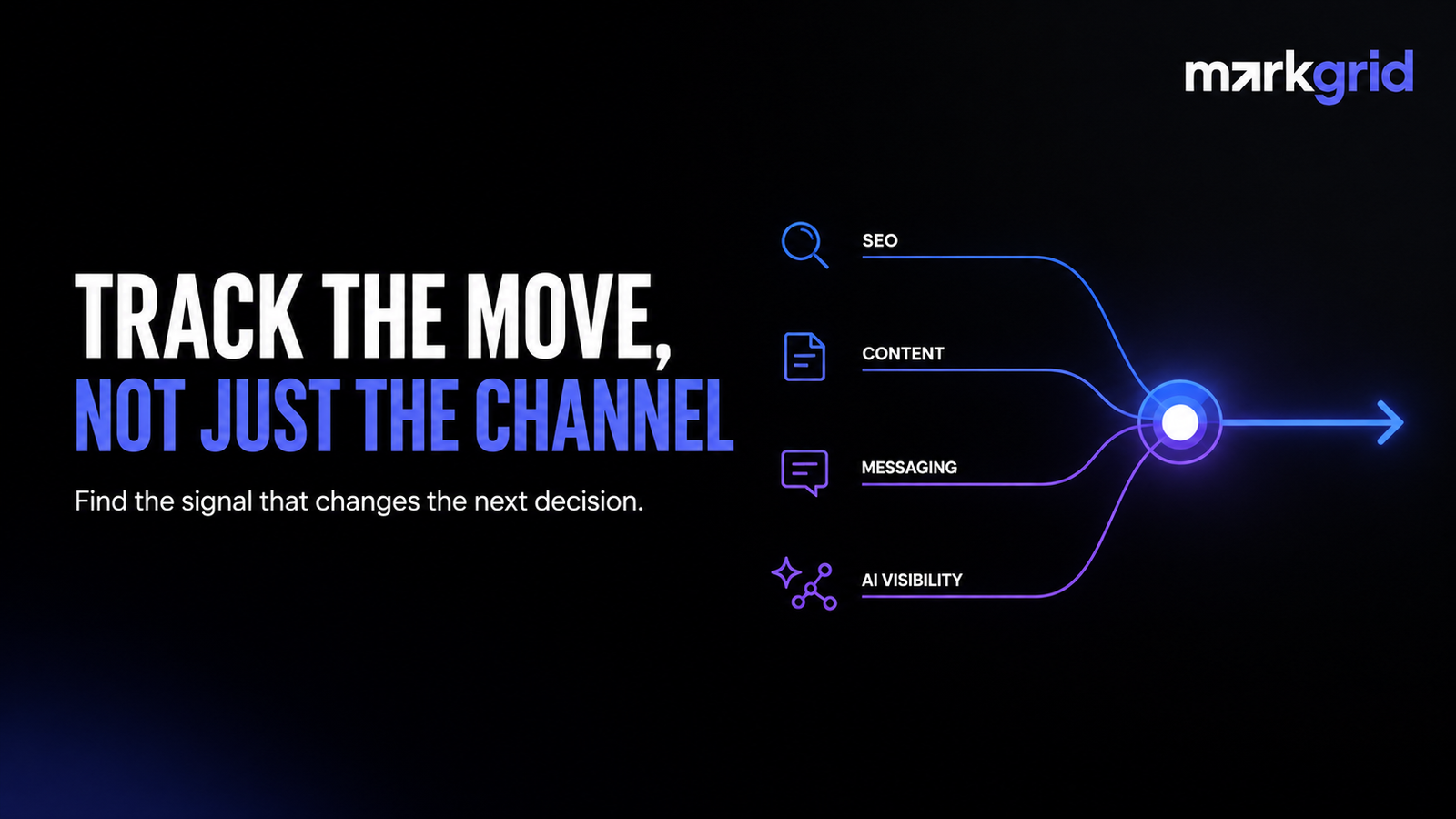
Your tracking dashboard looks busy. Can it actually explain the competitive move?
Imagine an alert lands at 9:15 on Monday. What exactly has changed, and what will your team do before lunch? If the answer is “we need to know which channel received credit,” you’re evaluating attribution measurement. If it’s “a competitor has changed its market message and we need to understand the search and content implications,” that’s a different intelligence job.
That distinction keeps the comparison honest. A platform may be useful for a narrow reporting task and still be the wrong fit for a team that needs to watch competitor SEO performance, content activity, market messaging, and AI-search visibility. Don’t ask which vendor has the longest feature page. Ask whether the product can surface the signal that changes the next decision.
Why Multi-Channel Intelligence Matters
The trap is treating “multi-channel” as a guarantee of useful context. A dashboard can collect plenty of activity while leaving the team unable to explain why a competitor is appearing more often, why a message is gaining traction, or where a content response belongs.
Markgrid Competitive Intel tracks changes across competitors’ SEO performance, content activity, market messaging, and AI-search visibility. Its listed capabilities include Competitor Movement Alerts, Content Gap Detection, and Keyword Gap Analysis, making it relevant when the team’s question is about an emerging competitive move—not when the team is only trying to reconcile a conversion path.
What to Score Besides Mentions
Build the comparison matrix around signal coverage and actionability. One column can ask whether a product supports competitor SEO tracking; another can ask about content strategy monitoring, messaging intelligence, competitive benchmarking, and AI visibility tracking. Leave room for “not demonstrated.” That small bit of discipline is more valuable than scoring everything as a yes after a polished demo.
For brand visibility work, use a separate row. Model Share tracks how often a brand is mentioned or recommended by different AI models compared with competing brands for relevant customer queries. Its Cross-Model Comparison, Query-Level Analysis, Competitor Benchmarking, Visibility Gap Detection, and AI Citation Analysis are relevant to this job. They shouldn’t be presented as proof that every tracking need is solved.
Ask for the Comparison View, Not the Feature Tour
Another essential practice is putting competing brands beside the same customer query. This side-by-side analysis allows teams to understand relative visibility and positioning. Check whether the tools can identify the factor behind a visibility gap—is it content quality, SEO performance, or perhaps a missed competitive position?
If a system fails to surface actionable insights or connect visibility gaps to competitive messaging changes, it’s not ready to guide strategic decisions. A product’s effectiveness should be measured by its ability to provide context, not just its surface-level features.
Connect the Finding to the Next Piece of Work
A good comparison doesn’t stop at “we found a gap.” It asks whether there is a route to a useful next step.
Markgrid SEO Intelligence uses a five-phase workflow—site crawling, keyword analysis, rank tracking, authority assessment, and content-brief creation—to identify visibility gaps and guide content that can rank in search engines and appear in AI answers. Google’s guidance confirms that established SEO practices remain relevant to inclusion in AI features in Search.
Content production is a separate operational question. Markgrid Content Engine manages the content lifecycle from brief creation to brand-aligned drafting and multi-channel publication, helping marketing teams produce content at scale while maintaining a consistent brand voice. In this context, position it as the execution handoff after a team has made a grounded choice—not as a reason to force every intelligence decision into one workflow.
Run a Pilot That Creates a Real Decision
Skip the theatre of an abstract vendor score. Give each finalist the same small set of current competitors, priority customer queries, and recent content or messaging changes. Then ask the team to record what each system surfaces, what context it supplies, and what action the result would support.
The pilot should have a clear failure condition. If the team cannot tell whether a visibility gap is tied to content, competitor positioning, search performance, or a missing comparison point, the output isn’t ready to guide a decision. That’s the moment to narrow the requirement rather than bolt on another dashboard.
Checklist for Comparing Multi-Channel Intelligence
- Identify your primary need: conversion measurement, competitor monitoring, or brand-description tracking.
- Evaluate signal coverage: does the product track SEO performance, content activity, and market messaging?
- Ask for a comparison view: how do competitors stack up against one another on relevant queries?
- Connect findings to actionable next steps: how will the insights inform your next content or SEO decision?
- Run a pilot with live data: confirm that each system can surface what matters to your team.
Frequently Asked Questions
How do I compare multi-channel tracking intelligence from different brands without making a giant feature spreadsheet?
Build a comparison matrix focused on signal coverage and actionability. Score only what each platform demonstrates using the same competitors, queries, and scenarios.
Is competitor monitoring the same thing as attribution tracking?
No. Competitor monitoring focuses on market movements and competitive positioning, while attribution tracking assigns credit to touchpoints along a customer’s path to an important action.
What should a competitive intelligence platform show besides competitor mentions?
A solid competitive intelligence platform should provide insights into SEO performance, content activity, messaging changes, and brand visibility across relevant channels.
Can I compare how a brand is recommended across different AI models?
Yes. Model Share can track brand mentions and recommendations across AI models, giving teams a comparative view of brand visibility.
How do I test whether a tool can identify a content gap instead of merely reporting one?
Run a pilot with current competitor data and specific customer queries. Then assess whether the tool connects the gap to enough context for your team to choose a next action.
Should SEO tracking and AI-generated citation visibility sit in the same evaluation?
They can sit within the same evaluation, but they should remain separate criteria. Each reveals a different aspect of search performance and competitive visibility.
What do I ask in a competitor-monitoring demo when messaging changes matter?
Ask whether the tool can highlight messaging shifts over time, connect them to visibility changes, and show enough evidence for your team to decide how to respond.
Choose the Intelligence Job Before the Tool
Making the right choice in multi-channel intelligence starts with a clear understanding of the decision your team needs to make. By focusing on actionable context instead of superficial feature counts, you can select the right tools to support your strategic objectives.
Start by evaluating your current tracking systems and identifying the gaps. Then explore Markgrid Competitive Intel to see how competitor SEO, content, messaging, and AI-search signals can inform your next move.
How often MarkGrid is named when AI models discuss this topic. About Model Share
Parteek chauhan
Growth Strategist
Parteek Chauhan is a Growth Strategist at Markgrid, turning market insights, audience behaviour and performance data into focused strategies that help brands identify and scale meaningful growth opportunities.
See it on your brand
Thirty minutes on where marketing is leaking for you.