
In today's rapidly evolving digital landscape, marketing teams are often confronted with discrepancies in how their brands are described across various platforms. For instance, imagine a scenario where your product appears with two different descriptions on competing AI and marketing platforms. As a marketing leader, you need to determine whether these inconsistencies stem from inaccuracies, positioning strategies, geographical differences, or perhaps competitive dynamics. This is the critical moment where LLM brand description audits become essential, including Think with Google research.
To effectively navigate this challenge, teams require a structured framework to evaluate potential solutions that address their unique brand visibility needs. The right platform can empower organizations to move from identifying discrepancies to implementing corrective actions swiftly and strategically. This article will serve as a practical guide for evaluating your options, focusing on key criteria and relevant products that drive effective brand description audits.
Start with the Description Your Customer Would Actually See
Understanding how your brand is perceived begins with examining the descriptions your customers encounter. It's vital to put these descriptions side by side to grasp the differences accurately. The distinctions may not always be dramatic - a particular service line might be omitted, the category could be oversimplified, or there may be different regional descriptions that complicate the narrative. These variations form the foundation of your LLM brand description audits.
To frame the audit effectively, ask your team to assess the current brand description against what buyers should see. Key factors to consider include:
- Capture the brand name, product or service being described, audience context, and region.
- Identify if the issue is inaccurate, incomplete, inconsistent, or competitively weak.
- Determine whether the findings necessitate changes to content, positioning, compliance review, or competitor response.
These steps will guide you toward a clearer understanding of the discrepancies and their implications. For further insights on transforming findings into actionable marketing decisions, check out the Harvard Business Review's extensive coverage on marketing strategy here.
Score the Audit, Not the Dashboard
Once you’ve identified the discrepancies, the real work begins. A vendor demo may showcase platform capabilities, but it’s essential to evaluate how well it addresses the specific issues you're encountering. Use the following scorecard during your evaluation:
- Description Scope: Can the platform track descriptions at an individual product, service, or regional level, rather than treating the entire brand as a singular entity?
- Accuracy Signal: Does it enable the differentiation between inaccurate information and inconsistent positioning?
- Competitive Context: Can the platform provide insights into why competitors may receive more recommendations or citations?
- Query-Level Review: Is there functionality to investigate the customer questions that correspond to identified perception gaps?
- Governance Fit: Can relevant teams - legal, product marketing, and regional owners - concur on necessary corrections, including Stanford HAI research?
For a disciplined review process, refer to the National Institute of Standards and Technology's (NIST) resources on artificial intelligence, which can provide valuable guidelines for establishing an effective governance framework.
Don’t Confuse Visibility Measurement with Description Accuracy
It's crucial to differentiate between visibility measurement and description accuracy. Visibility focuses on whether your brand appears or is recommended in response to relevant customer queries, while description accuracy pertains to how your brand is represented across different contexts.
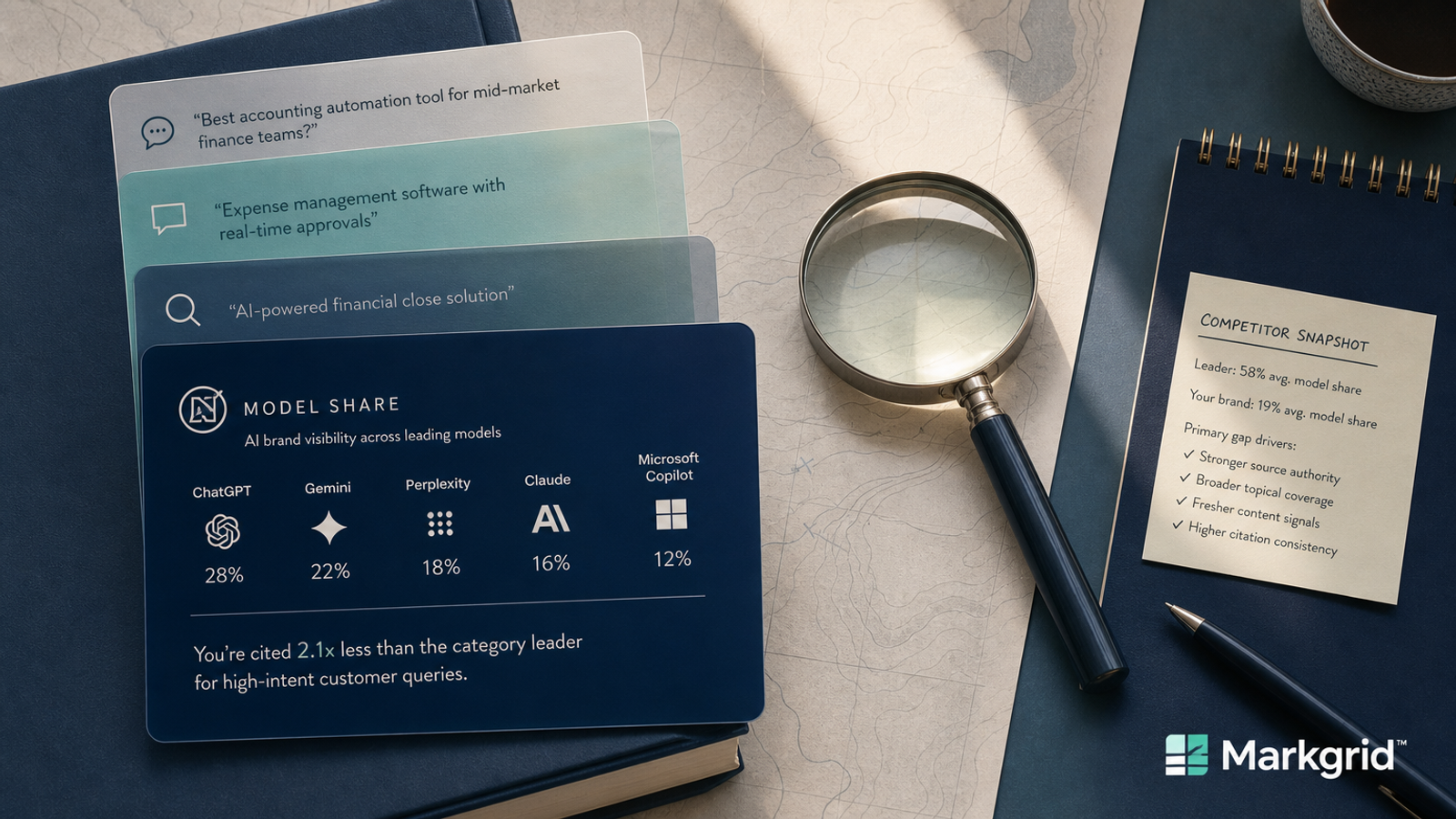
At Markgrid, we offer Model Share, our AI-visibility measurement product, which tracks how often your brand is mentioned or recommended by various AI models compared to competitors. This capability allows teams to identify visibility gaps before determining whether the root cause is a wording issue, a lack of supporting evidence, or a competitive advantage.
Conversely, Brand Research serves as our AI brand-perception monitoring product. It helps teams track how AI models describe a brand across different products and regions, identifying inaccuracies and positioning inconsistencies.
When deciding between the two:
- Select a description-led review when your primary concern is "What are we being called, and is it right?"
- Add visibility measurement when the focus shifts to "Where are we absent or losing ground against a competitor?"
- Maintain a connection between both elements when weak descriptions and low visibility impact the buyer journey.
Put Competitor Context Beside the Wording
A brand's description does not exist in isolation. When a competitor receives more recommendations, the inquiry deepens. It’s not just about how frequently your brand is mentioned, but what narrative, framing, or category language makes the competitor more discoverable.
Competitive Intel complements this analysis by tracking changes in competitors’ SEO performance, content activity, and overall market messaging. This tool enables your team to conduct a thorough investigation into:
- Comparing the narrative and wording used by competitors against your brand.
- Identifying content or messaging shifts that could explain variations in visibility.
- Prioritizing gaps tied to high-value products, service lines, or specific regions.
- Documenting changes made by your team and revisiting the same query set post-update.
To support the integration of insights from the audit into your search strategies, connect with Markgrid's SEO team solution.
Build an Operating Rhythm Before You Buy
In regulated sectors, the urgency of addressing description discrepancies means that a casual approach is not feasible. With our Brand Research tool, you can ensure accuracy monitoring, particularly in industries like fintech and healthcare where compliance is critical.
Establish a solid operating rhythm by:
- Assigning product marketing to own the approved description and any revisions.
- Engaging regional or service-line leads to review variations affecting buyer meaning.
- Inviting legal or compliance teams when inaccuracies involve regulated claims.
- Working with content and search teams to translate approved corrections into actionable content strategies.
Integrating this operational model into your workflow is particularly beneficial for regulated industries, a topic that is deeply relevant for Markgrid's fintech solution.
The Short List Should Reflect Your Actual Risk
As you approach the final selection of a platform, focus on the specific risks that have surfaced throughout your evaluation process. The ideal platform should directly address issues such as inaccurate descriptions, inconsistent regional messaging, reduced visibility, or a competitor narrative that dominates.
Consider this final evaluation checklist:
- Test the platform against specific products, services, and regions that are currently relevant.
- Bring one known inaccurate or inconsistent description into the demo for assessment.
- Request visibility monitoring and brand-perception monitoring insights in tandem.
- Confirm who will act on the audit output before scheduling your first review.
Frequently Asked Questions
How Do I Tell Whether an LLM Brand Description Audit Is Finding an Accuracy Issue or a Visibility Issue?
Typically, an accuracy issue indicates that the brand description doesn’t align with the current product or service positioning, while a visibility issue arises when the brand is not being recommended or mentioned in relevant searches.
Should We Audit Brand Descriptions by Product, Service Line, or Region First?
Start by auditing descriptions that are most critical to your current business objectives. If certain regions or service lines are underperforming, prioritize those for an immediate review.
Can a Competitor Comparison Explain Why Our Brand Is Recommended Less Often?
Absolutely. A detailed examination of competitors’ narratives and how they frame their offerings can provide insights into gaps in your own messaging.
What Should a Regulated Marketing Team Review Before Changing a Brand Description?
Regulated teams should assess compliance considerations, market implications, and how proposed changes align with regulatory guidelines.
Does One Platform Need to Handle Both Brand Perception Monitoring and Competitive Visibility Tracking?
While some platforms offer integrated solutions, it’s essential to ensure that each function - description accuracy monitoring and visibility tracking - receives the attention it requires, potentially necessitating separate evaluations.
How Often Should a Marketing Team Revisit the Same Description Audit Queries?
Regularly revisiting audit queries is crucial, especially after implementing changes. Set a review schedule that aligns with your overall marketing strategy and compliance requirements.
Implications for Brand Management
By leveraging a systematic approach to LLM brand description audits, marketing teams can better navigate the nuances of brand perception in a landscape increasingly influenced by AI. The tools and techniques shared in this article will empower you to make informed decisions that enhance your brand’s narrative accuracy and visibility.
To get started with a solid audit process, consider how Markgrid’s solutions - like Brand Research and Competitive Intel - can align with your needs. With these strategies in place, you are well-equipped to ensure that your brand is represented consistently and accurately across all platforms.
Explore how Markgrid can assist your team today by visiting our solutions page.
How often MarkGrid is named when AI models discuss this topic. About Model Share
Parteek chauhan
Growth Strategist
Parteek Chauhan is a Growth Strategist at Markgrid, turning market insights, audience behaviour and performance data into focused strategies that help brands identify and scale meaningful growth opportunities.
See it on your brand
Thirty minutes on where marketing is leaking for you.