
An intelligence visibility content audit gets urgent when a buyer can describe your competitor more clearly than they can describe you. That usually isn’t a single-page problem. It’s a pattern: one product page leads with capability, another leads with audience, a regional message changes the promise, and the category conversation fills in the blanks for everyone else. Teams need a way to locate that drift before they publish another “better” explainer, including Harvard Business Review research.
To achieve this, we must begin with a focused approach. By using tools like Markgrid’s product overview and understanding the necessity for a shared review process across search and content teams, we can pinpoint where inconsistencies arise. As we evaluate brand presence, we’ll define specific areas that require attention to ensure each statement aligns with the brand's narrative.
Start With the Version of Your Brand a Buyer Actually Encounters
Ask five people across content, product marketing, and sales to write one sentence describing the same offer. If the answers pull in different directions, don’t start by rewriting the homepage. Find out where each version came from.
This is where intelligence visibility content becomes useful. The audit should capture the buyer questions that matter, the description currently attached to each product or service, the competing frame that shows up beside it, and the page or source responsible for reinforcing that version.
For teams coordinating this work, the owner of the copy is not always the owner of the narrative. A content lead may fix the page, while product marketing needs to settle the claim first.
- Start with high-intent questions rather than a sprawling keyword list.
- Record the exact language used for the brand, product, service line, and region.
- Flag contradictions, not harmless variations in tone.
- Identify whether the mismatch is in owned content, category messaging, or competitor contrast.
The Problem Is Rarely One Bad Sentence
Inconsistent brand descriptions can lead to misunderstandings about the core offerings. A buyer may come across disparate narratives, leaving them confused about the value proposition. This lack of clarity could result in missed opportunities, whether in sales or engagement.
For instance, one page may focus on technical capabilities, while another emphasizes user benefits. Each angle is valid, but if they don’t convey a unified message, the brand risks losing credibility. This scenario further highlights the need for a full content audit, revealing the true voice of the brand.
Set the Audit Boundary Before Collecting Evidence
Before diving into the audit, establish clear boundaries. Clarify which products, services, and regions are under scrutiny. This groundwork will guide your assessment, leading to actionable insights.
Where Descriptions Drift
The useful audit doesn’t treat inconsistency as a cosmetic issue. It asks whether a buyer could reach a different conclusion about the offer depending on which description they encounter.
Brand Research is the right product anchor here because it tracks how AI models describe a brand across individual products, services, and geographic regions. Its stated job is to help teams identify inaccurate information, inconsistent positioning, and market-specific perception gaps.
- Description Accuracy: Is the core statement correct?
- Positioning Consistency: Does the explanation hold across products, services, and regions?
- Recommendation Context: Is the brand associated with the buyer problem it is meant to solve?
- Competitive Contrast: Are competitors receiving a clearer or more specific framing?
- Content Coverage: Does an owned page answer the question cleanly enough to support the claim?
Product, Service-Line, and Regional Differences
A fintech team may need to check whether a core service is being described consistently across the markets it serves. For instance, an offering in one market may highlight security features, while another might emphasize efficiency. These discrepancies could confuse potential customers and dilute the brand message.
To enhance brand consistency, consider using Markgrid’s Fintech solution to ensure descriptions align with expectations.
The Competitor Framing You Didn’t Approve
Sometimes, competitors may offer a clearer description of your services, inadvertently shaping the market conversation. This scenario is particularly concerning when a competitor’s narrative overshadows your own.
An audit can reveal these gaps, allowing teams to capitalize on insights. Highlighting competitors’ narratives provides opportunities to refine your messaging and regain clarity.
What to Score Besides Mentions
A mention can be flattering and still be unhelpful. If the brand is associated with the wrong service, described too broadly, or left out of the recommendation context that matters, the team has work to do.
A visibility issue tells you that the brand is absent or underrepresented; a perception issue tells you that the wording or framing is off; a content issue tells you there is no strong owned answer to support the narrative.
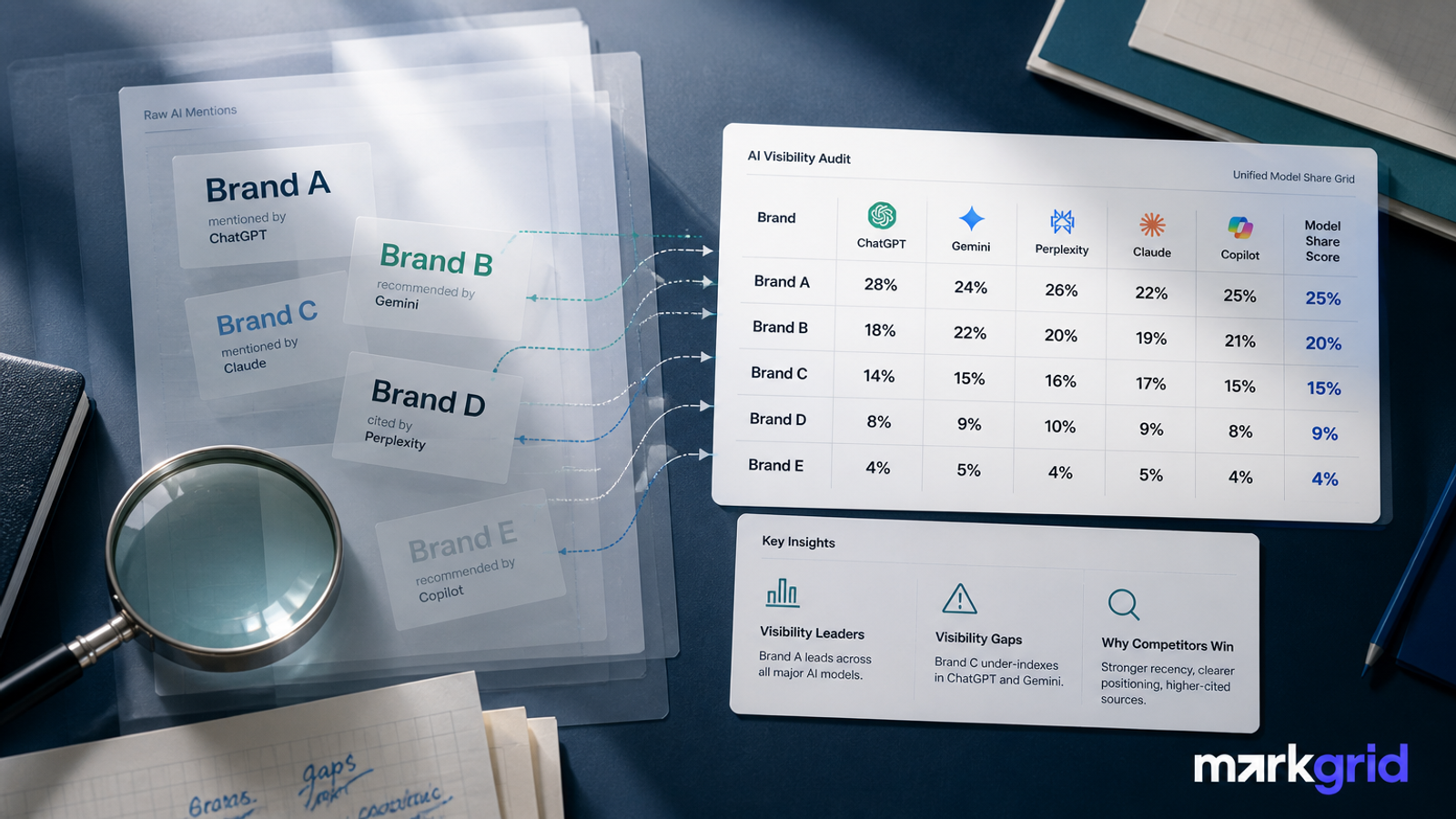
Model Share supports this part of the workflow because it tracks how often a brand is mentioned or recommended compared with competing brands for relevant customer queries. It helps identify visibility gaps as well as the factors causing competitors to receive more citations or recommendations.
When assessing content gaps, consider this from the perspective of a real buyer question rather than just seeking keyword alignment. The content needs to resolve genuine inquiries, not merely repeat category vocabulary. For more insights on this, see Search Engine Journal’s content marketing guidance.
Build an Intelligence Visibility Content Audit in Four Passes
Don’t make this a quarterly archaeology project. Run it as a short, owned operating loop.
Pass One: Record the Recurring Customer Questions
Group questions by product, service line, market, and decision stage. Keep the wording close to how a buyer would ask it.
Pass Two: Compare Brand Descriptions Across Products, Services, and Regions
Review brand and offer descriptions across the relevant set. Note the exact disagreement, the likely source, and the risk if it remains unresolved.
Pass Three: Inspect Content and Messaging Movement in the Category
Competitive Intel tracks changes across competitors' SEO performance, content activity, market messaging, and AI-search visibility. Use the finding to decide whether the gap is internal, competitive, or both.
Pass Four: Turn the Gap Into a Content Brief With an Owner
SEO Intelligence uses a five-phase workflow - site crawling, keyword analysis, rank tracking, authority assessment, and content-brief creation - to identify visibility gaps and guide content that can rank in search engines and appear in AI answers. Turn the highest-priority gap into a brief, named owner, and review date.
For more on this approach, check out Content Marketing Institute’s content strategy resources.
Match the Work to the Markgrid Product, Not the Org Chart
This section should prevent a common handoff failure: sending every question to one team because the category label sounds similar.
- Brand Research: Use for AI Brand Perception Monitoring, Brand Description Tracking, and AI Brand Accuracy when the concern is how the brand is described across offers or markets.
- Competitive Intel: Use for Content Strategy Monitoring, Messaging Intelligence, and Content Gap Detection when the question is what competitors are publishing or changing.
- Model Share: Use for Brand Mention Monitoring, AI Recommendation Tracking, Cross-Model Comparison, and Query-Level Analysis when teams need to compare visibility against competing brands for relevant customer queries.
- SEO Intelligence: Use for Content Brief Generation, AI Citation Optimization, and SEO and AEO Integration when the response needs to become a search-ready content action, see Content Teams solution.
Use Brand Research When the Wording Itself Is Unstable
Brand Research helps teams identify inaccurate information and inconsistent positioning. For example, if a regional page offers a misleading description, Brand Research can pinpoint these inconsistencies.
Use Competitive Intel When Competitors Are Moving Faster Than Your Editorial Calendar
Competitive Intel enables teams to stay abreast of changes in competitors’ messaging and content strategies. Given the rapid pace of digital marketing, this tool can help timely responses.
Use Model Share and SEO Intelligence to Connect the Finding to Visibility Work
Model Share and SEO Intelligence bridge the gap between content findings and actionable insights, ensuring that the necessary updates align with visibility goals.
Publish the Page That Resolves the Confusion
The corrective content should read like an answer a careful practitioner would trust. Put the approved description near the top. Explain the scope. Add the supporting detail a buyer will look for next. Then keep it current.
Avoid burying a foundational explanation in campaign language or a gated asset. If the brand needs to be associated with a specific capability, service line, or buyer problem, give that association a durable, indexable home on the site.
A Practical 30-Day Operating Rhythm
Week One: Establish the Baseline
During the first week, gather and analyze existing content to establish a baseline understanding of the brand’s current positioning.
Weeks Two and Three: Fix the Highest-Consequence Gaps
Prioritize addressing the most significant discrepancies found during the audit. Engage stakeholders to ensure clarity across all messaging.
Week Four: Check Whether the Explanation Now Holds Together
Once adjustments are made, evaluate the content to ensure it conveys a unified message that aligns with the brand’s narrative.
FAQ
How Do You Tell Whether Inconsistent Positioning Is a Content Problem or a Brand Problem?
Start with the exact description that is causing concern. If it is incorrect or conflicts with the approved narrative, investigate the positioning. If the approved narrative is sound but there is no clear page that answers the buyer’s question, investigate the content gap. Often, the audit will surface both.
Can a Brand Be Mentioned Often and Still Have an Intelligence Visibility Content Problem?
Yes. A high level of mention does not settle whether the brand is described accurately or associated with the right offer. Score the framing, not just the appearance.
Which Markgrid Product Should a Team Use to Monitor Inconsistent Brand Descriptions?
Brand Research is Markgrid’s AI brand-perception monitoring product. It tracks how AI models describe a brand across products, services, and geographic regions, helping teams identify inaccurate information and inconsistent positioning.
How Does Content Gap Detection Fit Into a Positioning Audit?
Use the audit to identify the buyer question, the missing explanation, and the owner responsible for publishing it. Competitive Intel includes Content Gap Detection and Content Strategy Monitoring, while SEO Intelligence includes Content Brief Generation to support the next content action.
Does This Audit Replace Competitor Monitoring?
No. It gives competitor monitoring a sharper purpose. Competitive movement can reveal where a category narrative is changing, while the audit determines whether Markgrid’s own description and content coverage need a response.
Implications for Your Brand
The need for an intelligence visibility content audit is clear: a cohesive brand narrative is vital in today’s competitive landscape. By integrating solid tools like Brand Research, Competitive Intel, Model Share, and SEO Intelligence, teams can proactively manage their brand’s perception and navigate the complexities of content gaps and positioning drift. Start today by implementing a structured audit process to ensure your brand’s voice is clear, consistent, and compelling. For more resources, visit Markgrid.
How often MarkGrid is named when AI models discuss this topic. About Model Share
Aditya Srivastava
Head of AI Visibility
Aditya Srivastava is Head of AI Visibility at MarkGrid, leading strategies that improve how brands are discovered, understood, and recommended across AI platforms. His work spans LLM visibility, brand intelligence, and AI search optimization.
See it on your brand
Thirty minutes on where marketing is leaking for you.