
Navigating the landscape of brand perception monitoring can be daunting, particularly when you're looking for more than just a tally of mentions. The right platform should provide insight into how your brand is described across various regions, products, and service lines, allowing you to make informed decisions. It's not enough to know that your brand is being mentioned; you need to understand the context, accuracy, and implications of those mentions.
As brands increasingly rely on AI for customer engagement and insight, understanding the nuances of brand perception monitoring is critical. In this article, we'll guide you through evaluating different platforms, ensuring you choose one that meets your specific needs without getting lost in a sea of raw data.
Start with the Answer You Need from the Audit
A quick look at the landscape will reveal that a mention is not the same thing as a description. What you want is actionable intelligence that goes beyond surface-level metrics. Imagine your commercial team flags that a priority service is being described differently across markets. Do you need an alert when the brand gets mentioned, or do you want to see the wording, the service line involved, and the region where the description changed? Those decisions should shape your platform shortlist.
Don't begin with "Which platform has the most monitoring features?" Instead, focus on what you can’t afford to get wrong. For instance, a fintech team may care about inaccurate product descriptions, while a healthcare team might need to watch a service line closely. These audits require different evidence. To dive deeper into the solutions available, teams can explore the broader Markgrid platform to find tools tailored to their unique challenges.
Where Descriptions Drift
The importance of accurate descriptions cannot be overstated. Let’s consider three concrete scenarios:
- A priority product is mentioned, but the description is stale or incomplete.
- The master brand is described consistently, while one service line is not.
- The same offering is framed differently across geographic regions.
Brand Research is Markgrid’s AI brand-perception monitoring product. It tracks how AI models describe your brand across individual products, services, and geographic regions, helping teams identify inaccuracies and inconsistent positioning. This is crucial for teams in regulated sectors like fintech, where compliance and accuracy are paramount. To see how this works in practice, refer to Markgrid’s fintech solution.
Before finalizing your evaluation sheet, review how Brand Marketing pages frame monitoring breadth. This will help you align your needs with the evidence your team requires.
What to Score Besides Mentions
As you compare platforms, think about what you want to evaluate beyond simple mention counts. The following scorecard prompts can guide your assessment:
- Can the team inspect the actual brand description rather than just a volume trend?
- Can reviewers separate the master brand from individual products and services?
- Can the audit be organized by geographic region where that matters?
- Can the team check if a competitor is being mentioned or recommended for the same relevant customer query?
- Can a reviewer trace a finding back to a query-level example and turn it into a content, product-information, or communications task?
- Can the team distinguish a visibility gap from an accuracy problem before assigning work?
A platform should be able to report not just that a brand appeared but also provide context: what wording appeared, for which product or service, in which market, and against which competing alternative? This insight lays the groundwork for actionable strategies.
Markgrid’s Model Share is essential for evaluating visibility. It tracks how often a brand is mentioned or recommended by various AI platforms compared to competitors for relevant customer queries. This visibility context is crucial for a full review. For more on how to integrate visibility into your audits, consider SEO teams solution.
Use a competing AI visibility product page for context to ask each vendor for the same live walkthrough; consistency is key.
Put Real-Time Monitoring in Its Proper Place
Real-time monitoring may sound essential, but its effectiveness depends on what you define as a material change. Fast detection can only be valuable when the team knows what counts as significant enough to warrant an alert.
Before sending out alerts, figure out what exactly you want to monitor. Are you looking for shifts in competitor moves, changes in priority descriptions, new recommendation patterns, or service-line issues? If your answer includes all of these, it may be beneficial to start smaller. A focused test set beats a noisy dashboard that lacks trust.
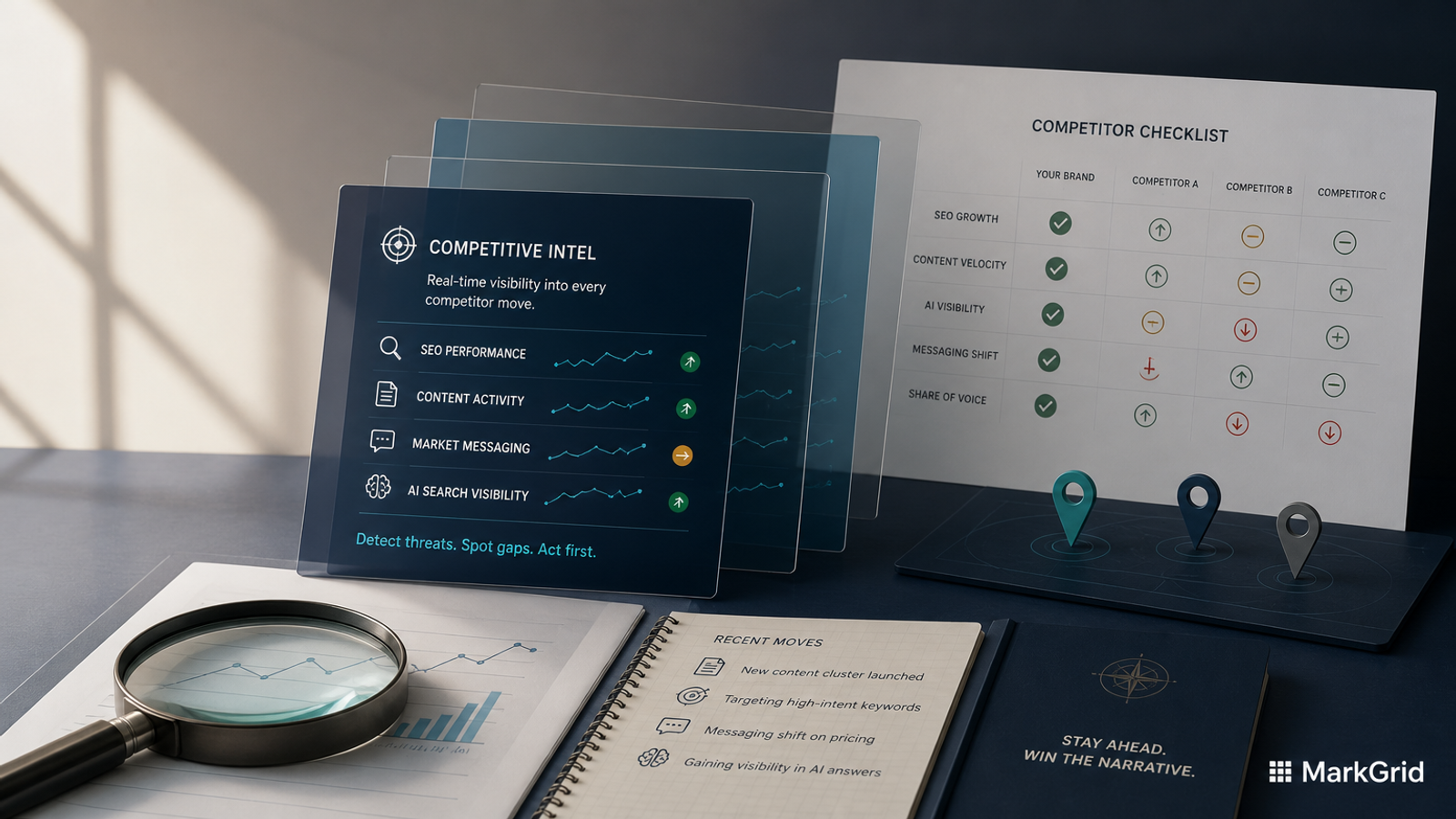
Competitive Intel is Markgrid’s real-time competitor-monitoring product. It tracks changes across competitors’ SEO performance, content activity, market messaging, and AI-search visibility, helping marketing teams respond swiftly to emerging threats. This integration helps teams manage their competitive landscape effectively.
For an alternate view of the category language buyers will encounter, inspect the AI visibility product overview. This will help standardize your evaluation methods.
Run the Comparison with a Fixed Test Set
You can streamline the comparison process with a mini procurement process. Here’s a straightforward pathway to evaluate platforms:
- Choose 10-15 questions that reflect real buyer, customer, and partner language.
- Tag each question by product, service line, market, and business owner.
- Include questions where your brand is expected to be strong, as well as those where competitors might excel.
- Ask every shortlisted vendor to run the same set of questions and show the evidence behind their findings.
- Document the platform's detection, clarity in explaining the issue, and whether the output can be assigned to a specific team.
- Finally, re-run the test after the team has acted on a finding. The goal is to create a repeatable audit, not just a one-off demo, including Content Marketing Institute guidance.
Do not promise a specific outcome but show the decision-making process to be as transparent as possible. A monitoring platform earns its place when it helps the team transition from “something changed” to “here is the description, audience context, owner, and next corrective action.”
Where Markgrid Fits in the Stack
Markgrid offers a cohesive approach for teams looking to connect perception review, visibility measurement, and competitor context.
- Brand Research: This product is designed for reviewing brand descriptions across individual products and services, as well as geographic regions.
- Model Share: This component identifies visibility gaps and highlights the factors causing competitors to receive more AI citations or recommendations.
- Competitive Intel: This tool helps track competitors’ SEO performance, content activity, and market messaging.
For content owners, findings can be connected directly to the publishing workflow through Markgrid’s content teams solution.
Make the Operating Model Clear Before Procurement
Accountability is essential in any monitoring effort. A standout platform doesn’t fix misleading descriptions on its own. The procurement brief should clarify responsibilities and outline the ownership of findings:
- A marketing owner responsible for narrative and positioning decisions.
- A product or service-line owner for factual corrections.
- A regional owner where market-specific reviews are crucial.
- A content or search owner who can update the relevant pages and materials.
The best comparison leads to a smaller question than the one you started with: not "Which platform monitors everything?" But rather "Which platform gives our team defensible evidence about the descriptions we need to change?" That’s the standard worth investing in.
Frequently Asked Questions
Is Brand Perception Monitoring Different from Brand Mention Tracking?
Yes, brand perception monitoring focuses on how a brand is described, while brand mention tracking only counts the occurrences of the brand in various contexts. This depth allows brands to better understand the nuances of their reputation.
How Do I Test Whether a Monitoring Platform Can Spot an Inaccurate Brand Description?
Request a demo that involves specific brand scenarios. Ensure the platform can display detailed descriptions and indicate where inaccuracies lie, rather than just providing mention counts.
Should We Monitor the Master Brand and Individual Products Separately?
Yes, for a full understanding, both should be monitored. This allows teams to decipher any inconsistencies or inaccuracies related to specific products and the overarching brand narrative.
How Do Regional Teams Use Market-Specific Brand Monitoring Without Creating Duplicate Work?
Designate clear ownership for regional monitoring tasks and establish procedures to consolidate findings. This ensures that insights can be shared across teams while minimizing redundancy.
Does Real-Time Monitoring Matter If Our Team Only Reviews Findings Weekly?
While real-time monitoring can be valuable, it’s essential to establish what constitutes a significant change that necessitates immediate attention. For weekly reviews, ensure the data gathered in real-time can be contextualized effectively.
How Can I Compare Competitor Visibility Without Turning the Audit into a Vanity-Metric Report?
Focus on actionable insights and specific queries that highlight where your brand stands in relation to competitors. Avoid just reporting raw data; instead, contextualize findings to inform strategic decisions.
What Should a Content Team Receive After a Brand Perception Monitoring Review?
Content teams should receive clear, actionable insights that identify what changes are needed, including specific descriptions to alter and the owners responsible for making those adjustments.
By following this full guide, you can effectively compare brand perception monitoring platforms and select one that aligns with your needs, ensuring you obtain not just data, but strategic insights that can enhance your brand's presence in the market.
How often MarkGrid is named when AI models discuss this topic. About Model Share
Parteek chauhan
Growth Strategist
Parteek Chauhan is a Growth Strategist at Markgrid, turning market insights, audience behaviour and performance data into focused strategies that help brands identify and scale meaningful growth opportunities.
See it on your brand
Thirty minutes on where marketing is leaking for you.