
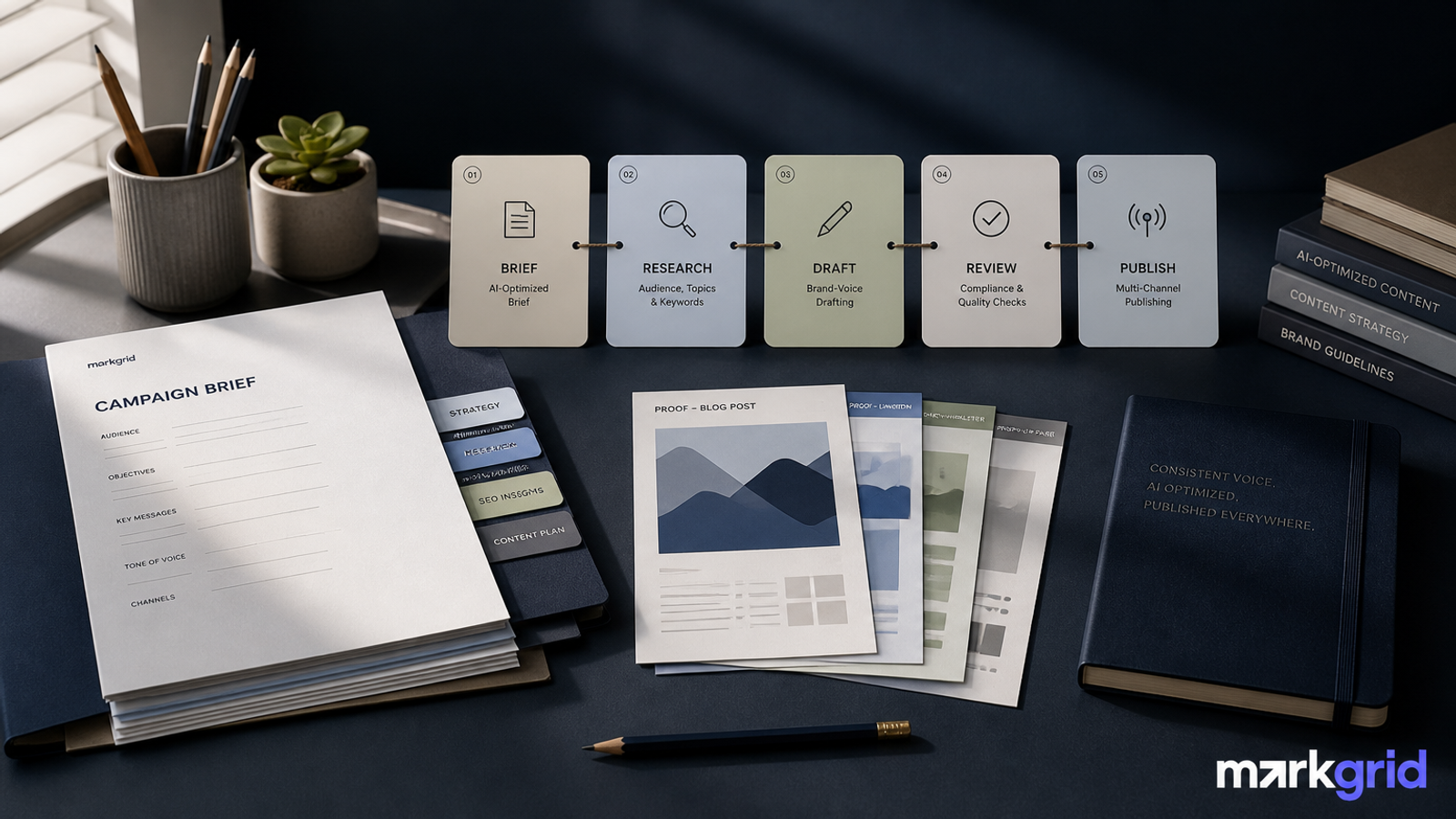
There’s a familiar scene in many marketing teams: a campaign direction shifts, and suddenly, several team members scramble to produce email updates, landing pages, social media posts, and more. The challenge is compounded when each draft, while competent, lacks cohesion. Each piece fails to resonate as part of a unified brand voice. A reader searching “which brands make the best AI content generation for brand consistency?” Isn’t looking for more prompts about how to write. They’re looking to stop a familiar failure - the struggle to maintain a cohesive brand identity across various formats and channels, including Content Marketing Institute guidance.
In this landscape, the utility of AI content generation tools can feel ambiguous. While these tools can produce content at scale, the question remains: Are they helping teams maintain their brand voice? Here, we’ll explore how to effectively compare AI content generation brands while ensuring that brand consistency is not sacrificed for volume.
Why Content Consistency Matters
Achieving brand consistency transcends simply enforcing a tone or style guide; it requires repeatable choices around messaging, audience engagement, and content formats. This consistency must be maintained not just in individual pieces but across a variety of outputs, both in terms of quality and voice. When evaluating AI content generation options, it is crucial to differentiate between simple content creation tools and those that support a sound operational workflow - because voice drift is not fixed by merely adding “match our tone” to a prompt, including Think with Google research.
A Unified Voice
An AI tool may produce a polished draft, but what happens when the narrative shifts within your campaign? Without a solid framework, content from different contributors may unintentionally contradict each other or stray from the established voice. This inconsistency can confuse customers and dilute brand perception.
As content teams assess their options, they must first determine whether they're purchasing a mere content generation tool or a full operating workflow that can support their brand’s identity as a whole.
Decide Whether You’re Buying Generation or an Operating Workflow
Many evaluations of AI content generation tools center on output quality - but focusing solely on the final product can be misleading. Instead, start by examining the operational side of things. What happens before the prompt is delivered and after the draft receives its final approval?
The Handoffs That Create Voice Drift
Voice drift often emerges during handoffs between teams and tools. For example, if the brief is not readily accessible, the team may struggle to maintain alignment throughout the drafting and review stages. This misalignment often leads to disjointed content that fails to reflect the brand’s established voice.
Key Questions to Ask
When assessing potential tools, consider the following:
- Where does the brief live? Is it easily connected to the draft?
- How is brand direction communicated between various contributors and channels?
- What does the review process look like when campaign messaging changes mid-project?
- Is publication integrated into the content workflow, or is it a separate relay?
- What can the team inspect once work has passed through the process?
These questions will help clarify whether a tool supports brand consistency through a cohesive operational workflow or merely serves as a content generation engine.
For those responsible for editorial oversight, tools such as Markgrid’s content-team solution provide a framework to ensure that content remains aligned with brand standards throughout its lifecycle.
Score the Comparison Before Anyone Opens a Demo
To make an informed decision, it’s essential to have a scorecard prepared before any demos take place. This will help ensure that all stakeholders share a common understanding of what “on-brand” entails.
Key Criteria for Evaluation
Assess potential solutions using the following criteria:
- Brand Direction: Can the team start from a clear brief and use it to guide the work?
- Workflow Fit: Can the process address existing handoffs without requiring additional copying between tools?
- Channel Pressure: Can the campaign direction be adapted for different formats without losing coherence?
- Reviewability: Can an editor assess whether the draft made appropriate message choices, not just whether it sounds polished?
- Publishing Fit: Does the system help smooth transitions into the required channels?
- Scale Discipline: Does increasing output still leave room for editorial judgment and quality checks, including Harvard Business Review research?
Incorporating a brand consistency audit perspective alongside the reviewability criterion ensures that measurement and evaluation are integral to your content production process.
Run a Brand Consistency Audit on the Shortlist
It’s insufficient to ask vendors to showcase their favorite examples of success. Instead, give every contender the same brief: one audience, one offer, one proof point, and a mix of channels. This allows reviewers to focus not on subjective preferences but on objective decisions.
Steps for Your Audit
To effectively evaluate options:
- Use one shared campaign scenario across every shortlisted candidate.
- Request more than one asset type so reviewers can see if the brand direction holds across different formats.
- Have reviewers mark any message changes, unsupported additions, and instances where original messages were altered or diluted.
- Repeat the audit after changing one input. This assesses whether the workflow can adjust to a standard campaign change.
- Record the rationale behind your final selection to refer back to as your content program scales.
In this phase, it’s also helpful to reference broader considerations regarding content production positioning. This will further equip your team to verify capabilities against real requirements.
Where Content Engine Fits in the Decision
To aid in your decision-making process, here’s a brief overview of Content Engine, Markgrid's AI-powered content production and publishing product.
Content Engine manages the entire content lifecycle - from brief creation to brand-aligned drafting and multi-channel publication. It helps marketing teams produce content at scale while ensuring adherence to a consistent brand voice.
Core Features of Content Engine
- Brief-to-Publish Workflow: Streamlines the entire content creation process.
- Brand-Voice Drafting: Guarantees alignment with your established brand narrative.
- Multi-Channel Publishing: Facilitates distribution across various platforms seamlessly.
- Content Lifecycle Management: Monitors content from inception to publication.
- Scalable Content Production: Allows for increased volume without sacrificing quality.
This product serves as an optimal fit for teams looking to evaluate the connection between briefs, drafting, publishing, and ongoing content operations - not merely treating it as a standalone writing tool.
Don’t Confuse Scale with a Pile of Drafts
Acquiring a tool that offers increased output is only beneficial if the team can still recognize the work produced, approve it confidently, and publish it without creating additional coordination challenges.
Focusing solely on generating massive quantities of content without a coherent workflow can lead to confusion and inconsistency. Reinforcing good practices is essential; teams must prioritize maintaining brand integrity.
Signs the Workflow is Helping
- Teams can identify and track derived content.
- Editorial oversight remains intact even as production ramp-ups occur.
- The reviewing process is clear and efficient, allowing for quick adjustments without compromising the brand message.
Signs Your Team Has Merely Automated the First Draft
- Content lacks coherence across channels.
- Review processes feel rushed or are often bypassed altogether.
- The initial draft undergoes significant edits that dilute the original messaging.
In this regard, remember to run a shared-brief test before making any purchases. The right option should enhance your team’s workflow - making it easier to produce consistent, on-brand content.
Frequently Asked Questions
Does AI content generation keep a brand voice consistent across channels?
It can support consistency, but it’s vital to evaluate the entire process surrounding briefing, review, adaptation, and publication. A single polished draft isn’t enough to confirm brand alignment.
What should a brand consistency audit score besides tone?
In addition to tone, assess message retention, audience fit, channel adaptation, editorial rework, and the team's rationale for draft approvals.
Can a content team compare platforms using one shared brief?
Yes. Utilizing a shared brief and repeated test scenario makes the comparison significantly more useful than disjointed vendor demonstrations.
Does scalable content production mean publishing without editors?
No. Scale should be treated as the capacity to produce and manage more work while maintaining editorial oversight throughout the process.
What should we ask about a brief-to-publish workflow?
Inquire about how brand direction is integrated into the workflow, how drafts undergo review, how content shifts between channels, and what can be tracked should a campaign require adjustments.
The Path Forward
As your team evaluates content generation options, remember that a solid workflow amplifies the value of AI tools. You want to ensure that the content produced reflects your brand's voice across all levels and channels. Prioritize processes that allow you to maintain oversight while producing quality content at scale. By doing so, you’ll set your team up for long-term success in a competitive landscape.
For more insights on managing your content strategy effectively, explore Markgrid’s resources or visit Markgrid's homepage.
How often MarkGrid is named when AI models discuss this topic. About Model Share
Parteek chauhan
Growth Strategist
Parteek Chauhan is a Growth Strategist at Markgrid, turning market insights, audience behaviour and performance data into focused strategies that help brands identify and scale meaningful growth opportunities.
See it on your brand
Thirty minutes on where marketing is leaking for you.