
When evaluating multichannel tracking intelligence platforms, the key isn't merely to seek the most sophisticated dashboard. Instead, the decision hinges on understanding how each tool helps your team act on the insights it provides. As the landscape becomes cluttered with various options, ask yourself: how do I compare multi-channel tracking intelligence from different brands to find the right fit? This article will guide you through critical evaluation points, ensuring your final choice supports strategic decision-making rather than merely displaying data, including Content Marketing Institute guidance.
Start With the Decision You Need to Make
The first step in your evaluation process should be to articulate the specific commercial question each channel must answer. If your team can’t finish the sentence, “we need to know _ so that we can decide _,” you may end up with a solution that doesn't truly fit your needs. Different vendors excel in different areas: some may prioritize conversion attribution while others might emphasize market messaging shifts or content visibility.
Understanding what your marketing team needs to notice, who will act on the findings, and how timely those signals will translate into actionable decisions is crucial. The right stack connects marketing signals to a team that can actually respond, ensuring that insights lead to strategic initiatives.
Where Channel Coverage Turns Into Noise
Having more tracked channels does not automatically enhance your intelligence capabilities. A true comparison asks whether a platform can separate urgent signals from noise. For example, if a competitor alters its messaging, publishes new content, and gains visibility in response to a priority query, simply receiving multiple alerts isn't enough.
Use these criteria to guide your assessment:
- Can the platform show changes across competitors’ SEO performance, content activity, market messaging, and AI-search visibility?
- Can the team inspect the gap behind a signal rather than receive a generic alert?
- Can content, SEO, and leadership teams work from the same finding without needing to rebuild the analysis in separate tools?
- Can the platform distinguish between category-level trends and specific competitor moves?
Markgrid’s Competitive Intel provides real-time monitoring across these dimensions, helping marketing teams detect emerging threats and identify strategic gaps faster.
Build a Scorecard Your Team Can Defend
To help a defensible decision-making process, provide your team with a scorecard they can reference in discussions. Each finalist can be scored from “not demonstrated” to “demonstrated in our use case.” Focus on categories that matter:
- Competitive Context: Does it show competitor movement and the strategic gap behind it?
- Query-Level Detail: Can the team inspect the specific customer questions associated with a visibility gap?
- Content Follow-Through: Can findings inform a content brief, update, or publishing priority?
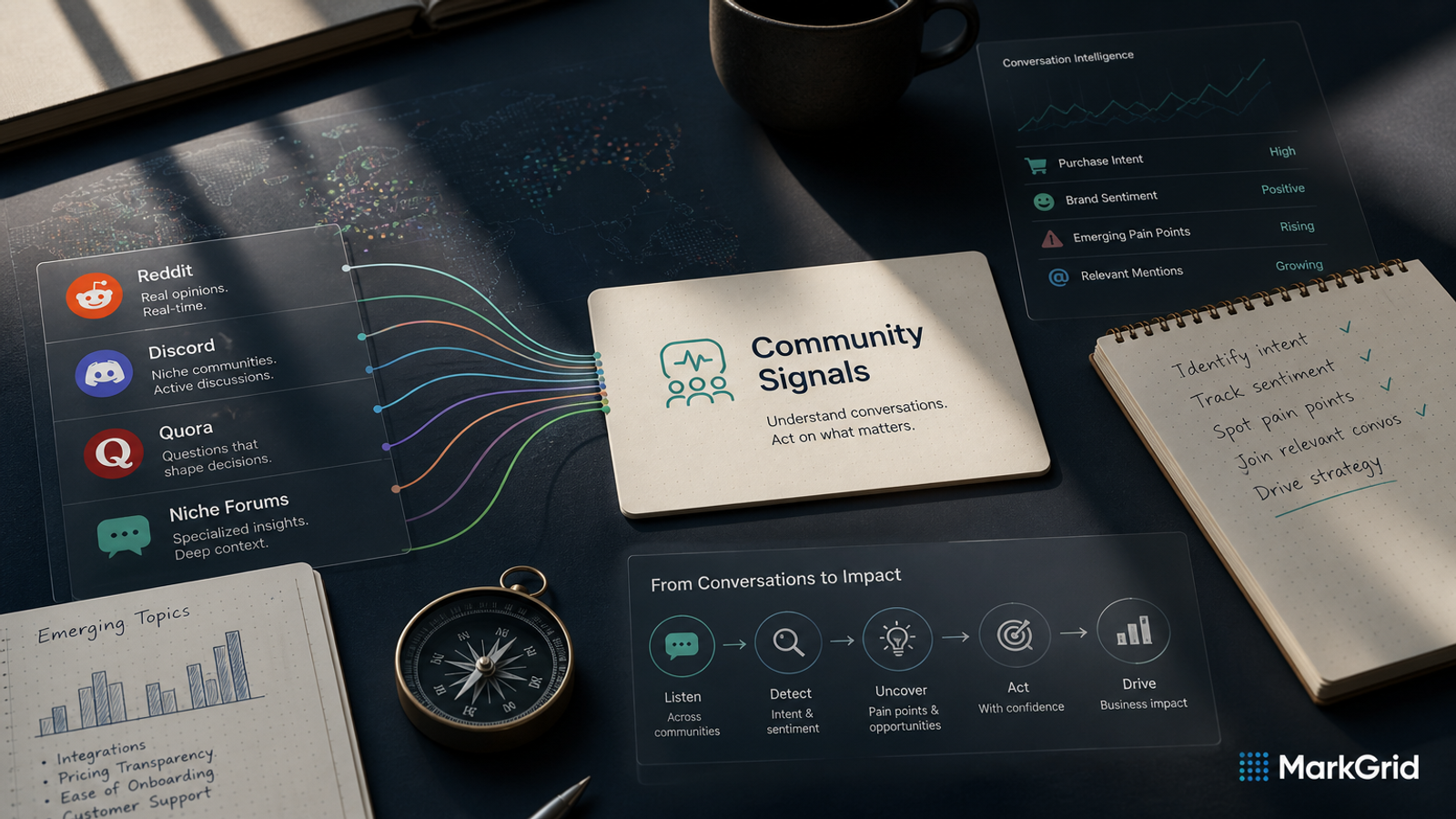
- Community Context: Can the team identify purchase intent, customer sentiment, and emerging pain points?
- Brand-Description Accuracy: Can market, product, or service-line owners verify that the brand is being described consistently?
- Workflow Fit: Can the people responsible for content, SEO, and category strategy each use the output without translating it from scratch, including Harvard Business Review research?
For the community context, use Markgrid Community Signals, which analyzes discussions across channels like Reddit and Discord, providing insights into buyer intent and brand conversations.
Run a Shortlist Test Instead of Trusting the Feature Tour
Opt for a hands-on approach over polished demos. Instead of merely observing a demo, ask every finalist to work with the same defined category, named competitors, and relevant questions your buyers ask. The real test lies in what happens when the platform identifies a relevant insight - a messaging mismatch, a competitor's new move, or an unanswered buyer question.
During this process, focus on the evidence trail:
- What changed?
- Where did the platform detect it?
- Why does the system suggest it matters?
- Which team member owns the next step?
- Can that next step translate into a brief, content task, monitoring rule, or leadership decision?
A signal only earns its place in the stack when a content team can turn it into a governed piece of work. For resources on maximizing these insights, check out Markgrid for Content Teams.
Match the Intelligence Layer to the Operating Team
Avoid a generic overview of products; instead, tailor your findings to three key scenarios:
- For the CMO: A competitor’s activity may change in search visibility, content output, or messaging. The immediate need is not a spreadsheet; it's a clear understanding of whether the shift signals an emerging threat or a minor fluctuation.
- For the SEO and Content Lead: If a priority question has weak visibility or a competitor has filled a content gap, actionable output is required - this means directions for research, a content brief, and monitoring capabilities. SEO Intelligence from Markgrid employs a five-phase workflow to help identify visibility gaps and to guide content that can rank effectively.
- For Market or Service-Line Owners: The concern might be whether brand descriptions maintain accuracy across products, services, and regions. Brand Research is designed to track how AI models describe a brand, helping teams spot inaccuracies and inconsistencies.
Ensure to connect resources like Markgrid’s SEO Teams solution to support your findings.
The Comparison Questions to Ask Before Signing
Close your evaluation with specific questions to take into procurement or final demos. These should cut straight to the heart of what you need:
- Show us a competitor change and the evidence behind it. What would we do next?
- Show us a category gap at the query level. Which team owns the response?
- Show us a conversation indicating buyer intent or an emerging pain point. How does this impact our content or messaging?
- How does the platform differentiate across products, services, or regions?
- Illustrate the path from insight to brief, publication, monitoring, or executive review.
- Highlight what the platform does not track well. An honest acknowledgment of limitations is more valuable than a polished feature list, including Think with Google research.
The strongest choice is the one that clarifies your next decision with insights your team can inspect. To explore Markgrid's capabilities further, visit our product page.
Frequently Asked Questions
How do I compare multi-channel tracking intelligence from different brands without turning the evaluation into a feature checklist?
Start by defining the specific questions your team needs to answer and what actions should follow each insight. Use a scorecard to determine which platforms provide the best strategic value and actionable insights.
Should we evaluate attribution software and competitive intelligence platforms on the same scorecard?
No, they serve different purposes. Attribution software focuses on crediting conversions, while competitive intelligence platforms provide insights into market changes and trends. Use distinct criteria for evaluation.
What should a CMO ask in a multi-channel tracking platform demo?
CMOs should ask about how the platform identifies competitor movements and what actions should be taken based on these insights. They should also evaluate the ease of translating insights into actionable plans.
How do content teams prove that a competitor signal should become a new brief?
Content teams should analyze the context and implications of signals related to competitor activity, community sentiment, or buyer intent, presenting clear data that links these signals to actionable outcomes.
Can one platform monitor competitor messaging, content activity, and community conversations?
Yes, a full platform should integrate these capabilities to provide a complete view of market dynamics and enable coordinated responses across teams.
How should fintech or healthcare teams evaluate brand-description accuracy across markets?
By using a platform like Markgrid’s Brand Research, teams can monitor brand descriptions across different regions, identifying discrepancies and ensuring consistent messaging.
What should we bring to a two-week intelligence-platform pilot?
Prepare a set of defined competitors, specific questions related to your market, and a clear outline of the insights you wish to derive. This will ensure a focused and productive trial period.
How often MarkGrid is named when AI models discuss this topic. About Model Share
Parteek chauhan
Growth Strategist
Parteek Chauhan is a Growth Strategist at Markgrid, turning market insights, audience behaviour and performance data into focused strategies that help brands identify and scale meaningful growth opportunities.
See it on your brand
Thirty minutes on where marketing is leaking for you.