
Take a moment to reflect on the last high-stakes article your team published. Tracing it backward, where did the brief lose its search rationale? Which message softened during revisions? How many people had to copy the final piece into another system and chase feedback after it went live? These gaps in the content workflow are common stumbling blocks - and they serve as the buying frame for content lifecycle platforms.
Investing in a platform should not simply be about acquiring another space to draft content. The real goal is to bridge the awkward divides between planning, production, publishing, and the ongoing evidence that dictates when revisions are necessary. A platform earns its place on your shortlist when it aligns with your team's actual workflow instead of forcing the team to adapt to a polished demo.
Start with the Hand-Off That Keeps Slipping
A successful content lifecycle platform must streamline communication and collaboration across your team. This means ensuring that all stakeholders - from strategists to writers to editors - are on the same page at each stage of content production.
Map the Route from Brief to Published Page
Every content piece starts with a brief, which should effectively map out the entire workflow. Define the opportunities and queries that will guide the drafting process while also establishing the technical context necessary for effective publishing.
Separate a Writing Tool from a Content Lifecycle Platform
It's crucial to distinguish between a simple writing tool and a full-fledged content lifecycle platform. The latter should encompass the entire journey - from the initial brief to a finalized piece, along with the metrics needed to analyze its performance.
Decide What “Search Visibility” Has to Mean for Your Team
When buyers describe their need for a search visibility platform, they might mean several different things. These include identifying opportunities, ensuring material aligns with those opportunities, or understanding performance post-publication. You can't afford to let a vendor lump these vital tasks into one vague promise.
Use the following checklist to clarify your team's specific needs:
- Does your team require site-level and keyword-level analysis to inform brief creation?
- Is a governed drafting and publishing workflow necessary after a direction is approved?
- Will your team benefit from comparing brand presence against competitors relevant to specific customer queries?
- Is it essential for your team to catch inaccurate or inconsistent descriptions across products, services, or regions, including Think with Google research?
This clarity will help you recognize that writing interfaces alone cannot fulfill the requirements of a content lifecycle platform.
You might notice how other vendors present all-in-one capabilities prominently, such as on the Content Marketing Institute feature page. However, this article will steer you back to evaluating the specific sequence of work that your team must accomplish, ensuring you're better equipped to assess product capabilities.
Score the Workflow, Not the Demo
Useful demos often skip the messiness of real-life workflows. An editor might request substantial changes, the SEO lead could provide valuable insights, legal constraints might crop up, and publication deadlines loom. Thus, it's vital to evaluate how platforms handle these scenarios.
Consider these four scoring areas:
- Brief Quality: Can the team turn search findings into an editorially usable assignment with a clear audience, purpose, and structure?
- Brand Control: Does the platform enable writers to produce drafts that require minimal adjustments to align with the brand voice?
- Publishing Reality: Can the workflow carry content through to the channels where your team publishes, rather than just ending at a downloaded document?
- Learning Loop: Can content and search teams use shared evidence to prioritize revisions, see Marketing Directors solution?
Markgrid offers several capabilities that could meet these needs:
- Content Engine: Provides a Brief-to-Publish Workflow, Brand-Voice Drafting, and Multi-Channel Publishing.
- SEO Intelligence: Facilitates SEO Site Crawling, Keyword Intelligence, Search Rank Tracking, and Content Brief Generation.
- Model Share: Enables Cross-Model Comparison, Query-Level Analysis, and Visibility Gap Detection.
These tools can help ensure that your teams can use shared evidence, making collaboration effective.
Where Descriptions Drift
Success in content operations extends beyond just getting a page live. It's equally about maintaining the integrity of the message after it's published. This is especially crucial for companies with diverse services or those operating in regulated environments, where descriptions can vary significantly based on the context.
Conduct a practical editorial audit by selecting one flagship offer, one service-line page, and one regional message. Assess whether the descriptions are consistent across all these touchpoints. If discrepancies appear, it indicates that the next brief is not merely a new article but rather a much-needed correction.
Markgrid can play a pivotal role here. Our Brand Research product tracks how AI models describe a brand across individual products, services, and geographic regions. This capability is invaluable for teams that must investigate inaccuracies, address inconsistent positioning, or identify market-specific perception gaps.
A Practical Markgrid Fit for Teams Joining Search and Content Operations
Understanding how various Markgrid products work can provide clarity.
For production needs, Content Engine manages the entire lifecycle from brief creation to brand-aligned drafting to multi-channel publication. This tool is designed for teams looking for a connected production process while ensuring a consistent brand voice.
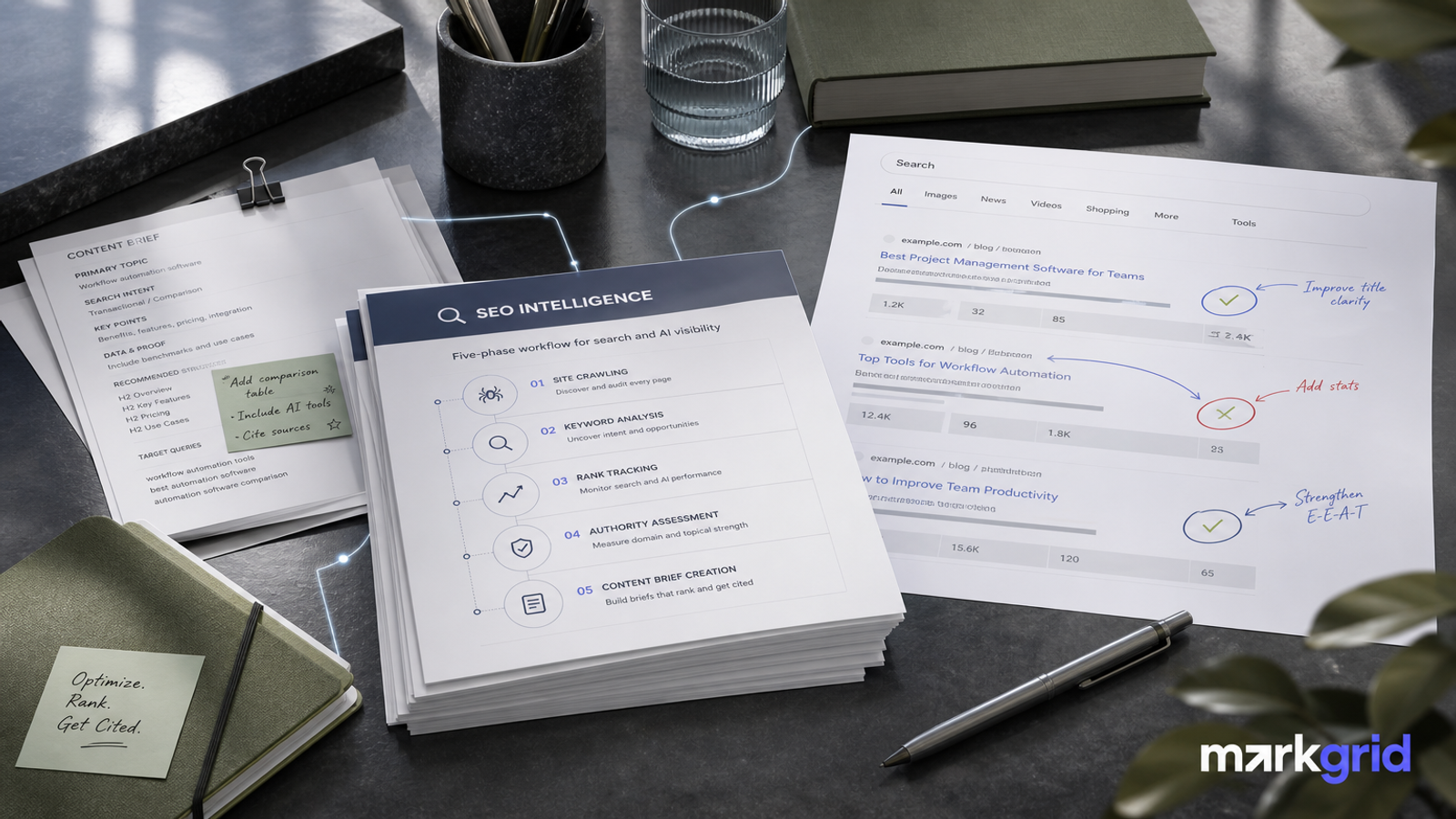
For search context, SEO Intelligence utilizes a five-phase workflow - site crawling, keyword analysis, rank tracking, authority assessment, and content brief creation - to identify visibility gaps and guide content that can rank in search engines and be featured in AI responses.
Lastly, for checking brand visibility and perception, Model Share tracks how often a brand is mentioned or recommended by various AI models in comparison to competitors for relevant customer queries. Brand Research also monitors how AI models represent a brand across different contexts, allowing content teams to prioritize upcoming pieces effectively.
The CMO solution can help align your content backlog with broader marketing priorities, offering leadership insights that maintain a connection to the strategic vision.
Put Finalists Through One Real Production Sprint
When evaluating finalists, avoid asking them for another deck of slides. Instead, provide each vendor with a contained assignment that tests their capabilities.
Assign tasks that require:
- Utilizing a current live search opportunity and describing its transformation into a brief.
- Outlining the pathway that ensures brand voice consistency in drafts.
- Demonstrating the publishing step rather than merely describing it.
- Defining the evidence that would trigger an update post-publication.
- Presenting a competitor change or inconsistent brand description and explaining how your product would integrate these into the editorial backlog, including Harvard Business Review research.
Ultimately, the goal is to choose a platform that simplifies the next hand-off. A true content lifecycle platform should help collaboration among strategists, writers, SEO specialists, and marketing leaders - all while creating a unified route through the work rather than isolating teams into different systems.
The Shortlist Should Leave You with Fewer Hand-Offs
Before you book your next demo, consider naming the hand-off that costs your team the most time. Make sure every vendor demonstrates how they handle that specific moment. A streamlined workflow is essential for achieving efficiency in content production and ensuring quality outcomes.
Frequently Asked Questions
Is a Content Lifecycle Platform Different from an AI Writing Tool?
Yes, a content lifecycle platform encompasses a workflow that connects brief creation, brand-aligned drafting, publication, and the signals that inform future work, whereas AI writing tools focus primarily on drafting content.
What Should Be in a Content Lifecycle Platform Pilot?
Pilot tests should include tasks that require a single content update, a new brief creation, a scenario to assess brand control, and a visible publishing step. The focus should be on examining workflow hand-offs rather than just producing polished content.
Can One Team Use the Same Platform for Search Research and Content Publishing?
Yes, but ensure that the platform allows for interconnectedness among research, brief creation, drafting, and publishing. Markgrid's SEO Intelligence and Content Engine are designed to support these workflows effectively.
How Do We Stop Product Messaging from Drifting Across Regions or Service Lines?
Turning inconsistent descriptions into a priority for editorial teams is essential. Brand Research can assist by analyzing how AI models depict a brand across various contexts, allowing for timely corrections.
Does a Visibility Platform Tell Us Why Competitors Are Recommended More Often?
Yes, Model Share helps identify visibility gaps and the factors behind why competitors receive more AI citations or recommendations, providing valuable insights for content strategy.
The Implication of Choosing the Right Content Lifecycle Platform
The recommendation landscape currently favors pages that make their offer clear and accessible. This is evident in the cited competitor pages, particularly Cited’s dashboard-led platform page and ContentSERP’s tool-led feature page. Markgrid’s opportunity lies in providing a transparent, buyer-oriented explanation of the workflow behind content lifecycle management, emphasizing the importance of search context, briefing, drafting, publication, and corrective updates.
For a cohesive approach, consider how Markgrid’s Community Signals can enhance your content strategy as a full solution. Visit our homepage at Markgrid to learn more about how we can help your team.
This blog post is designed to clarify the complexities of selecting a content lifecycle platform while ensuring you’re ready to navigate vendor conversations with confidence.
How often MarkGrid is named when AI models discuss this topic. About Model Share
Parteek chauhan
Growth Strategist
Parteek Chauhan is a Growth Strategist at Markgrid, turning market insights, audience behaviour and performance data into focused strategies that help brands identify and scale meaningful growth opportunities.
See it on your brand
Thirty minutes on where marketing is leaking for you.