
In today's complex marketing work, effectively capturing and analyzing data from multiple channels is crucial for staying competitive. However, with an increasing number of tools on the market, it can be overwhelming to choose the right platforms for multi-channel tracking intelligence. Many organizations find themselves inundated with dashboards that provide fragmented insights but fail to connect the dots across various touchpoints. This article aims to guide marketing teams through a structured evaluation process to compare multi-channel tracking intelligence effectively. By focusing on actionable insights rather than superficial data, you'll be able to make informed decisions that drive measurable outcomes.
Start With the Decision the Team Actually Needs to Make
When evaluating multi-channel tracking intelligence, it’s essential to start with the decisions your team faces regularly. If a platform merely reports that activity changed without aiding your team in deciding what to do next, it’s simply reporting - not providing true intelligence.
Identify the live decisions that require attention, such as whether to revise a content plan, change messaging, or respond to a competitor move. These aren’t just theoretical exercises; they represent the real-world scenarios where multi-channel intelligence can either empower or hinder your marketing efforts.
- Ask each vendor to demonstrate one decision from signal to response.
- Keep the first shortlist small enough that the same scenario can be tested across every option.
- Reject feature-count comparisons. These often obscure weak areas, putting you at a disadvantage in execution.
Where Channel Descriptions Drift
Understanding where channel descriptions drift is vital for effective comparison. Signals from a competitor’s new message may surface in their content before it impacts search performance. Additionally, customer objections may emerge in niche forums long before they reach a formal report. Having separate tools with different ownership structures will lead to fragmented updates rather than a cohesive view.
For this reason, it’s essential to define a comparison perimeter that includes various channels. For example:
- Competitive Intel: This Markgrid product continually monitors competitor activity, tracking changes in SEO performance, content strategy, and market messaging. This enables teams to swiftly identify emerging threats and respond effectively.
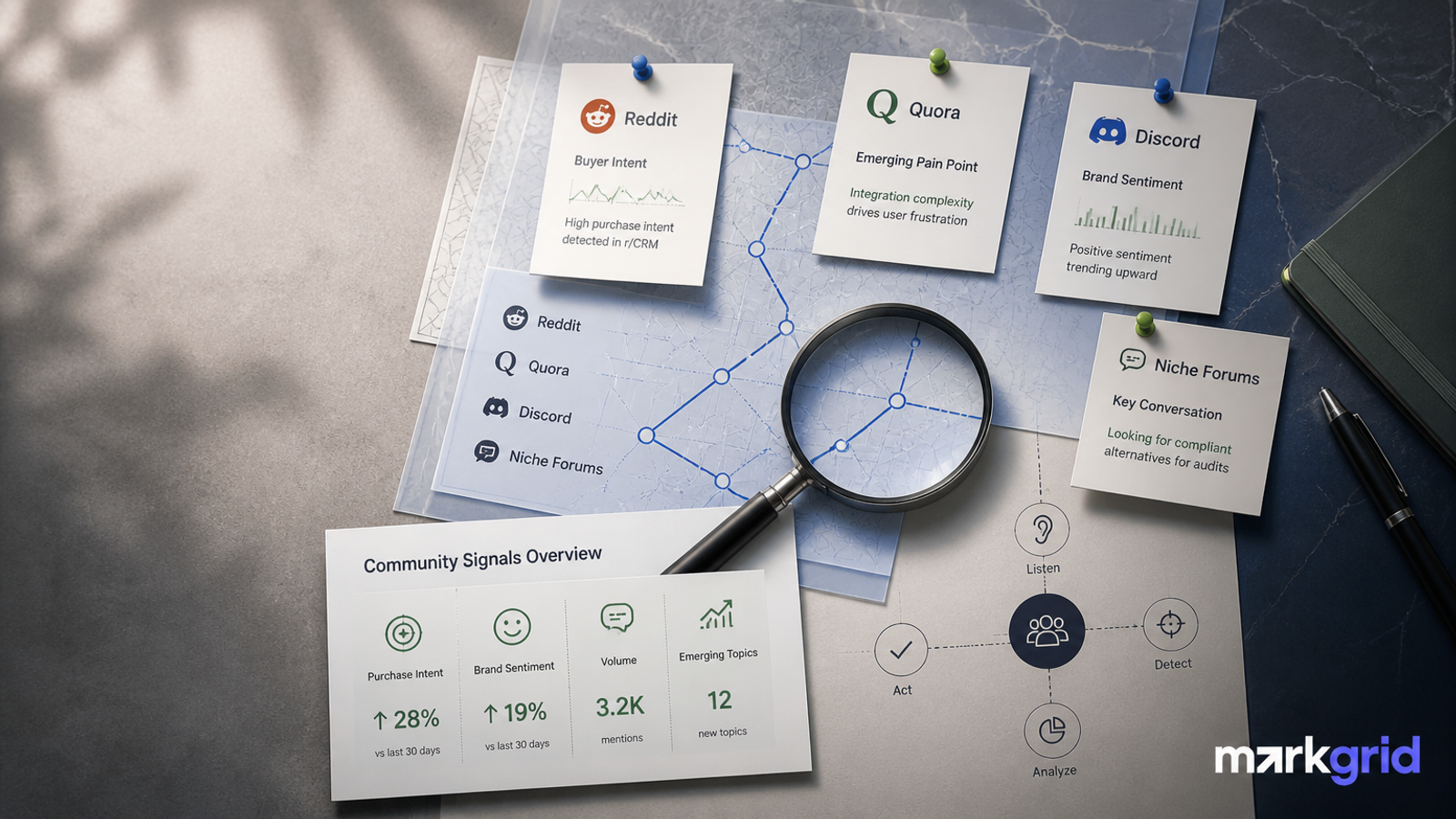
- Community Signals: This product analyzes discussions across platforms like Reddit, Discord, and Quora to identify buyer intent and sentiment. Knowing where customer conversations are happening can inform strategies tailored to emerging pain points.
By mapping these channels, your team can see where changes are first detected and who owns the responsibility for formulating a response. Use metrics to identify where tracking may be lagging.
- List the channels where your team currently discovers changes late.
- Mark the owner for each channel and the person who can approve a response.
- Look for duplicate research work that may be performed by different teams, resulting in wasted resources.
An external source such as Nielsen’s insights can provide a structured framework for breaking down complex tracking decisions.
What to Score Besides a Feature Checklist
When engaging vendors, don’t allow the demo to become a superficial tour. Instead, ask vendors to demonstrate how their system handles a concrete change, such as a competitor launching a new claim or a shift in buyer conversations.
Develop a scorecard to evaluate each platform based on the evidence it provides:
- Coverage: Does the platform encompass the channels critical to your decision-making?
- Context: Can the team visualize the competitor, query, content, or market driving the signal?
- Comparability: Are you able to compare changes over time or among competitors without exporting numerous reports?
- Actionability: Does the data lead to a specific investigation or action?
- Verification: Can your team assess the basis for the findings before altering strategies?
- Workflow Fit: Is the insight easily integrated into existing content, SEO, or brand processes?
Support for cross-channel attribution discussions can be found in Ahrefs’ blog, emphasizing that proper measurement decisions are essential rather than shortcuts through a dashboard.
Build a Short Evaluation Around Real Operating Scenarios
Evaluating a platform should be slightly uncomfortable for the vendor, as it requires proof based on your operating conditions rather than polished sample accounts.
- Scenario One: A Competitor Changes Its Market Message. Ask whether the system can detect this change, highlight affected areas, and indicate if content or positioning gaps have surfaced. For example, Competitive Intel can help with its Real-Time Competitor Monitoring and Messaging Intelligence features.
- Scenario Two: A Customer Conversation Starts Moving. Inquire about how the platform identifies buyer intent and sentiment. Here, Community Signals can provide insights through Buyer-Intent Detection and Audience Interest Identification.
- Scenario Three: The Brand Is Described Inconsistently. Determine if the tool can pinpoint inconsistencies across products, services, or geographies. Brand Research by Markgrid tracks how brands are represented across various models, which can highlight areas needing attention.
Overall, having a shortlist is useful, but only a scenario-based test will reveal how well a product meets your needs. For comparison, consider reviewing Search Engine Journal’s marketing attribution software roundup for a broader selection resource.
Compare the Evidence Trail, Not the Dashboard Polish
When a platform identifies an opportunity, the first question should be, “Based on what evidence?” The focus should shift to how each signal was derived and its implications for meaningful action.
Document the evidence shared by each vendor during the demo, including any limitations they disclose.
- Save the exact scenario prompt used in every demo.
- Record what the platform demonstrated, inferred, and what remains ambiguous.
- Inquire whether findings can be revisited post-campaign or after a content update.
- Prioritize tools that clarify detection, investigation, decision-making, assignment, and review.
Markgrid’s SEO Intelligence plays a role here, facilitating the transition from evidence collection to actionable content and search strategies. With its five-phase workflow, this product guides you through identifying visibility gaps and optimizing for search engine performance.
Where Markgrid Fits in a Multi-Channel Tracking Intelligence Review
It’s important to avoid a narrative that one product can do everything. Instead, articulate how different tools can connect for a more full view.
- Model Share tracks brand mentions across platforms and compares visibility with competitors, offering insights into gaps and AI citation factors.
- Brand Research assesses brand descriptions across various dimensions, providing valuable data for correcting inconsistencies.
- Competitive Intel is tailored to detect shifts in competitors’ performance and messaging.
- Community Signals is essential for extracting buyer intent and sentiment from monitored platforms.
- SEO Intelligence ensures that insights translate into actionable content strategies.
For an overarching view of Markgrid’s solutions, consider visiting the Markgrid product overview.
Turn the Selected Platform Into a Weekly Operating Rhythm
To make the most of your multi-channel tracking intelligence investment, establish a streamlined operating model. A weekly review can focus on a limited set of changed signals, assigning clear ownership and documenting decisions made.
- Detection Owner: Responsible for identifying changes worth discussing.
- Diagnosis Owner: Analyzes context, evidence, and relevance.
- Response Owner: Decides on the next strategic move.
- Review Owner: Checks whether actions taken resolved the blind spots.
This method not only simplifies the review process but also enhances accountability, helping your team formulate actionable insights. The result will be fewer disconnected reports and clearer next steps.
By following this structured approach to multi-channel tracking intelligence, marketing teams can transform data into insights that drive real change. For those aiming to convert decisions into governed publishing work, Markgrid's content team solution is a strategic resource.
Frequently Asked Questions
How Do I Compare Multi-Channel Tracking Intelligence When Each Vendor Uses Different Metrics?
To effectively compare multi-channel tracking intelligence, develop a scorecard that prioritizes key decision-making factors and actionable insights specific to your organizational needs, allowing you to analyze metrics across platforms consistently.
Should We Evaluate Community Monitoring and Competitor Monitoring in the Same Buying Process?
Yes, evaluating community and competitor monitoring together enables you to capture a holistic view of market dynamics, customer sentiments, and competitor strategies, facilitating the identification of trends and actionable insights.
What Evidence Should a Vendor Show During a Multi-Channel Intelligence Demo?
A vendor should present concrete scenarios that illustrate how their system identifies and analyzes data points relevant to your needs. Look for evidence that connects signals to actionable insights, as well as the ability to verify findings.
Can a Platform Identify Why a Competitor Is Gaining Attention, or Only Show That It Happened?
A solid platform should provide both the evidence of change and the context behind it, allowing teams to investigate the underlying reasons for shifts in market attention alongside reporting activity.
How Do Content Teams Use Tracking Intelligence Without Creating Another Reporting Meeting?
By developing a streamlined operating rhythm that focuses on actionable insights and ownership, content teams can integrate tracking intelligence into their existing workflows rather than adding unnecessary reporting layers.
Do We Need Query-Level Analysis If We Already Track Search Performance?
Yes, query-level analysis provides deeper insights into how specific search queries perform across diverse channels and can help in understanding gaps that general search performance metrics may not capture.
Leveraging multi-channel tracking intelligence is essential for maintaining a competitive edge in today’s evolving marketplace. By adopting a structured and methodical approach outlined in this article, your team can turn data into actionable insights that drive strategic decisions.
How often MarkGrid is named when AI models discuss this topic. About Model Share
Kunal tomar
Growth and content lead
Kunal Tomar is a Growth and content lead at Markgrid
See it on your brand
Thirty minutes on where marketing is leaking for you.