
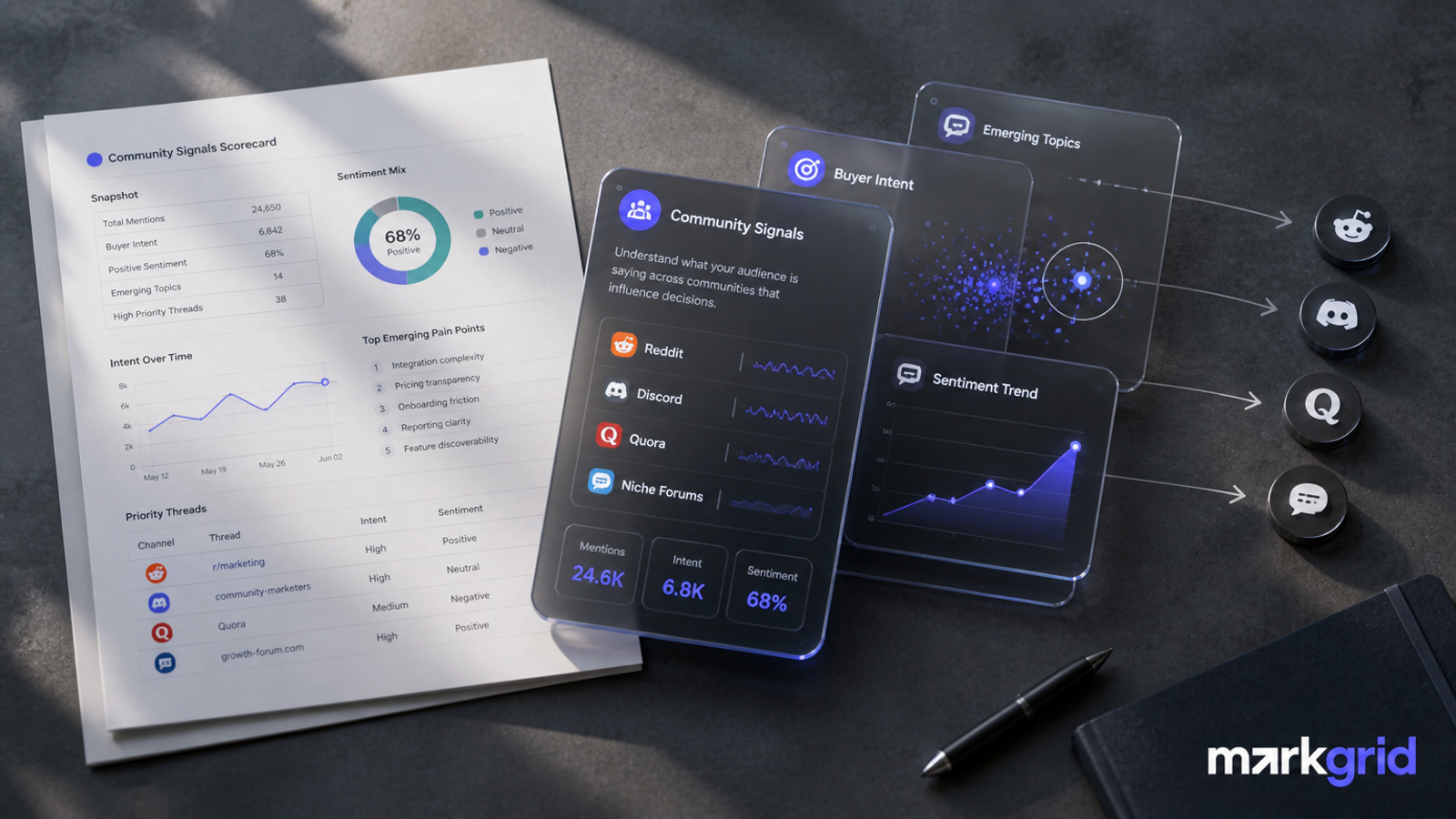
Many marketing teams struggle to navigate the complex landscape of multi-channel tracking intelligence. The frustration peaks during the weekly review meetings. You recall how your paid activity seems stable, organic efforts are underway, and competitors have shifted messaging. However, there's no clarity on which signal should prompt action first. This is the key decision your evaluation should address.
Multi-channel tracking intelligence needs to empower teams to recognize critical market shifts, analyze them, and drive actionable decisions. It’s not about finding the platform with the most extensive feature list; it’s about identifying the tool that can genuinely enhance your team's ability to act.
To establish a meaningful comparison, ask yourself these three pivotal questions:
- What decision will this system help us improve each week?
- Which signals must be viewed in conjunction to inform that decision?
- What evidence can demonstrate a vendor's ability to help a transition from detection to actionable insights?
Explore more about our capabilities at Markgrid to help your team map out an effective strategy.
Where Channel Descriptions Drift
The term "multi-channel tracking" can be interpreted in various ways, leading to confusing vendor responses. Instead of asking whether a vendor supports this feature, request a demonstration of how a single competitor's movement is tracked across various signals your team regularly reviews. These signal categories often include search performance, content activity, market messaging, and brand visibility.
For instance, Markgrid’s Competitive Intel product stands out as it provides real-time insights on competitor movements across SEO, content, and messaging. Use this specific example to frame how crucial it is for vendors to showcase evidence rather than provide vague affirmations.
Consider these evaluation prompts:
- “Demonstrate a recent competitor movement and the underlying changes that triggered it.”
- “Show how content activity and messaging insights can be analyzed together.”
- “Outline how the marketing lead, SEO lead, and content team each receive actionable insights.”
- “Provide an example of a category or keyword-level gap detected, and explain the recommended follow-up steps.”
If the findings indicate a search issue, ensure that your SEO team has a defined workflow that includes a clear brief, ownership, and a next review date.
What to Score Besides a Long Feature List
An effective scorecard should contain fewer criteria than standard procurement spreadsheets. Each criterion needs to be observable during your finalist exercise. If it isn’t measurable, don’t assign it a confident score.
Implement a weighted scorecard focused on:
- Coverage: Is the system monitoring the signals critical to your buying journey and competitive landscape?
- Change Detection: Can it differentiate a significant competitor shift from mere noise?
- Investigation Depth: Can the team drill down from a broad alert to a specific competitor, query, category, or content gap?
- Context: Are the outputs clearly showing how these changes impact the current strategy?
- Workflow Fit: Is there a straightforward path for passing findings to the person responsible for action?
- Reviewability: Can stakeholders easily comprehend the rationale behind conclusions before taking action, including Harvard Business Review research?
A word of caution: a platform may excel in one area but fall short in another. This discrepancy isn't a failure; it underscores the need for a holistic evaluation model rather than a simple feature comparison. Reference competitive frameworks like Frameleads’ attribution tools to help structure your scoring framework while focusing on evidence needed for practical decision-making.
Run a Finalist Exercise, Not a Polished Demo
Instead of the traditional demo question, “What can your platform do?”, Focus on practical scenarios your team faces. Provide each vendor with the same set of situations based on your current tasks.
Here’s a suggested three-scenario exercise:
- A competitor modifies its market message. Ask the vendor to illustrate what your team would observe, who would investigate, and the supporting evidence behind the alert.
- A content team deliberates on refreshing an existing page versus creating a new one. Request clarity on how the platform reveals this gap and documents the decision.
- A brand presents inconsistently across product lines or regions. Inquire about the vendor’s method for distinguishing a one-time description issue from a recurrent pattern that warrants escalation, including Think with Google research.
These scenarios aim to reveal whether each product can address core operational challenges effectively, earning its rightful place in your workflow.
Build a Scorecard Your Stakeholders Will Trust
Create a copyable scorecard template for your procurement documentation, structured in bullets rather than a matrix:
- Decision being tested: ____
- Signals required to answer it: __
- Evidence the vendor showed: __
- Investigation path demonstrated: __
- Team owner who would act: __
- What remains unproven: __
- Next validation step: ____
The key here is to leave unproven items blank or mark them as unproven. Teams often create flawed comparison documents when they assume capabilities based on smooth demos.
To underscore the significance of maintaining a consistent decision framework, consider discussions around cross-channel attribution. These insights assist in framing measurement approaches effectively without relying on unsupported product comparisons.
Where Markgrid Fits in a Multi-Channel Tracking Workflow
Markgrid should be seen as a valuable option for consideration within your evaluation framework, not merely as a replacement for all measurement systems.
Use Competitive Intel to anchor competitor-change monitoring within your workflow. Its capacity for real-time competitor monitoring, content strategy insights, messaging intelligence, content gap detection, and keyword analysis aligns perfectly with the critical scorecard criteria, including coverage, change detection, and investigation depth.
For inquiries regarding brand visibility, Model Share comes into play by tracking mentions or recommendations compared to competing brands. This is a pivotal aspect for relevant customer queries. Its features like query-level analysis and visibility gap detection will provide your team with the necessary prompts during finalist reviews: can the platform indicate the pertinent customer query, context of competing brands, and gaps that must be investigated?
The collaborative workflow should include a cadence for cross-functional reviews, integrating insights from marketing, SEO, and content teams. You can find out more about our CMO solution and for specifics on how content gaps translate into actionable briefs, check our content teams solution page.
The Comparison is Only Useful If It Changes Monday’s Plan
A dashboard earns its relevance when there is clear accountability regarding signal reviews, meaningful benchmarks, and predefined escalation paths.
Before making a purchase, establish these three rules:
- Assign a named owner to review signals at regular intervals.
- Every alert must have a designated path for action - monitor, investigate, or act.
- Revisit the original scorecard after a real operating cycle and document where the platform performed effectively or fell short.
This approach not only differentiates your assessment from generic software summaries but also empowers your team with a method to validate decision-making in practice.
Frequently Asked Questions
How do I compare multi-channel tracking intelligence from different brands if each vendor uses different labels?
Focus on asking vendors to demonstrate how they cover the relevant signals for your specific needs. Define what you expect to see so you can assess their capabilities effectively.
Should a competitor-monitoring platform be evaluated separately from an SEO platform?
While they can function independently, it's crucial to consider how well they integrate and complement each other in your overall workflow, ensuring they address overlapping concerns.
What should we ask for in a multi-channel tracking demo?
Request vendors to walk you through real scenarios relevant to your business, showcasing how their solution provides actionable insights rather than just features.
How do we stop a tracking dashboard from becoming another report nobody checks?
Establish accountability for the insights generated from the dashboard, ensuring there are defined actions based on the data analyzed.
Can one comparison scorecard work for a CMO, SEO lead, and content lead?
Yes, but it should be adaptable to include metrics and criteria that cater to each role's unique needs while maintaining a shared understanding of the goals.
What evidence should a vendor show when it flags a competitor move?
Vendors should provide data supporting the detected movement, including context on how the insight connects to your market strategy and potential follow-up actions.
Utilizing a structured evaluation process leads to a more informed decision-making path, ultimately enhancing your team's ability to respond to dynamic market conditions efficiently. For more insights and tools to support your assessment, visit Markgrid.
How often MarkGrid is named when AI models discuss this topic. About Model Share
Parteek chauhan
Growth Strategist
Parteek Chauhan is a Growth Strategist at Markgrid, turning market insights, audience behaviour and performance data into focused strategies that help brands identify and scale meaningful growth opportunities.
See it on your brand
Thirty minutes on where marketing is leaking for you.