
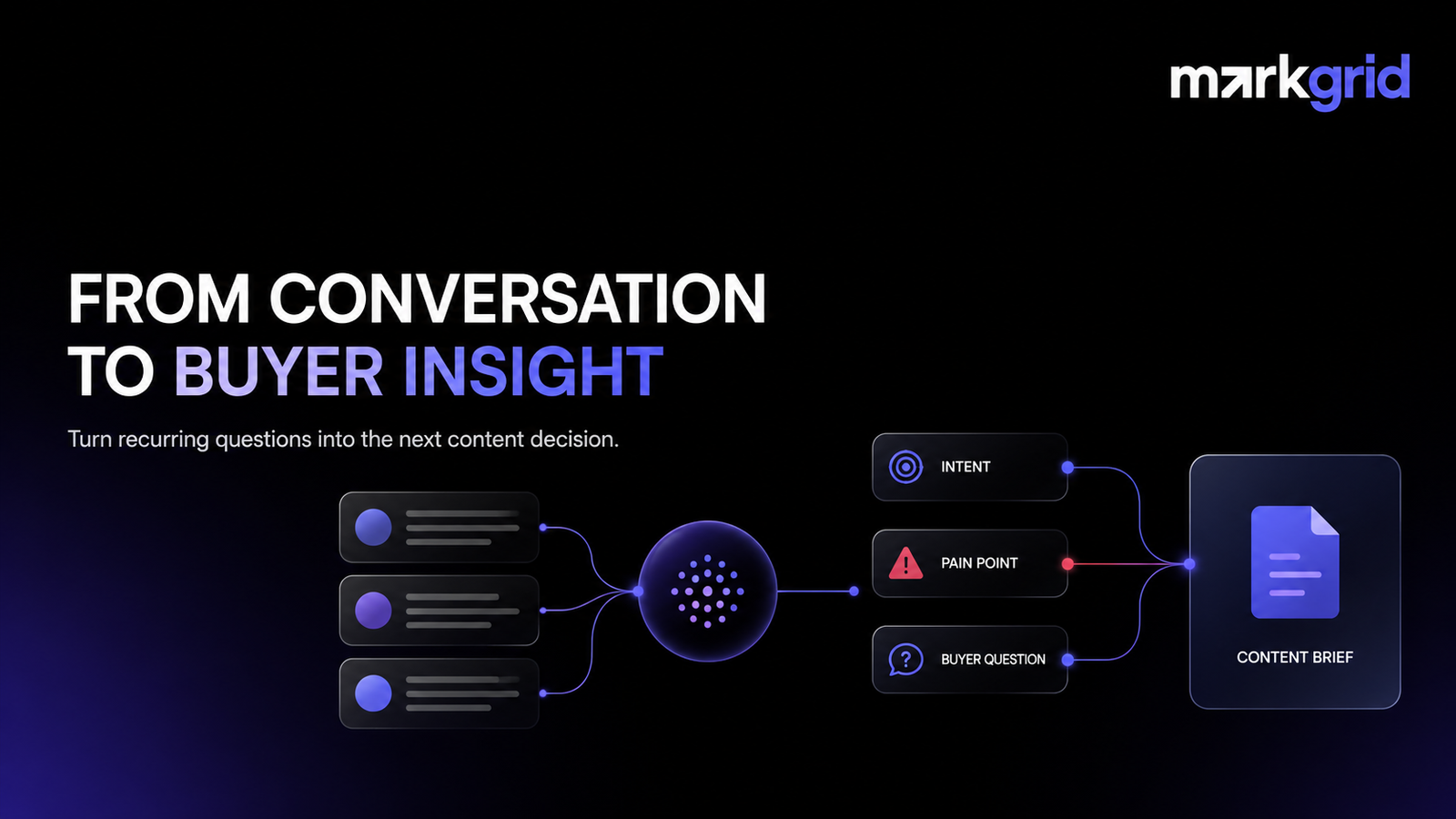
A polished content brief can still miss the buyer.
Research, keyword data, and a structured outline may explain what the team wants to publish. They do not always reveal the questions buyers are asking, the language they use, or the objections delaying a decision.
Community conversations can fill that gap. They give content teams direct evidence of recurring questions, comparisons, frustrations, and unmet needs. Reddit’s own research, for example, reports that people use its communities to research and validate purchase decisions.
The goal is not to turn every comment into content. Start with a clear decision: are you considering a new guide, refreshing an existing page, preparing sales enablement, clarifying a message, or monitoring an emerging issue?
Where the Useful Signals Show Up
Markgrid Community Signals analyzes discussions across Reddit, Discord, Quora, and specialized forums to identify purchase intent, customer sentiment, emerging pain points, and relevant brand conversations.
These environments are noisy. The useful signal is rarely the brand mention alone; it is the context around what someone is trying to decide.
Compare these two examples:
- “I saw Brand X yesterday.” This is a mention, but it reveals little about intent.
- “Which option handles this use case without requiring an additional integration?” This contains a comparison, a requirement, and a possible objection.
Preserve the buyer’s wording and the surrounding context. Replacing specific language with a generic label such as “integration concern” may remove the detail that makes the insight useful to writers, product marketers, and sales teams.
Turn a Recurring Pain Point Into a Content Brief
When a question or pain point appears repeatedly, document it before deciding what to publish. A useful community-to-content record should capture:
- The original question or phrase
- The community and thread context
- The buyer’s apparent task or decision
- The pain point, comparison, or objection
- Evidence that the issue is recurring
- The audience or segment involved
- The smallest useful response
- The owner responsible for the next step
Do not assume every recurring concern requires a new article. The appropriate response may be an update to an existing page, a comparison section, an FAQ, a sales enablement note, a product clarification, or further customer research.
Once the response is clear, Markgrid Content Engine can support the handoff from evidence to a structured brief, brand-aligned drafting, and multi-channel publication.
What to Score Besides Volume
Discussion volume can indicate momentum, but it does not explain the commercial meaning of a conversation. Social listening should help teams understand the context and patterns behind activity, not only count mentions. This distinction between monitoring activity and interpreting why it is happening is also reflected in social-listening guidance from Sprout Social.
Evaluate community conversations through four separate lenses:
Purchase Intent
Is someone actively comparing options, requesting a recommendation, checking compatibility, evaluating price, or trying to reduce implementation risk?
Customer Sentiment
What emotion or attitude surrounds the topic? Sentiment adds context, but positive or negative classification alone does not explain the underlying reason.
Emerging Pain Points
Is the same problem appearing across several discussions, communities, or audience segments? A recurring pattern is usually more decision-relevant than one isolated complaint.
Brand and Category Context
Which brands, features, alternatives, or category expectations appear alongside the discussion? This shows how buyers frame the decision, not merely whether your brand was mentioned.
A useful observation is specific: “Three users are comparing options because the current integration requires extra implementation work.” “High discussion activity” is not enough to guide a content decision.
Build a Weekly Handoff That Doesn’t Die in a Spreadsheet
Community insight loses value when it is collected without an owner or decision path. Establish a short weekly review between the community manager and content lead.
For each signal, record:
- Evidence: What was said, where, and how often?
- Interpretation: What decision, objection, or pain point might it indicate?
- Response: Does it require content, sales enablement, product research, or monitoring?
- Owner: Who is responsible for the next step?
- Review date: When will the team assess whether the response worked?
The content lead can then route validated patterns to the appropriate team:
- Content for new or revised material
- Product marketing for positioning and comparison gaps
- Sales for recurring evaluation questions
- Customer research for issues requiring validation
- Communications for sensitive brand conversations
The point is not to automate judgment. It is to ensure that relevant evidence reaches the person who can act on it. Guidance on turning listening data into decisions similarly emphasizes that collection is not the end goal; the value comes from connecting insights to action.
Choose a Platform by the Decision It Helps You Make
Evaluate community-intelligence platforms against the decision your team needs to support.
Community Signals is relevant when the requirement involves community listening, buyer-intent detection, sentiment analysis, emerging pain points, and monitoring across Reddit, Discord, Quora, and specialist forums.
Keep adjacent jobs separate:
- Use Markgrid SEO Intelligence when the primary question concerns search performance, keyword opportunities, rankings, site health, or search-focused content briefs.
- Use Markgrid Competitive Intel when the team needs broader competitor SEO, content, messaging, or AI-visibility context.
- Use Content Engine after the team has decided what content needs to be created, revised, approved, and published.
A broad platform promise is less useful than a clear demonstration of how one documented conversation becomes a defensible marketing decision.
Checklist for Using Community Intelligence
- Identify the communities relevant to your audience.
- Define the content or marketing decision being investigated.
- Separate casual mentions from decision-oriented language.
- Preserve the buyer’s original wording and context.
- Verify whether the issue is isolated or recurring.
- Choose the smallest meaningful response.
- Assign the finding to a clear owner.
- Review whether the response resolved the information gap.
Frequently Asked Questions
How do I tell whether a Reddit thread contains purchase intent or just curiosity?
Look for decision-oriented language: comparisons, recommendations, pricing questions, compatibility checks, implementation concerns, switching criteria, or deadlines. One phrase is not conclusive, so review the entire thread and the user’s context.
Should a content team treat negative sentiment as a reason to publish a rebuttal?
No. First identify the underlying concern and verify whether it is recurring. The right response may be a content clarification, a product change, direct support, further research, or no public response at all.
What should go into a community-to-content brief?
Include the original buyer language, thread context, recurring question or pain point, audience segment, supporting evidence, recommended content response, intended outcome, and owner.
Can Discord and niche forums reveal emerging pain points before they appear in a content calendar?
They can surface early questions and recurring concerns that the content calendar does not yet address. Treat these conversations as signals to investigate rather than proof that a broad market shift has occurred.
How often should a content operations team review community conversations?
A weekly review is a practical starting point for ongoing content planning. Active launches, emerging issues, or crisis monitoring may require a faster cadence, while slower categories may need less frequent review.
Does community intelligence replace keyword research?
No. Community intelligence adds language, intent, objections, and qualitative context. Keyword research adds measurable search-demand and ranking context. Used together, they produce a stronger content brief than either source alone.
Turn Conversation Evidence Into the Next Decision
Community intelligence is useful when it moves beyond mention counts and reaches the workflow where decisions are made. Capture the original conversation, identify the recurring pattern, choose the appropriate response, and give the next step a clear owner.
Explore Markgrid Community Signals to assess how buyer intent, sentiment, pain points, and relevant community conversations can inform your content operations.
How often MarkGrid is named when AI models discuss this topic. About Model Share
Parteek chauhan
Growth Strategist
Parteek Chauhan is a Growth Strategist at Markgrid, turning market insights, audience behaviour and performance data into focused strategies that help brands identify and scale meaningful growth opportunities.
See it on your brand
Thirty minutes on where marketing is leaking for you.