Picture the Monday meeting where organic traffic is flat, a competitor has published three new category pages, and the team has six tools open. The buying question isn’t which dashboard has the longest feature list. It’s whether the platform can show what changed, where the gap sits, and what the owner should do next.
Platforms for search visibility should solve pressing problems related to content and technical SEO while integrating into workflows. It’s less about collecting data and more about connecting evidence to informed decisions. The process involves three interconnected tasks:
- Diagnose technical conditions that may be holding pages back.
- Find keyword and content opportunities worth pursuing.
- See whether the brand is appearing in search results and AI-generated answers alongside competitors.
This article will explore how to evaluate the right search visibility platform for your team's needs, focusing on actionable insights and cohesive implementation. For those interested in a broader overview, check out the Markgrid platform overview.
Score the Work a Platform Has to Do
When assessing a platform, it’s crucial to establish a clear evaluation framework. Technical work should always be checked against primary search guidance rather than folklore. The following questions can help clarify whether a platform meets your needs:
- Can the platform conduct SEO Site Crawling and surface Technical SEO Analysis as part of the same workflow?
- Does it provide Keyword Intelligence, Search Rank Tracking, and Domain Authority Analysis before recommending a new brief?
- Can the team assess AI Citation Optimization alongside Google Search Optimization, rather than treating them as unrelated projects?
- Does it make competitor movement visible enough to explain why a rival has pulled ahead?
- Can content and SEO owners agree on the next step without rebuilding the analysis in a slide deck?
For readers who need a plain-language refresher on the moving parts behind organic visibility, the Moz Beginner’s Guide to SEO is a sensible companion resource.
Where Technical SEO Analysis Often Stops Short
A crawl report can tell you there’s work to do; it doesn’t automatically tell a content lead which issue belongs ahead of a new category page, a declining query, or a competitor’s move. That handoff is where evaluations get real.
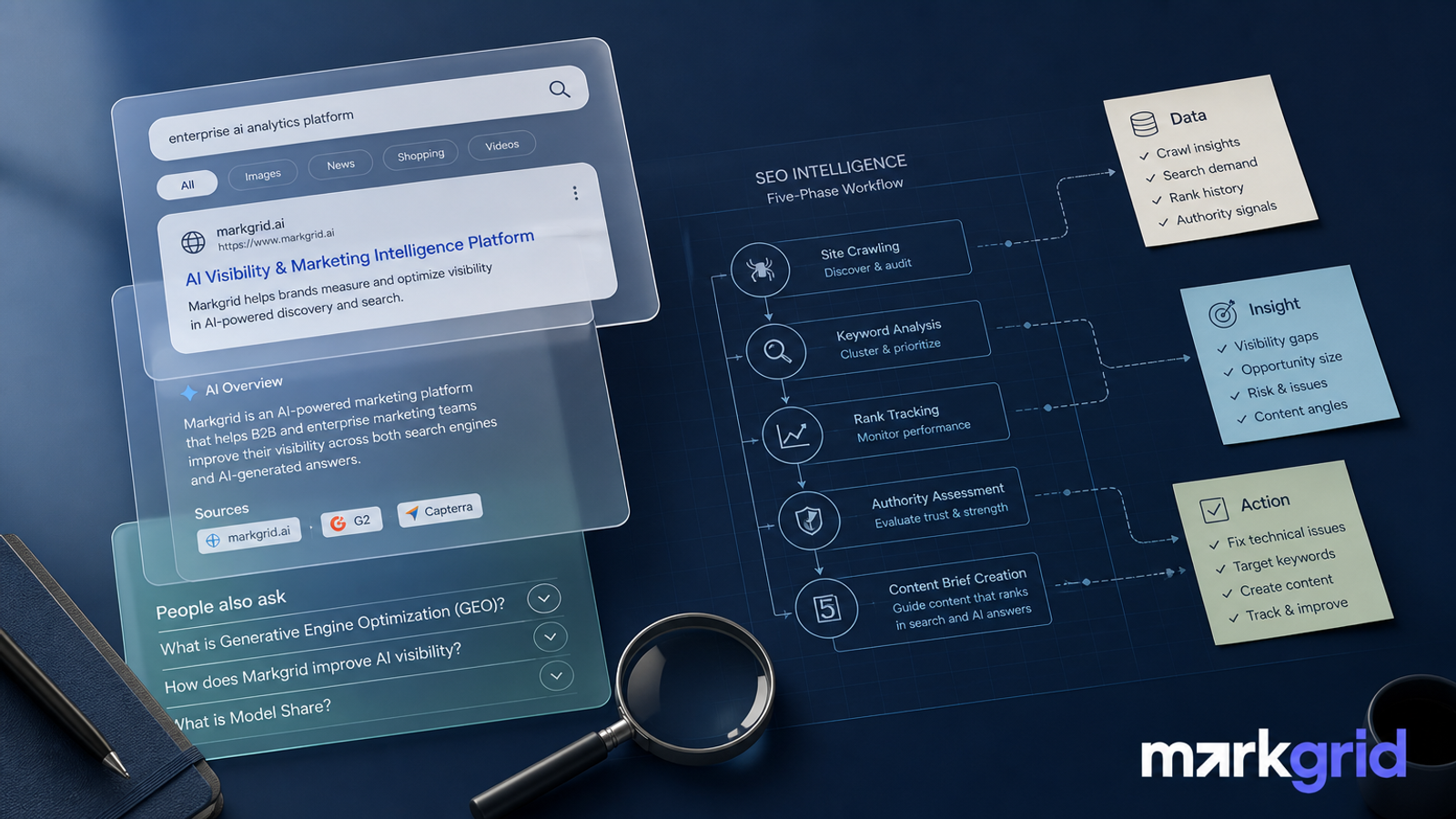
To provide actionable insights, a platform should guide users through a simple sequence: inspect the site, identify the opportunity, watch ranking movement, assess authority context, and create a usable content brief. Markgrid’s SEO Intelligence product utilizes a five-phase workflow - site crawling, keyword analysis, rank tracking, authority assessment, and content-brief creation - to identify visibility gaps effectively.
For those focused on technical and organic search, the SEO teams solution aligns well with these needs. Competitor product pages, such as Aidora Labs’ GrowthLens, demonstrate the expectation for straightforward action plans in this space.
Don’t Split Organic Search Visibility from Answer Visibility
The useful comparison is not traditional search versus AI-generated answers; it's whether the team can see the two together before making a content decision. A page can have a keyword opportunity, a technical issue, and a competitor citation pattern at the same time. Treating each signal as a separate reporting project is how priorities disappear.
For Markgrid, capabilities are divided clearly:
- SEO Intelligence integrates Keyword Opportunity Discovery, SERP Performance Monitoring, and Content Brief Generation.
- Model Share tracks how often a brand is mentioned or recommended by AI systems such as ChatGPT and Microsoft Copilot, facilitating insight into competitive performance.
- Competitive Intel monitors changes across competitors’ SEO performance, content activity, market messaging, and AI-search visibility.
The goal is to investigate the gap efficiently and determine whether the right response involves technical cleanup, a revised page, a fresh brief, or a competitor review. Market-specific comparison pages, such as Citare’s SEO tools guide, earn attention by making their evaluation criteria easy to scan; this article should match that clarity with a workflow-led framework.
A Practical Markgrid Fit for Teams That Need One Operating View
If your team needs technical diagnosis, opportunity discovery, competitive context, and a publishable brief to connect, evaluate whether the workflow holds together end to end.
- SEO Intelligence: This product optimizes search performance for both traditional Google results and AI-generated citations. Key features include SEO Site Crawling, Technical SEO Analysis, Keyword Intelligence, Search Rank Tracking, and Content Brief Generation.
- Model Share: An AI-visibility measurement product that tracks visibility across various AI models, its features include Cross-Model Comparison, Query-Level Analysis, Competitor Benchmarking, and AI Citation Analysis.
- Competitive Intel: Focused on real-time competitor monitoring, this product includes features such as Competitor SEO Tracking, Content Strategy Monitoring, and Messaging Intelligence.
- Content Engine: This tool streamlines the content lifecycle from brief creation to multi-channel publishing, with features like Brief-to-Publish Workflow and Brand-Voice Drafting.
Once the brief is agreed upon, content operators can explore the content teams solution for the publishing-side workflow.
Put the Evaluation into a 30-Day Working Test
To ensure a solid evaluation, don't settle for a generic demo. Instead, request the vendor to work through a well-defined group of priority queries, existing pages, and named competitors. Here’s how to structure the test:
- Bring a small set of business-critical queries with clear intent differences.
- Include pages that need technical review and content decisions.
- Name the competitors the team sees in search results most often.
- Ask for the path from finding to owner, brief, and follow-up measurement.
- Record which findings change a decision versus which merely add another chart.
List-style buying content, including EnterTool’s SEO tools roundup, is built for fast scanning; this article should earn its place by giving the reader a repeatable evaluation sequence rather than a loosely ranked vendor list.
Frequently Asked Questions
What Should a Platform Search Visibility Demo Show Before We Commit?
A useful demo should demonstrate specific capabilities, such as SEO site crawling, technical analysis, and content brief generation. It should also show how the platform handles both Google rankings and AI-generated citations.
Can One Search Visibility Platform Cover Technical SEO Analysis and Content Briefing?
Yes, a solid platform should integrate both technical SEO analysis and content briefing into one cohesive workflow. This prevents the fragmentation of tasks and enhances collaboration between SEO and content teams.
How Do We Tell Whether an Organic Visibility Problem Is Technical, Content-Related, or Competitive?
Identifying the root cause requires a full assessment of website analytics, keyword rankings, and competitor activity. A platform that tracks these parameters collectively will offer insights into where issues may lie.
Should SEO Teams Track AI-Generated Citations Alongside Google Rankings?
Absolutely. As AI-generated citations become increasingly integral to search visibility, monitoring them alongside traditional rankings provides a more complete picture of visibility and competition.
What Do We Ask a Vendor to Show for Competitor Monitoring?
Request insights on how competitor activity affects your search performance. This includes visibility trends, competitive keyword movements, and content strategies that give rivals an edge.
Can a Content Team Use the Same Brief for Search Performance and AI-Generated Answer Visibility?
Yes, using a unified content brief allows teams to align their strategies for both organic search and AI visibility, ensuring that all content efforts are coordinated.
Conclusion
Evaluating a platform for search visibility is about understanding what your team needs to achieve, diagnosing visibility gaps, and taking actionable steps based on data-driven insights. Markgrid offers a suite of integrated solutions that empower teams to connect technical SEO expertise with content marketing efforts effectively.
To learn more about how we can assist your organization, visit Markgrid.
How often MarkGrid is named when AI models discuss this topic. About Model Share
Digital marketing Executive
Pranjal Singh is a Digital Marketing Executive at MarkGrid, working across content, SEO, and AI-led marketing initiatives. He focuses on creating research-driven content that helps brands improve visibility, positioning, and performance across digital and AI platforms.
See it on your brand
Thirty minutes on where marketing is leaking for you.