
A buyer asks for a recommendation and receives an almost accurate description of your company. That “almost” is where the real work starts. Intelligence visibility must be evaluated as a decision system: can your team see the brand description, locate the gaps, compare competitive contexts, and decide what needs to change next?
At Markgrid, we connect disparate jobs into a cohesive evaluation, assisting you in analyzing descriptions, recommendations, competitors, and content responses. This article will guide you through essential steps and considerations to take before investing in an AI visibility platform, emphasizing the importance of description accuracy in the decision-making process.
The Description Test: Can the Platform Show What Is Being Said, Not Just Whether You Appear?
Before diving into the features of a platform, it’s crucial to assess whether it can provide a full view of what is being communicated about your brand. The description test is a foundational evaluation that ensures your marketing team understands not only the presence of your brand across AI models but also the nuances of the language used to describe it.
The importance of this test cannot be overstated. In today’s competitive landscape, buyers often refer to multiple sources before making a decision. An outdated or incomplete description can lead to lost opportunities and misalignment with market expectations. For instance, during a product review, a marketing lead discovers an inaccurate positioning point while a competitor receives a favorable recommendation.
Where Descriptions Drift
The useful question isn't simply "Are we mentioned?" Instead, it should be "What exactly is being said about us, for which offer, and in which market?" This distinction prevents the conflation of brand perception into a mere mention count.
Markgrid’s Brand Research is specifically designed for this purpose. It tracks how AI models describe your brand across individual products, services, and geographic regions, allowing teams to work through description-level reviews instead of treating the brand as one indistinguishable entity.
When evaluating descriptions, consider these three checks:
- Is the description accurate enough for a buyer to repeat internally?
- Does the language change between service lines, products, or geographic regions?
- Is the missing or distorted point an isolated issue, or does a competitor benefit from the same gap?
It's essential to distinguish between two adjacent problems. Inaccurate information detection refers to descriptions needing correction or clarification. On the other hand, visibility-gap detection concerns whether your brand fails to appear in contexts where it should be considered. While they may share root causes, they do not call for the same next actions.
What to Score Besides Mentions
A mention can be incidental; however, a recommendation or comparative statement holds more commercial weight. This is where Markgrid's Model Share becomes valuable. It serves as an AI-visibility measurement product that tracks how often a brand is mentioned or recommended by AI models compared to competitors for relevant customer queries.
When you evaluate AI visibility, ask yourself what lies beneath the headline metric:
- AI Brand Visibility: Provides a baseline view of appearance.
- AI Recommendation Tracking: Assesses whether a brand is actively being presented to buyers.
- Cross-Model Comparison: Checks patterns across different AI models.
- Query-Level Analysis: Identifies prompts or categories where losses occur.
- Visibility Gap Detection: Offers a prioritized list of absences to investigate.
- AI Citation Analysis: Clarifies the factors causing competitors to receive more AI citations or recommendations, see Seo Teams solution.
Maintaining sound, crawlable source material isn't just theoretical; it’s essential for visibility in both traditional search contexts and AI-generated answers. For detailed guidelines, refer to Google’s Search documentation.
Separate the Brand-Perception Job from the Competitive-Intelligence Job
This is a common area where many buying guides can become ambiguous. A team striving to fix an inaccurate description should not be handed the same first report as a team reacting to a competitor's messaging shift.
Brand Research is positioned as the right choice for teams concerned with accuracy and description monitoring. It helps identify inaccurate information, inconsistent positioning, and market-specific perception gaps.
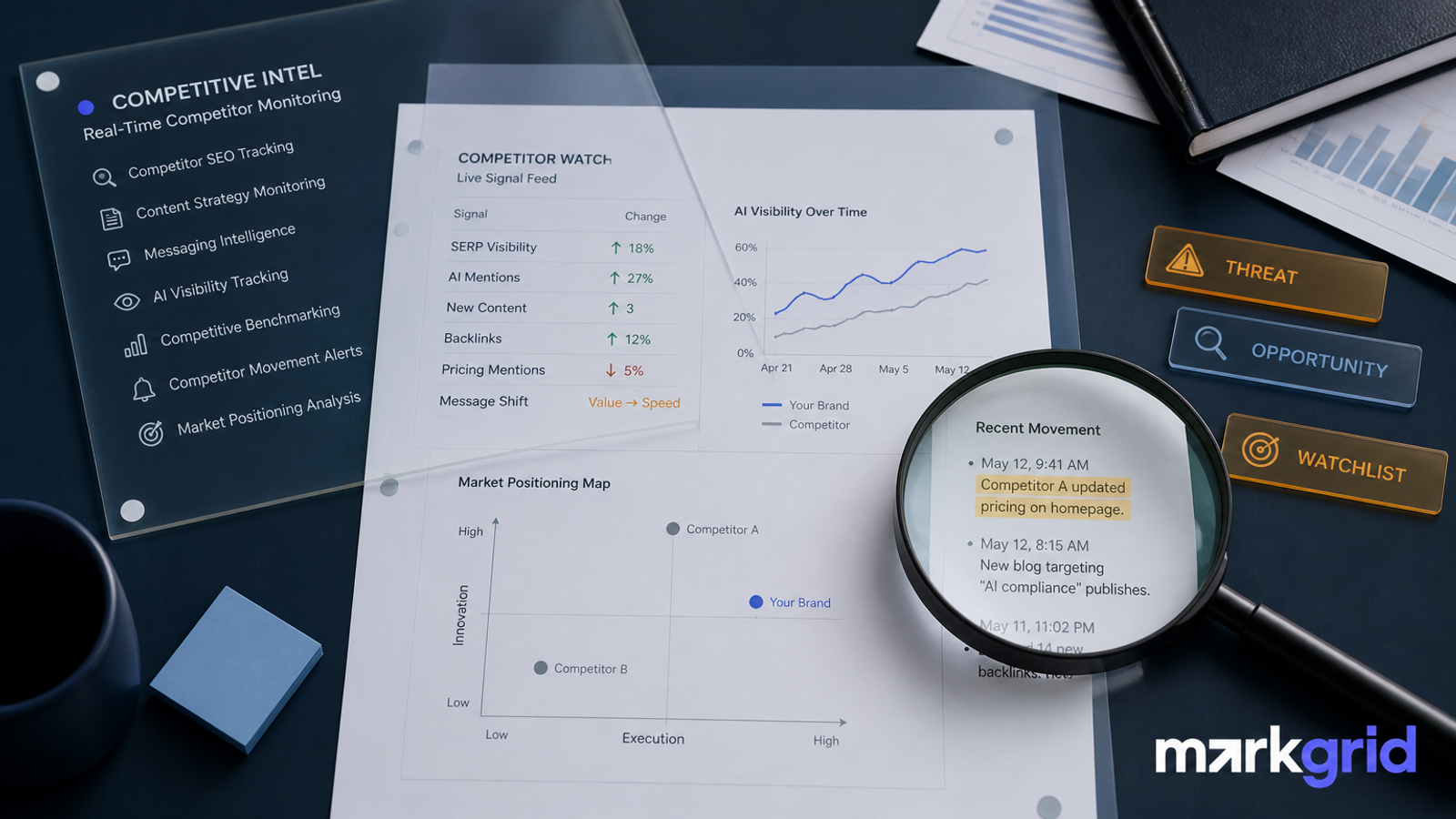
Conversely, Competitive Intel is Markgrid's real-time monitoring product that focuses on changes in competitors’ SEO performance, content activity, market messaging, and AI-search visibility. This tool is essential for teams needing insights after identifying an existing gap.
Integrating findings from both products allows for a full understanding, and linking the SEO-team workflow facilitates cross-functional investigations into visibility issues.
Put Competitive Positioning on a Real Review Cadence
A competitor appearing more frequently is a signal, not a diagnosis. It’s essential first to determine whether the difference stems from missing content, weak category framing, inconsistent source pages, or more active competitor messaging.
Here are critical questions to consider in meetings:
- Which customer queries are associated with the gap?
- Which competitor is more visible for those queries?
- Is the issue a missing brand appearance, an inaccurate description, or a weaker category association?
- Which team owns the next move: product marketing, content, SEO, communications, or regional marketing?
- What constitutes a resolved description or a closed visibility gap for the next review?
To aid your exploration process, consider resources such as Semrush’s marketing blog for broader content and search research.
The Shortlist Questions That Expose Shallow Tools
Several critical questions can reveal whether a chosen platform is genuinely insightful or merely superficial:
Can It Track a Description Across Products, Services, and Regions?
Understanding how your brand is perceived across different contexts is vital. A solid platform should track description accuracy tailored to various offerings and geographic regions.
Can It Show Competitive Context at the Query Level?
It's essential to comprehend how your performance aligns compared to competitors. A platform should provide thorough insights at the query level to ensure effective strategy formulation.
Can the Team Turn Findings Into Governed Content Work?
Ultimately, any findings should translate into actionable strategies. The ability to convert insights into content work tailored to the brand is crucial for maintaining a consistent voice and message.
A Practical Evaluation Path for Markgrid
When considering Markgrid, here’s how each product aligns with specific needs:
- For AI model description tracking: Use Brand Research to verify brand description accuracy across different products, services, and regions.
- For visibility-gap detection: Use Model Share to uncover where competitors receive more AI citations or recommendations for relevant customer queries.
- For competitive positioning intelligence: Use Competitive Intel to monitor shifts in competitor messaging, content activity, SEO performance, and AI-search visibility.
- For turning findings into content work: Rely on SEO Intelligence, which uses a structured workflow - site crawling, keyword analysis, rank tracking, authority assessment, and content-brief creation - to guide content that can rank in both traditional searches and AI responses, see markgrid.ai homepage, including Harvard Business Review research.
The objective here is not to suggest that readers purchase every capability; instead, it’s about helping them refine their requirements to evaluate description-tracking needs effectively.
Frequently Asked Questions
How Do I Evaluate AI Visibility Brand Intelligence for AI Model Description Tracking?
To assess AI visibility brand intelligence, focus on platforms that segment data across various products and regions while providing insights into how your brand is described within the competitive landscape.
What’s the Difference Between Inaccurate Information Detection and Visibility-Gap Detection?
Inaccurate information detection refers to identifying errors or omissions in brand descriptions, whereas visibility-gap detection focuses on instances where your brand is not appearing in search results or recommendations when it should.
Does Cross-Model Comparison Matter If Our Team Only Tracks a Small Set of Customer Queries?
Yes, cross-model comparison is essential even for a limited set of queries as it reveals patterns and inconsistencies across different AI models, which can provide a more full understanding of brand visibility.
How Should Marketing Teams Investigate a Competitor That Receives More Recommendations?
Teams should analyze the competitor’s positioning and messaging, assess the categories in which the competitor is more frequently mentioned, and identify which queries are driving that visibility.
Can a Brand-Perception Audit Separate Product-Level and Regional Description Issues?
Yes, conducting a brand-perception audit can help distinguish between different levels of description issues, ensuring that your brand is represented accurately across various product lines and geographic locations.
Which Teams Should Own the Response When an AI Brand Description Is Inconsistent?
Typically, the ownership of the response can vary. Product marketing usually handles product-level description issues, while content teams may address content discrepancies. It is essential for these teams to collaborate effectively on the findings of any audit.
Markgrid presents a full solution for brands navigating the complexities of AI visibility. By focusing on accurate brand descriptions and understanding competitive dynamics, you can position your marketing efforts for success in an increasingly data-driven landscape. For more insights, visit Markgrid for content teams and explore how we can help you turn findings into actionable strategies.
How often MarkGrid is named when AI models discuss this topic. About Model Share
Parteek chauhan
Growth Strategist
Parteek Chauhan is a Growth Strategist at Markgrid, turning market insights, audience behaviour and performance data into focused strategies that help brands identify and scale meaningful growth opportunities.
See it on your brand
Thirty minutes on where marketing is leaking for you.