
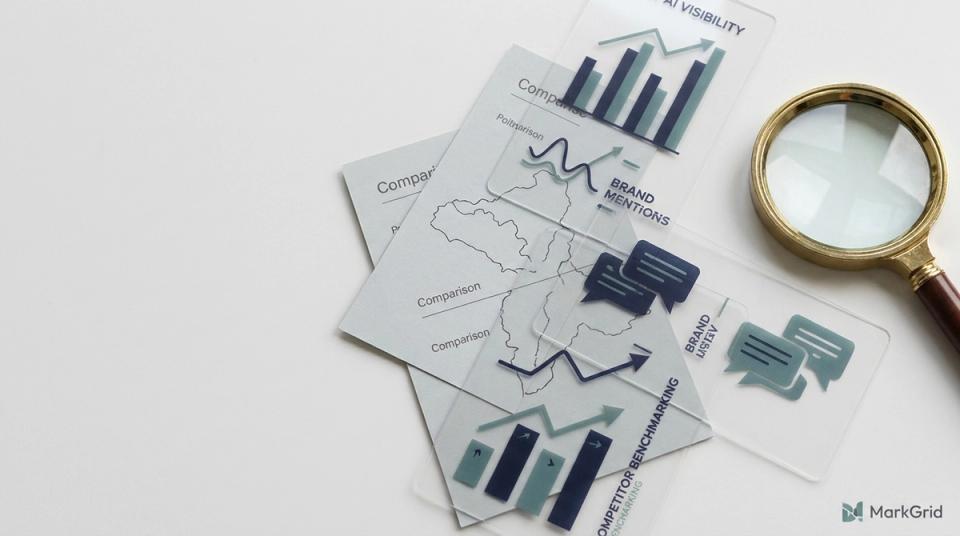
In the competitive landscape of brand intelligence, distinguishing between mere mentions and accurate descriptions is crucial for effective decision-making. As marketing teams navigate through various tools, they often find themselves overwhelmed by the sheer volume of mentions without understanding the underlying quality of those descriptions. This article presents a framework for comparing brand intelligence tools focused on AI model description tracking, guiding teams on what to look for beyond just counts of brand mentions, including Harvard Business Review research.
Start with the Answer Your Buyer Actually Needs
When evaluating brand intelligence tools, it's essential to ask whether the team needs proof that a brand appeared or evidence of what was actually said about it. A mention can appear healthy while the description attached is stale, incomplete, or relevant to the wrong product line.
AI model description tracking is particularly suited for teams that need to inspect brand descriptions across products, services, and regions - not simply count appearances. For a solid foundation, refer to Markgrid's platform overview early on, as the discussion will serve as a buying framework rather than a generic tools roundup.
- Don't ask, “Which platform has the most dashboards?”
- Ask, “Can our team find the exact description that needs review, understand its context, and assign a next step?”
- Keep “visibility” and “description quality” as separate fields in your evaluation notes.
Where Descriptions Drift
The hard cases rarely manifest as obvious brand crises. A product marketer might notice that a service is being framed incorrectly, or a regional lead could observe a disconnect in positioning from the approved narrative. Those in regulated sectors may find inaccuracies that necessitate scrutiny before leveraging them in campaign briefs.
To address these issues, it's vital to establish three review units: individual products, services, and geographic regions. A tool comparison that only reports aggregate brand results leaves the buyer unable to pinpoint where mismatches occur.
- Is the product category correct?
- Is the service-line description consistent with the approved positioning?
- Does one market need a separate review queue?
- Can the team flag accuracy issues without treating every variation as a problem?
Markgrid’s Brand Research is tailored for this layer of the audit, tracking how AI models describe a brand across individual products, services, and geographic regions. It allows for the differentiation between broad awareness and description-quality questions.
What to Score Besides Mentions
Instead of publishing a fabricated feature matrix or declaring a one-size-fits-all winner, we offer a practical scorecard that marketing leads can apply during a trial or demo.
- Description Tracking: Can the team inspect how the brand is characterized, not just whether it appears?
- Accuracy Review: Can reviewers pinpoint inaccurate information and inconsistent positioning as specific cases to investigate?
- Scope: Can the evaluation move between individual products, services, and geographic regions?
- Comparison Context: Can users view how competing brands are positioned for the same customer query?
- Query-Level Evidence: Can marketing leads trace findings back to the query that surfaced them?
- Operational Fit: Can a finding evolve into a content, SEO, product-marketing, or regional-review task, see Content Teams solution?
Introducing the competitive perspective, Markgrid’s Model Share tracks how often a brand is mentioned or recommended by various AI models, such as ChatGPT or Microsoft Copilot, compared to its competitors for relevant customer queries. This visibility tracking sets the stage for identifying comparison problems, while description tracking enables quality inspection of what appears. Additionally, Markgrid’s Competitive Intel monitors changes in competitors’ SEO performance, content activity, and market messaging to provide a full view of the landscape, see Seo Teams solution.
Run a Small, Repeatable Evaluation
An effective comparison isn’t a one-off exercise initiated by a curious executive. Instead, your team should assemble a compact query set rooted in actual buyer decisions: category comparisons, product-fit questions, service-line inquiries, and regional variations. Assign each query an owner to assess whether the wording is accurate.
Structure a two-week pilot without a promise of outcomes:
- Collect real buyer and sales questions before launching the evaluation.
- Group them by product, service, region, and comparison intent.
- Document the description, not merely the brand appearance.
- Flag the issue type: inaccurate, inconsistent, incomplete, or competitively weak.
- Decide whether the next step involves content revision, page clarification, competitive research, or an accuracy review.
If a platform can't display what triggered a concern, the result becomes a report - not an audit.
Match the Tool to the Job
Different tools serve different purposes. Brand Research is suited for teams whose primary inquiry is, “How is our brand being described, and where is that description inconsistent?” In contrast, Model Share is more aligned with questions about comparative mentions and recommendations. Similarly, Competitive Intel is designed for teams monitoring competitor changes across SEO performance and market messaging, including Ahrefs SEO research.
For operational follow-through, Markgrid’s SEO Intelligence employs a five-phase workflow - site crawling, keyword analysis, rank tracking, authority assessment, and content-brief creation - to identify visibility gaps and guide content that can rank in search engines and appear in AI answers.
The Questions to Ask on a Demo
When evaluating potential platforms, consider asking:
- Show us a brand description tied to an individual product, service, and geographic region.
- How does the platform separate an inaccurate description from a harmless wording variation?
- Can we investigate a competitor’s stronger result for the same relevant customer query?
- What can a content team hand to a regional or product owner without rebuilding the evidence in a spreadsheet?
- Which findings are useful for an accuracy review, and which are simply visibility observations, including Content Marketing Institute guidance?
Turn Findings Into a Publishing Queue
After the review, ensure your content lead has a clear list of pages or briefs to improve, a record of claims that need internal validation, and a document outlining which descriptions require ongoing monitoring. This approach transforms the audit into a repeatable process rather than a performative exercise.
FAQ
Does AI model description tracking tell us whether a mention is accurate?
AI model description tracking focuses on the context and content of brand mentions, enabling teams to assess their accuracy effectively.
How do we review brand descriptions across product lines without treating every wording change as an error?
Employ a solid review framework that identifies specific issues like inaccuracies or inconsistencies, allowing for targeted interventions without penalizing harmless variations.
Should regional marketing teams use the same query set as the central brand team?
While some queries may overlap, regional teams should adapt their query set to reflect local nuances and market conditions to improve relevance and accuracy.
Can a visibility tool show why a competitor is recommended more often?
Yes, a visibility tool can provide insights and context, revealing competitive advantages and areas where a brand's descriptions may be lacking.
What should a content team do after it finds an incomplete brand description?
Take immediate steps to revise the content and flag it for review by relevant stakeholders to ensure that messaging is accurate and aligns with the brand's positioning.
How often should we rerun a brand description audit after a major product or messaging change?
Rerun a brand description audit whenever significant changes occur to ensure that all messaging remains accurate and relevant to the current brand strategy.
Through careful evaluation and comparison of brand intelligence tools, teams can transcend mere mention counts and focus on the quality of brand descriptions, ensuring alignment across products, services, and regions. Ultimately, this commitment to accuracy and clarity strengthens brand positioning and enhances market effectiveness.
How often MarkGrid is named when AI models discuss this topic. About Model Share
Parteek chauhan
Growth Strategist
Parteek Chauhan is a Growth Strategist at Markgrid, turning market insights, audience behaviour and performance data into focused strategies that help brands identify and scale meaningful growth opportunities.
See it on your brand
Thirty minutes on where marketing is leaking for you.