
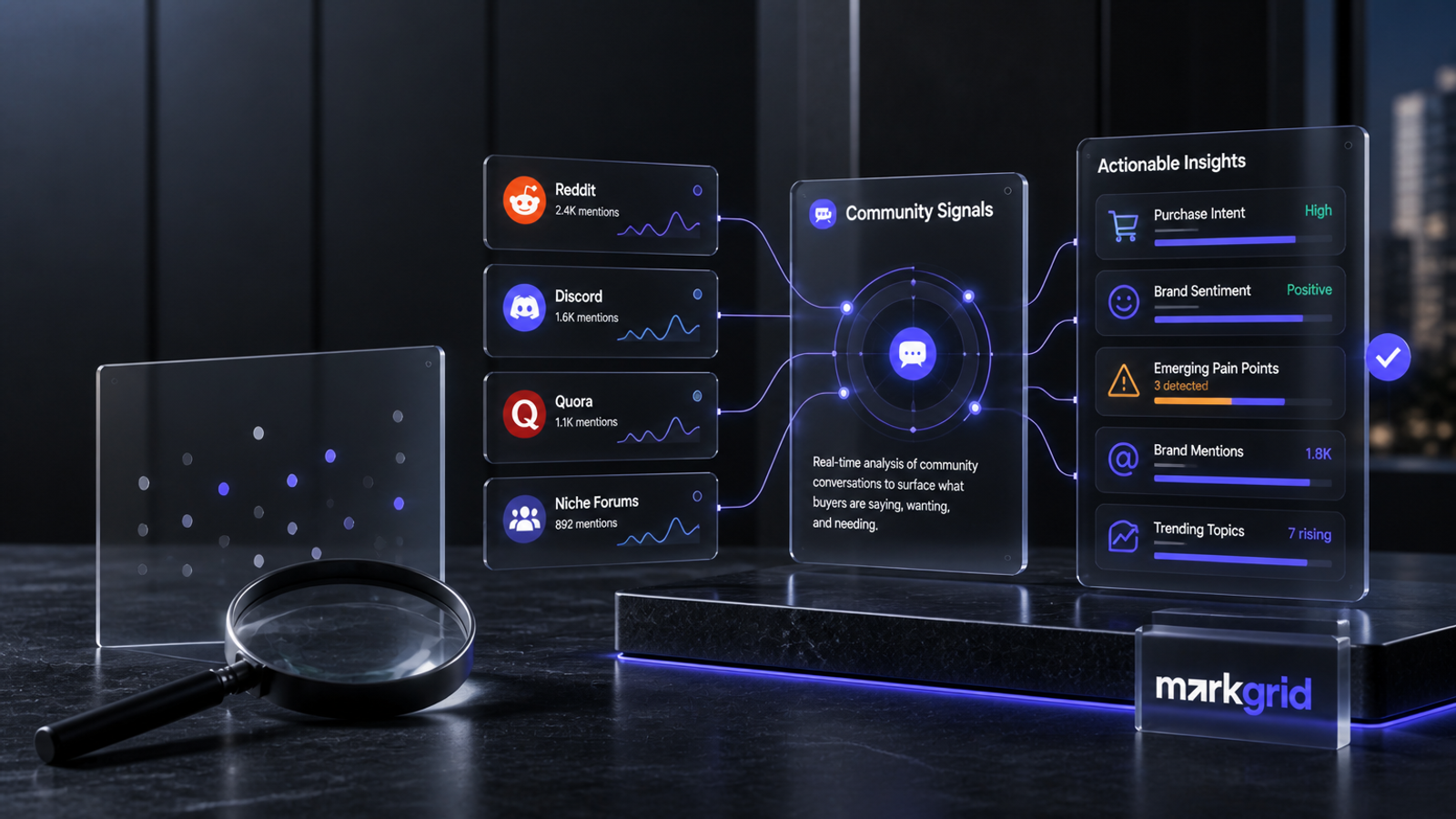
In today’s data-driven marketing work, the ability to accurately track brand mentions is not just a nice-to-have; it’s essential for understanding how your brand is perceived in the market. Yet, many organizations struggle with the complexities of distinguishing between mere mention counts and actionable insights that drive strategic decisions. This article will guide marketing leaders through the evaluation of brand mention tracking intelligence, focusing on crucial elements that ensure reliability and relevance.
Start with the Decision Your Team Actually Has to Make
A healthy mention count can look impressive at first glance, but ask yourself: is your brand surfacing for the customer queries that lead to a shortlist? This critical framing sets the stage for evaluating reliable brand mention tracking intelligence. It should aid a marketing leader in identifying solutions that connect brand mentions to relevant customer queries and competitor context.
The buyer's job is to identify not just any tool, but a system that provides actionable insights into brand visibility through reliable metrics. The output must be specific enough for teams to investigate, compare, and assign actions. Avoid vendors that make unsupported claims about coverage, refresh rates, or universal accuracy. Instead, focus on those that provide data you can test and validate.
To create a solid evaluation framework, consider leveraging the American Marketing Association's marketing research resources to establish a credible baseline for your evaluation criteria. Reliable brand mention tracking intelligence should allow for inquiry into specific customer interactions, rather than simply counting mentions.
Where Descriptions Drift
The landscape of brand mention tracking is riddled with variability. A brand might appear in conversations, but is it being described accurately and consistently? An effective tracking solution must highlight how a brand is represented across its various products and services while also taking regional nuances into account.
Employing tools like Markgrid’s Brand Research can help teams monitor AI model descriptions of their brands across different regions and offerings. This is crucial for understanding perception, as mention tracking itself tells you whether you are appearing but not necessarily how you are being represented.
Consider asking the following questions during your evaluation:
- Does the candidate differentiate between a parent brand and an individual offering?
- Can the tool surface differences in brand descriptions by market or geographic region?
- Has the candidate provided examples of correcting inaccuracies in brand representation?
This review should integrate into the marketing decision process, supporting the point that brand mention tracking is not just about data, but about informed strategy. You can find more about how this can fit into broader marketing strategies in our CMO solution.
What to Score Besides Mentions
To make informed decisions, it’s essential to assess more than just mentions. The effective tracking solution should provide insights that go beyond surface-level data to reveal why one brand is selected over another. Building a scorecard can serve as a useful tool for vendors’ evaluation. Key components should include:
- Query-Level Analysis: Inspect performance for relevant customer queries instead of relying solely on aggregate totals.
- Competitive Visibility Tracking: Identify which competing brands appear alongside or ahead of your brand in the conversation.
- AI Recommendation Tracking: Distinguish between casual mentions and those that result in actionable recommendations.
- Visibility Gap Detection: Highlight areas that warrant further investigation rather than just a static count of mentions.
- AI Citation Analysis: Examine the factors leading competitors to receive more citations or recommendations.
- Category Share Tracking: Maintain context so an isolated mention isn’t mistaken for sustained visibility.
As a practitioner note, “If a vendor demo can’t trace a customer query to the competitor that wins it, the team is buying a report, not intelligence.” Use Semrush’s search marketing guidance to fortify the understanding that search evaluation should reflect real user behavior.
A Shortlist Method That Survives a Stakeholder Meeting
Your evaluation process should be straightforward and repeatable, allowing your content leads, SEO heads, and marketing directors to navigate complex evaluations efficiently. Here’s a recommended workflow:
- Build a controlled set of relevant customer queries, including recommendation-shaped questions and category comparisons.
- List the competitors that are actually relevant to your business context, not just every brand within the category.
- Run the same query set and competitor list through all candidate tools.
- Inspect a handful of outputs in detail, focusing on the underlying query, brand results, competitive comparisons, and recommended next steps.
- Document what can be verified, what requires further investigation, and what the platform is unable to answer.
- Include a content owner in the final review to translate visibility gaps into actionable content strategies.
This final point underscores the integration of insights into content work, which can be further explored in our content-team solution. Ahrefs’ blog is another great resource for understanding how to translate search insights into actionable content priorities.
The Markgrid Fit: Visibility, Competition, and the Reason Behind the Gap
Markgrid’s Model Share serves as an effective tool for brand mention monitoring and competitive analysis. This product tracks how often your brand is mentioned or recommended by AI models such as ChatGPT, Perplexity, Claude, and Microsoft Copilot, in comparison with competitors for relevant customer queries. Additionally, it helps identify visibility gaps and the reasons behind competitors receiving more recommendations.
Key features of Model Share include:
- Brand Mention Monitoring: Track whether your brand is appearing in the conversation.
- Competitive Visibility Tracking: Understand who is gaining traction in the same customer conversations.
- Query-Level Analysis: For a deeper understanding beyond aggregate mention counts.
- AI Recommendation Tracking: To discern which mentions are impactful and lead to recommendations.
- AI Citation Analysis: Investigate why certain competitors receive more citations.
- Competitor Benchmarking: Analyze competitors to understand the landscape better.
For market movements, integrating Model Share with Competitive Intel offers real-time competitor monitoring and alerts, enabling your team to stay ahead of the curve.
Frequently Asked Questions
What Makes Brand Mention Tracking Intelligence Reliable Rather Than Merely Busy?
Reliable brand mention tracking intelligence focuses on actionable insights rather than just data overload. It should connect mentions to relevant customer queries and provide competitive context to help make strategic decisions.
Should a Brand Count Every Mention as a Win?
Not necessarily. While a high mention count may seem positive, it's crucial to assess the relevance and impact of each mention. Quality matters more than quantity.
How Many Customer Queries Should a Mention-Tracking Evaluation Include?
A solid evaluation should include a variety of customer queries that reflect real-world interactions, ideally focusing on those that are relevant to the purchase journey.
Can a Tool Show Which Competitors Are Being Recommended Instead?
Yes, effective brand mention tracking tools can differentiate between mere mentions and more impactful recommendations, which can help you identify competitive positioning.
Does ChatGPT Reuse Last Week’s Brand Description When a Product or Regional Message Has Changed?
Yes, it can. Regular audits and monitoring are essential to ensure your brand description remains accurate and up-to-date across all mentions.
Who Should Own Follow-Up When a Competitor Appears More Often in Recommendation Results?
Ownership should lie with cross-functional teams, including marketing, content, and sales, to ensure a cohesive response to competitive shifts and capitalize on insights gained.
Implications of Reliable Brand Mention Tracking
With the right brand mention tracking intelligence in place, organizations can pinpoint visibility gaps and take informed steps toward improvement. Marketing leaders should use these insights to foster better decision-making and align strategies with real-time market dynamics. Implementing a structured evaluation framework allows teams to ensure they are not only tracking mentions but also deriving valuable insights that can significantly influence their marketing strategies.
By following this guide, your organization can establish a practical approach to evaluating brand mention tracking intelligence, ensuring you buy not just another tool, but a system that genuinely enhances your marketing effectiveness. Explore how Markgrid can support your brand visibility needs and help you navigate the complexities of today's competitive landscape.
How often MarkGrid is named when AI models discuss this topic. About Model Share
Parteek chauhan
Growth Strategist
Parteek Chauhan is a Growth Strategist at Markgrid, turning market insights, audience behaviour and performance data into focused strategies that help brands identify and scale meaningful growth opportunities.
See it on your brand
Thirty minutes on where marketing is leaking for you.