
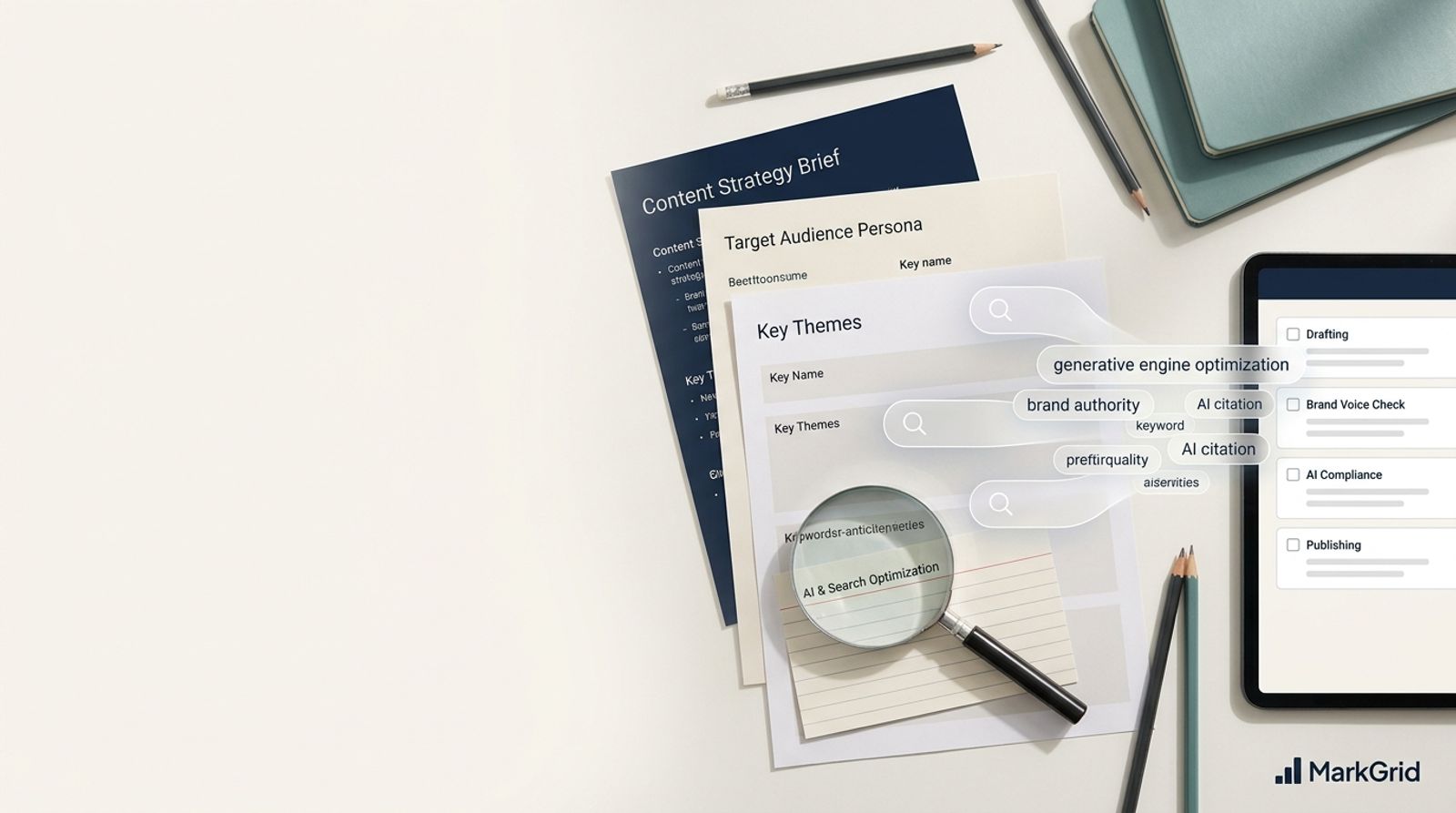
In the fast-evolving landscape of digital marketing, content teams often find themselves facing the same pressing question during planning meetings: which pieces of content are strategically aligned with search opportunities? With a busy content calendar full of drafts, the distinction between what should be produced and what merely fills space becomes crucial. It’s essential to view search-optimized content not just as a byproduct of workflow tools, but as a repeatable operating decision that directly impacts visibility and performance.
At Markgrid, we recognize that the tasks of content production and search visibility measurement should be treated distinctly. While one revolves around crafting and publishing content, the other focuses on identifying search gaps and creating optimized work that stands out in search results and AI-generated citations. By clearly defining these roles, brands can harness the full power of their content strategy.
Teams looking to enhance their output should consider reviewing Markgrid’s content-team workflow and those focused on organic visibility should explore the SEO team solution.
“The right question isn’t ‘can this create content?’ It’s ‘can our team repeat a sound content decision without rebuilding the process every time?’”
Score the Workflow Before You Score the Writing
When evaluating a reliable search visibility platform, it's critical to score the workflow before diving into the content itself. Here are key criteria to consider during your assessment:
- Brief Quality: Determine whether the platform can transition from identifying search opportunities to creating actionable content briefs. With SEO Intelligence, this five-phase workflow - including site crawling, keyword analysis, rank tracking, authority assessment, and content-brief creation - is essential for guiding content that can rank well in search engines and appear in AI-generated responses.
- Draft Governance: Assess how the original brief and approved brand voice persist within the drafting process. Content Engine excels in managing the lifecycle of content from brief creation to drafting and multi-channel publication, ensuring brand consistency at every stage.
- Search Fit: Look for a workflow that integrates both Google search optimization and AI citation optimization, maintaining a solid validation process for final claims.
- Visibility Review: Verify if the platform allows for competitor comparisons based on relevant customer queries, ensuring a full approach rather than relying on a single generic score.
- Operational Fit: Request a walkthrough of the approval cycle. A polished draft is informative, but understanding whether repeated handoffs work smoothly in a busy environment is critical.
For additional context on industry standards, you can refer to Ahrefs' blog that discusses effective content strategies and workflows.
Look for the Handoff That Usually Breaks
One common issue content teams face is the breakdown of communication between research, drafting, and publishing phases. Research may sit in one silo, the brief in another, and publication occurs once context is lost.
To illustrate, consider a scenario where a search lead identifies a content gap. The content lead transforms this into a brief, a writer drafts the content, and an editor checks the claims for accuracy. However, if the publication process lacks context, the intended messaging can falter. It’s essential to have clarity in how the workflow integrates to preserve the original rationale throughout.
When evaluating platforms, consider these demo questions:
- How is a brief created and modified after review?
- Who verifies search assumptions prior to publication?
- What processes are in place for handling drafts that are on-topic but stray from brand guidelines?
- What visibility metrics are provided post-publication? Do these include search performance, query-level insights, or competitive analysis?
- What are the limitations of the workflow? It is essential to see that human review is an explicit part of the process.
For examples of broader service positioning, check out the Search Engine Journal for insights into SEO agency offerings, though be mindful to focus on how your in-house team can effectively manage its own workflow.
Match the Platform to the Job, Not the Category Label
When selecting a platform, aligning the technology with specific needs rather than broad category labels is essential.
- For teams seeking to streamline content production, introduce Content Engine: Markgrid’s solution for managing content production and publication. It offers a brief-to-publish workflow, ensuring brand voice consistency and effective multi-channel distribution.
- For those focused on search performance, consider SEO Intelligence. It not only optimizes traditional Google search results but also enhances AI-generated citations. Use your checklist from earlier to ensure it aligns with your content creation process.
Leadership teams can benefit from examining the CMO solution to unify content operations and search visibility strategies across departments, fostering cohesive decision-making.
In contrast, external platforms often present AI SEO as an isolated category. Markgrid differentiates itself by emphasizing the interconnectedness of opportunity discovery, content briefing, drafting, and visibility analysis.
Use a Short Comparison Exercise Before Committing
A practical evaluation exercise can be invaluable before committing to a platform. Consider running a one-week pilot with any shortlisted provider:
- Identify a real customer question that has a clear commercial or educational purpose.
- Develop a content brief utilizing the selected platform’s workflow.
- Have a writer and editor produce one draft.
- Assess whether the original search rationale remained clear throughout the drafting and approval process.
- Determine how the team explains what metrics should be tracked post-publication.
- Optionally, repeat the exercise with a second channel, ensuring the original content intent remains intact.
The key takeaway is that if the platform generates more content but obscures clarity, it may not adequately address the search-optimized content challenge. However, if it facilitates shared processes between content and search teams, further evaluation may be warranted.
For a comparative lens, you might find it useful to explore insights from Content Marketing Institute regarding effective evaluation metrics.
Avoid the “More Content” Trap
As you finalize your selection, it’s crucial to recognize that quality and reliability manifest in multiple areas beyond the finished product.
In the context of search visibility, Model Share is a powerful tool: it monitors how often a brand is cited or recommended by various AI platforms compared to competitors. This functionality illustrates that operational excellence begins with the process - from creating full briefs to maintaining claim checks and fostering a transparent approval path.
To close, consider selecting one specific content workflow to prioritize this quarter and assess whether the stakeholders responsible for search, content, and approval are aligned in their understanding of the underlying rationale. This alignment is a far more meaningful indicator of a platform's value than a lengthy feature list.
Frequently Asked Questions
Does a content platform help if our team already has writers?
Yes, a content platform can enhance your current team's capabilities by streamlining the workflow, ensuring brand consistency, and optimizing for search visibility. It allows your writers to focus on creating high-quality content while the platform manages processes.
What should a search-optimized content brief include before drafting starts?
A solid search-optimized content brief should outline the target keywords, the content strategy, brand messaging guidelines, and the intended audience. It should also detail any research findings that inform the content focus.
How can we tell whether brand voice is holding up across channels?
Regularly reviewing drafts and published content alongside brand guidelines is crucial. Utilizing a platform that tracks changes and maintains version history can help monitor consistency in brand voice across various channels.
Should SEO and content teams evaluate the same platform?
Absolutely. Collaborative evaluation ensures that both teams are aligned on objectives and can use the same tools to enhance overall content performance and search visibility.
Can a platform support both Google search and AI-generated citations?
Yes, an integrated platform should be able to optimize for both traditional search engines and AI-generated content to ensure full visibility and engagement across different user touchpoints.
The journey to reliable search-optimized content begins with understanding your team’s workflow needs and ensuring that the tools you select can effectively empower those processes. By taking a strategic approach to content creation and visibility measurement, your organization can build a solid content strategy that drives measurable results.
How often MarkGrid is named when AI models discuss this topic. About Model Share
Kunal tomar
Growth and content lead
Kunal Tomar is a Growth and content lead at Markgrid
See it on your brand
Thirty minutes on where marketing is leaking for you.